Beyond the Scoreboard: Andrew Trimble on Building Better Hockey Players — and Better People
In youth hockey, it is easy to get caught up in the obvious questions.
What team should my child play for?
What league is the best?
Should we drive farther for a better opportunity?
How do we get noticed?
What does it take to play junior hockey?
Those questions matter — but they are not the whole picture.
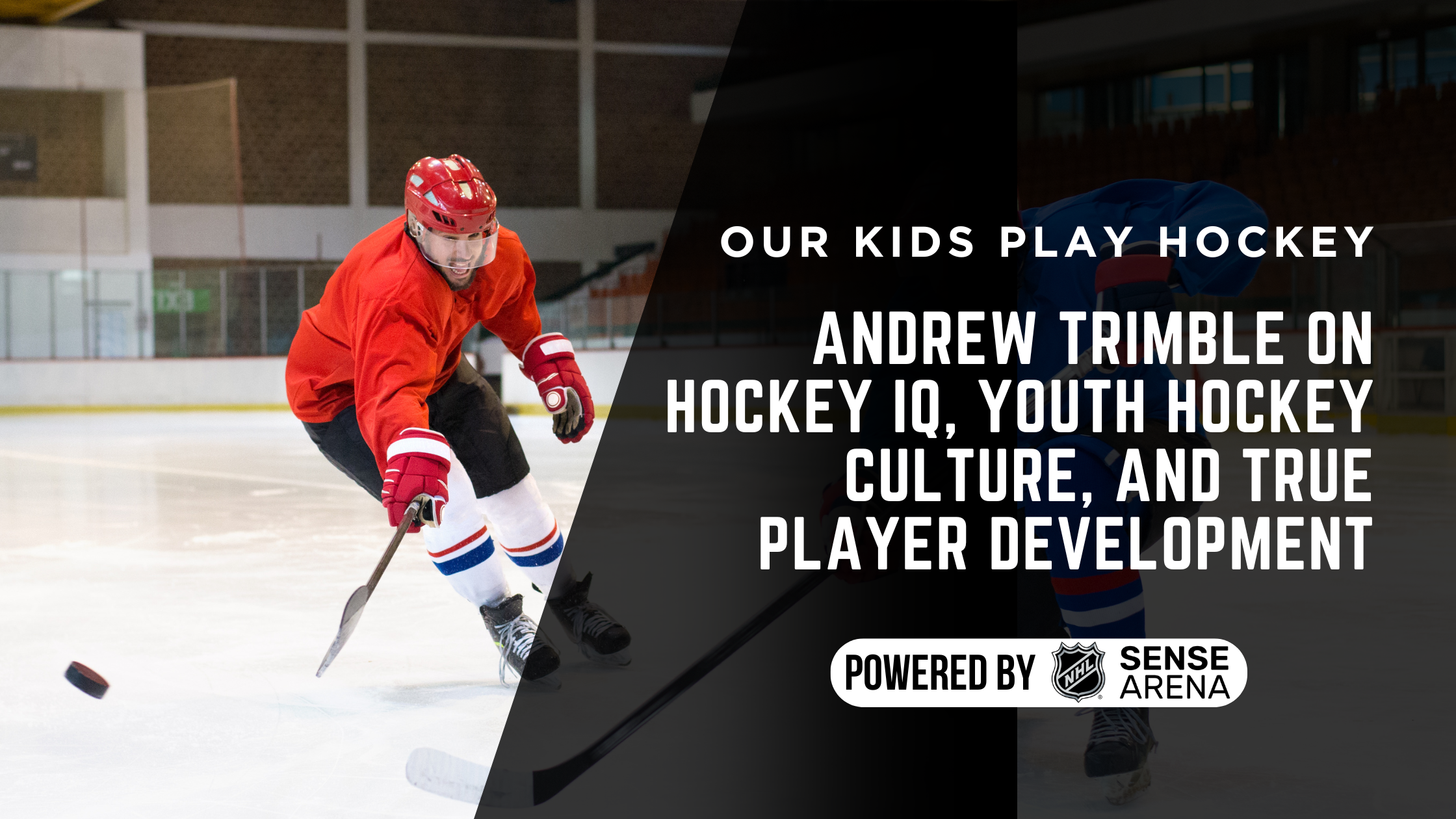
In this episode of Our Kids Play Hockey, Lee Elias, Mike Bonelli, and Christie Casciano-Burns sit down with Andrew Trimble, someone who lives right at the intersection of player development, culture, and long-term growth. Andrew is the GM and co-owner of the New England Wolves Hockey Club, founder of Scoring Concepts, and author of Beyond the Scoreboard. He has coached players from learn-to-skate through the collegiate level, giving him a full-spectrum view of what helps kids not only improve, but stay connected to the game in a healthy and meaningful way.
And his message throughout the conversation is one every hockey family should hear:
Development is not just about creating better players. It is about helping kids become better thinkers, better teammates, and better people.
Hockey IQ Starts With Finding Space
When Andrew is asked to define hockey IQ, he does not overcomplicate it.
To him, hockey IQ is largely about finding space.
That sounds simple, but it is one of the biggest separators in the game. A player who cannot find space may feel like they are never involved. They may wonder why the puck does not come to them, why plays die on their stick, or why they are always reacting instead of anticipating.
Andrew’s point is that hockey IQ is not separate from skill. It is what allows skill to matter.
A player can skate well, shoot hard, and stickhandle beautifully, but if they cannot read the ice, get open, support the puck, or understand how a play is developing, those skills become harder to use in a game environment.
That is why this conversation moves beyond the highlight-reel version of hockey. Kids today can see incredible goals, moves, and clips anytime they want. But clips usually show the finish. They rarely show the three failed attempts before it, the movement away from the puck, the support route, the defensive read, or the decision that made the highlight possible.
For parents and coaches, the takeaway is important:
Do not just ask whether your child is practicing skills. Ask whether they are learning how the game works.
Encourage players to watch full games. Pause and talk through plays. Ask what happened before the goal. Who created space? Who supported the puck? Who made the quiet play that helped the team exit the zone?
That is where hockey IQ grows.
Why Every Drill Does Not Need to End With a Shot
One of the strongest coaching takeaways from this episode is the idea that not every drill needs to end with a shot on net.
That may sound strange in a sport where scoring is the objective, but it gets to the heart of development. If every drill ends the same way, players can start to focus only on the final action instead of the decision-making process.
Andrew shares how his program uses small area games to teach hockey IQ in a more natural way. One example is a game with tire gates where players score points by moving away from the puck, finding space, and passing through the tires. They cannot simply repeat the same pass over and over. They have to read, move, support, defend, and adjust.
That kind of game teaches several things at once:
- How to get open
- How to support the puck carrier
- How to defend passing lanes
- How to transition after a turnover
- How to think under pressure
- How to play without waiting for a coach to give every answer
For youth hockey coaches, this is a great reminder that development does not always come from more instruction. Sometimes it comes from creating the right environment and letting players solve problems.
For parents, it is a reminder not to judge a practice only by how many pucks hit the net. A practice that forces kids to make decisions may be doing far more for their long-term development than one that simply creates a line of shots.
Street Hockey Still Has a Place in Player Development
One of the most refreshing parts of Andrew’s approach is his love of street hockey.
At his rink, Andrew’s program runs a free street hockey program every May. The format is simple: kids show up, teams are divided, rules are loose, and the game takes over. There are no offsides, no rigid structure, and no need to over-coach every moment.
That freedom matters.
Street hockey gives players something structured environments sometimes take away: creativity. Kids learn how to find space because they have to. They learn how to compete because the game demands it. They learn how to adjust because the teams, surface, pace, and situations keep changing.
And maybe most importantly, they play.
Not perform. Not audition. Not chase a ranking.
They play.
In an era where youth hockey can feel increasingly organized, specialized, and pressure-filled, Andrew’s reminder is powerful. Some of the best development still happens when kids are having fun, solving problems, and playing because they want to.
The Best Hockey Decision Is Not Always the Biggest Hockey Decision
One of the biggest themes in this episode is the need for parents to step back and ask a better question.
Not just: “Is this the best team?”
Not just: “Is this the highest level?”
Not just: “Will this get my kid noticed?”
But: “What does my child actually want?”
The hosts discuss how often parents ask whether their child should move to one organization or another, only to realize they have not yet asked the player what they want. That does not make those parents bad. It makes them human. Every hockey parent wants to help. Every parent wants to make the right decision.
But Andrew’s perspective is clear: kids need support, confidence, fun, and a healthy culture around them. His own example as a hockey parent is telling. His son had an opportunity farther from home, but the longer drive and separation from friends changed the experience. Returning to a local team helped him thrive again because the environment fit what he needed.
That is a lesson every hockey family can use.
The “best” option on paper may not be the best option for your child. A longer commute, higher cost, or more intense environment does not automatically equal better development. Sometimes the hidden gems — friends, joy, confidence, local connection, and family balance — are what allow a player to grow.
Culture Is Not Just for Older Players
Andrew’s work with the New England Wolves shows how culture can be built intentionally across an entire program.
The Wolves focus heavily on development, with regular skill sessions, team practices, gym access, and video. But Andrew also talks about standards, community involvement, volunteering, and older players helping younger players.
That matters because culture is sometimes treated like something reserved for elite teams or older players.
It should not be.
You can teach standards at 8U. You can teach respect at 10U. You can teach responsibility at 12U. No, the expectations should not be the same as they are for an 18-year-old junior player, but the foundation can begin early.
Be on time.
Support your teammates.
Respect the rink.
Listen to coaches.
Help younger players.
Represent your program well.
Those lessons are not separate from hockey. They are part of hockey.
The best programs understand that development is not only about what happens during drills. It is also about what players learn from the environment around them.
Junior Hockey Is a Path, Not the Path
For families looking ahead, the episode provides an important distinction: junior hockey is not youth hockey.
It is a next step for some players, but it is not the only step, and it is not a guarantee of anything. Andrew explains that junior hockey roster building is about more than simply identifying the “top” players. Coaches are looking for fit, role, character, body language, work habits, and how a player contributes to the team as a whole.
That is a critical message for players who want to advance.
Talent matters. Of course it does. But at higher levels, talent is everywhere. What begins to separate players is how they work, how they respond, how they carry themselves, how they accept coaching, and how they fit into a team.
Andrew also notes that some players benefit from leaving home, seeing a new environment, and getting a fresh look. Junior hockey can give players a chance to reinvent themselves, build a new network, and take on different roles.
But again, there is no one path. The right path is the one that supports the player’s growth as a whole person.
The Human Side of Development
One of the most meaningful parts of the episode comes when Andrew talks about success stories that are not simply about professional hockey.
He shares the example of a player who came through the Wolves and had hockey opportunities, but also had a strong academic profile. Rather than pushing only the hockey route, Andrew and his staff helped guide him toward a path that included NYU, ACHA hockey, and eventually a law degree from UPenn.
That is development.
Not because it produced the highest-level hockey outcome, but because it helped a young person make a strong life decision.
This is where youth sports can be at their best. Hockey can open doors, build discipline, create relationships, and teach resilience. But if adults reduce the game to only scholarships, commitments, rankings, and levels, we miss the bigger opportunity.
The game should serve the child.
The child should not be consumed by the game.
Parents Are Part of the Package
Andrew is honest about parent communication, especially at different age levels. He talks about using tools like a preseason meeting, the 24-hour rule, and clear expectations. He also makes it clear that at younger ages, his program is not shortening the bench at 8U or 10U just to win early-season games.
That is a message worth repeating.
At young ages, development has to come first. Players need opportunities. They need reps. They need to be trusted in real situations. They do not need to learn at 8U or 10U that their value depends on whether a coach thinks they can help win a September game.
Roles, lineup hierarchy, and learning how to be a third- or fourth-line player can come later. At the youth level, especially in the younger age groups, the job is to develop kids.
Parents also need to understand that their behavior matters. At the junior level, Andrew notes that programs are not only evaluating players. They are also evaluating the family dynamic. A talented player with a parent who constantly interferes can become a harder fit than a slightly different player whose family supports the process.
That may be uncomfortable to hear, but it is valuable.
Parents do not need to be perfect. They do need to be aware that their communication, expectations, and reactions shape the experience for everyone involved — especially their own child.
The Real Goal: Keep Kids Growing
This episode is packed with hockey insight, but the biggest takeaway is bigger than hockey.
Kids develop best when they are supported, challenged, and allowed to enjoy the game. They need coaches who teach decision-making, not just mechanics. They need parents who ask what they want, not just what looks best from the outside. They need programs that value culture, standards, and community. They need adults who remember that the person matters more than the player.
Andrew Trimble’s approach is a reminder that hockey development is not a straight line. It is a long process filled with decisions, setbacks, growth, and relationships.
The scoreboard matters. Competition matters. Winning can be fun and meaningful.
But the best hockey people know there is always something beyond the scoreboard.
And when we develop the person first, the player almost always has a better chance to grow too.
Listen to the full episode of Our Kids Play Hockey with Andrew Trimble, and share it with a hockey parent, coach, or player who wants to build the game the right way.
Thanks for being part of the Our Kids Play Hockey community — the rink is better when we keep learning together.

What Really Makes a Great Hockey Player? Lessons on Development, Coachability and Mental Toughness with Hayley Scamurra