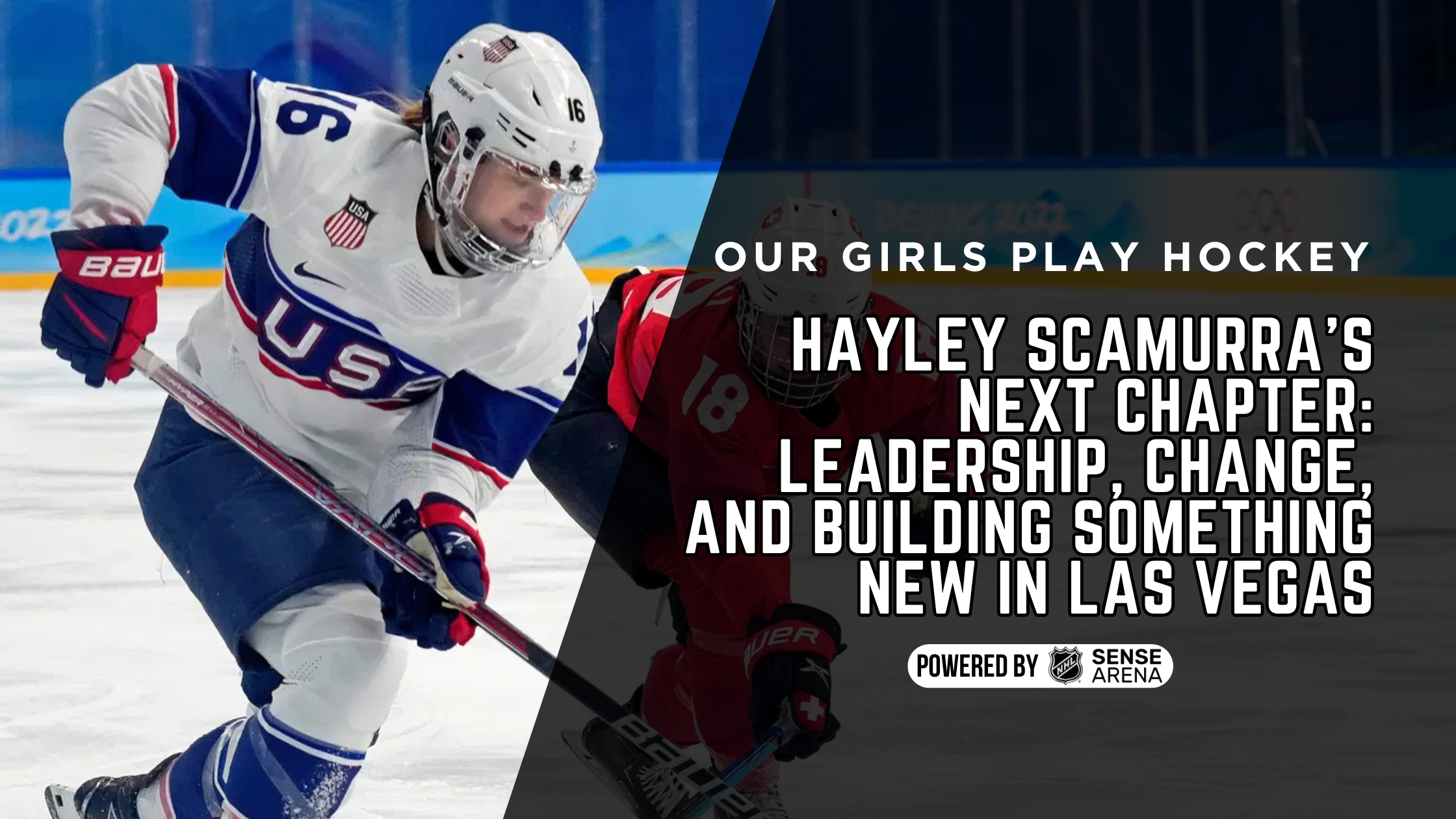
Hayley Scamurra’s Next Chapter: Leadership, Change, and Building Something New in Las Vegas
Winning a championship is supposed to feel like the end of a journey.
For Hayley Scamurra, it became the beginning of something entirely new.
After helping Montreal capture the Walter Cup and completing one of the strongest seasons of her professional career, Hayley entered an offseason filled with celebration, uncertainty, and change. PWHL expansion created new teams, new roster rules, and difficult decisions for players across the league.
Within days, Hayley went from celebrating a championship in Montreal to signing a three-year agreement with the PWHL’s new Las Vegas team.
Her decision offers more than a behind-the-scenes look at professional women’s hockey. It provides meaningful lessons for young players, parents, and coaches about handling change, building relationships, accepting leadership, and staying open to unexpected opportunities.
Change Can Bring More Than One Emotion
Athletes are often expected to describe a new opportunity as completely exciting. The reality is rarely that simple.
Hayley loved her time in Montreal. She grew as a player, became part of a championship team, developed close relationships, and experienced the support of a passionate hockey community.
Leaving that environment naturally came with sadness.
At the same time, Las Vegas offered a unique opportunity: the chance to help build a professional hockey team from the ground up.
Hayley described the transition as experiencing all the emotions at once. There was heartbreak over leaving Montreal, gratitude for everything she experienced there, and excitement about the chance to accept a larger leadership role in Las Vegas.
That honesty is important for young athletes.
A player can be excited about joining a new team while still missing her former teammates. She can recognize that a move is right for her future while still finding the goodbye difficult. She can appreciate a new coach without forgetting the people who previously helped her grow.
Those feelings do not contradict one another. They show that the previous experience mattered.
For parents helping a young player through a transition, the first step should not always be trying to make the disappointment disappear. Acknowledge it. Give the player space to process it. Then begin exploring what the new opportunity may make possible.
Why Las Vegas Was the Right Fit
The PWHL expansion process moved quickly and included several complicated phases. Existing teams could protect only a limited number of players, while the expansion teams received opportunities to negotiate with selected athletes.
Hayley could have waited to see how the process unfolded, but doing so may have left her with less control over where she played next. Signing with Las Vegas gave her the opportunity to choose an organization that clearly valued what she could bring to the team.
That value extended well beyond goals, assists, and championship experience.
Las Vegas recognized Hayley’s:
- Two-way ability
- Confidence and professionalism
- Leadership experience
- Community involvement
- Commitment to mentoring young athletes
- Understanding of team culture
- Ability to help establish a new organization
This is an important reminder for developing players: your value to a team is not limited to what appears on the scoresheet.
Production matters, but so do preparation, attitude, communication, reliability, and the way a player treats the people around her.
Strong teams do not simply collect talented players. They bring together people who can help that talent work toward a shared purpose.
Your Reputation Is Built Before the Opportunity Appears
One of the most powerful parts of Hayley’s story involves her relationship with Las Vegas head coach Kim Weiss.
Hayley first trained with Kim after the 2022 Olympics. At the time, neither of them could have known that they might eventually work together on a PWHL expansion team.
But Hayley’s effort during those training sessions mattered.
Kim had already seen how Hayley worked, learned, competed, and interacted with others. She did not need to rely only on statistics or secondhand information when considering what Hayley could bring to the new team.
That relationship also helped connect Hayley with Domi DiMaggio, who became her agent and later the general manager of the Las Vegas organization.
Years after those original connections were formed, they helped create Hayley’s newest professional opportunity.
Young athletes sometimes believe they only need to make a strong impression during tryouts, showcases, or championship games. In reality, reputations are built during ordinary moments:
- Summer workouts
- Optional skates
- Conversations with coaches
- Responses to correction
- Interactions with teammates
- Effort when no evaluator appears to be watching
Hockey is a connected community. Coaches move into new roles. Teammates become mentors. Players become coaches, scouts, agents, and executives.
No athlete will handle every moment perfectly. But consistency builds trust, and trust often leads to opportunity.
Leadership Can Take Different Forms
Hayley has often viewed herself as a quieter, behind-the-scenes leader.
She supports teammates, welcomes younger players, contributes to team culture, and helps others feel comfortable without needing to be the loudest voice in the room.
In Las Vegas, that role may become more visible.
As one of the team’s experienced players, Hayley will help establish the standards and identity of a new organization. Younger players will watch how she prepares, responds to adversity, communicates with coaches, manages travel, and represents the team in the community.
That does not mean she needs to change her personality.
Authentic leadership is not about volume. It is about influence.
A player can lead by:
- Preparing consistently
- Welcoming a nervous rookie
- Remaining composed during difficult moments
- Communicating honestly
- Supporting teammates
- Accepting responsibility
- Demonstrating professional habits every day
Leadership should challenge an athlete to grow, but it should not require her to become someone she is not.
Helping Young Players Become Professionals
The continued growth of the PWHL means more girls can realistically imagine professional hockey as part of their futures.
It also means young players entering the league must learn what it takes to become professionals.
Professional hockey does not follow the predictable rhythm many athletes experience in college. Games may happen on different days each week. Teams travel frequently. Practices, recovery sessions, media responsibilities, community appearances, and games must all fit into a changing schedule.
The physicality also creates a major adjustment.
Hayley remembers feeling the physical toll more during her first professional season. Over time, her body adapted and her preparation improved. Now she has the experience to help younger teammates navigate that same transition.
Her mentorship may include major conversations, but it will also appear in everyday moments:
- Recovering after a physical game
- Preparing for road trips
- Managing an inconsistent schedule
- Staying confident after limited ice time
- Handling the pressure of professional sports
- Asking for help before a challenge becomes overwhelming
For girls watching the league, this is another powerful form of representation. They are not only seeing women compete at the professional level. They are seeing women lead, teach, negotiate, mentor, and help build organizations.
Rest Is Part of Becoming Better
After the championship celebration, Hayley took some time away from structured training.
She packed, traveled home, reconnected with family, and allowed herself to decompress after a demanding season.
Then she began to feel excited about working out again.
That excitement told her she was ready to return.
Young athletes are sometimes afraid that rest will allow someone else to pass them. Parents may also feel pressure to register players for every available camp, clinic, tournament, and training session.
But effective training requires physical and mental energy.
A healthy break can help an athlete:
- Recover from accumulated soreness
- Reconnect with family and friends
- Enjoy interests outside hockey
- Restore enthusiasm for training
- Reflect on the previous season
- Return with greater focus
Rest should not become permanent inactivity, but training should not feel like punishment either.
When an athlete begins looking forward to movement and preparation again, it may be a sign that recovery has served its purpose.
No Athlete Completes the Journey Alone
Hayley also spoke openly about the support she receives from her partner and trainer, Nick Stoop.
His role changes depending on what she needs. Sometimes he helps guide her training. Sometimes he offers perspective. Sometimes he brings unmistakable energy from the stands.
Other times, he simply listens.
That last form of support is easy to overlook.
Athletes do not always need someone to fix the problem. Sometimes they need space to express disappointment, fear, frustration, or uncertainty without immediately receiving advice.
For parents and coaches, one useful question can be:
“Would you like advice, or would you like me to listen?”
That question gives the athlete some ownership over the conversation and helps the adult respond to the actual need.
Hayley’s support system also includes family, teammates, coaches, mentors, and members of the larger hockey community.
Her experience challenges the idea that independence means handling everything alone.
Strong athletes develop the courage to face difficult moments. They also develop the wisdom to accept support.
There Is No Need to Rush the Next Goal
Hayley has previously used written statements and visual reminders to pursue major goals.
Two of the biggest became reality: winning Olympic gold and becoming a Walter Cup champion.
So what comes next?
For now, Hayley is not forcing the answer.
She is training, celebrating with family, preparing for her move, and allowing her next goal to become clearer over time.
That patience may be one of the most valuable lessons from the conversation.
Athletes often rush from one season to the next without processing what they learned or appreciating what they accomplished. Goal setting is important, but a goal chosen from pressure or panic may not provide meaningful direction.
Sometimes the next objective becomes clearer after an athlete has time to:
- Reflect on what brought her joy
- Identify where she wants to improve
- Understand her changing role
- Adjust to a new environment
- Recognize what her team needs
- Reconnect with her deeper motivation
Being present is not the same as becoming complacent.
It means paying enough attention to choose the next destination with purpose.
A New Opportunity for Girls’ Hockey in Las Vegas
Las Vegas presents Hayley with an opportunity that extends beyond the professional team.
Girls’ hockey is growing in the area, and the arrival of a PWHL organization will give young players direct access to professional role models.
A girl in Las Vegas will now be able to attend a professional women’s hockey game and imagine herself on the ice. She may meet a player at a clinic, watch the team train, or see women’s hockey celebrated throughout her community.
Hayley has already invested deeply in mentorship. Her move gives her another community to support and another generation of athletes to inspire.
That may eventually become one of the most meaningful parts of this new chapter.
Embrace the Chapter in Front of You
Hayley’s journey has not followed a straight line.
Different teams, cities, leagues, coaches, and relationships helped prepare her for an opportunity she could not have predicted.
Her message to young players is not that every change will immediately feel good. It is that they can remain open to what change may offer.
A new team can create a leadership opportunity.
A difficult goodbye can reveal how much an experience mattered.
A summer training session can create a career-changing connection.
A period of uncertainty can lead somewhere extraordinary.
Hayley is leaving a championship organization and joining a team that has yet to establish its identity, traditions, and history.
Now she has the opportunity to help create them.
Continue following Our Girls Play Hockey for more honest conversations with Hayley Scamurra and the people helping shape the future of the women’s game. Wherever you are in your hockey journey, stay open to growth, support the people around you, and remember that an unexpected turn may become the beginning of something remarkable.

How to Be a Better Teammate to Your Hockey Goalie