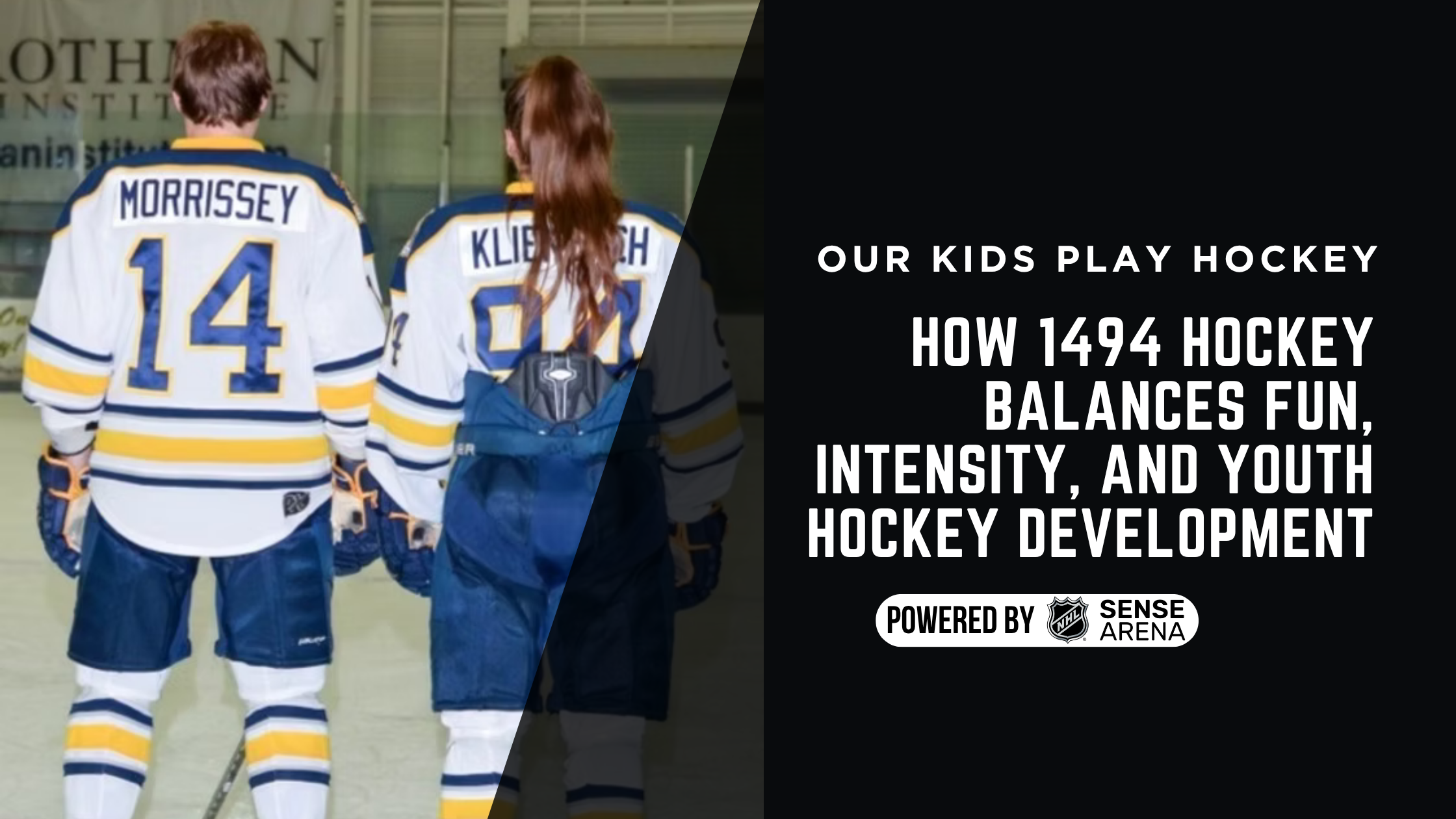
How 1494 Hockey Balances Fun, Intensity, and Youth Hockey Development
Hard Work Can Be Fun: What 1494 Hockey Teaches Us About Developing Young Players
Youth hockey constantly presents adults with a difficult question:
How hard should we push?
Push too little, and players may never discover what they are capable of.
Push too hard, and hockey can begin feeling like another job.
Parents want development.
Coaches want effort.
Players want to compete.
Everybody wants to win.
But somewhere inside all of that, kids still need to actually enjoy going to the rink.
In this episode of Our Kids Play Hockey, Lee Elias and Christie Casciano-Burns sit down with Shayne Morrissey and Grace Klienbach of 1494 Hockey to explore how those ideas can coexist.
Their answer is not a perfect formula.
It is something more useful:
Build an environment where coaches know their players, players feel supported, effort is expected, mistakes are part of learning, and having fun never becomes an excuse for avoiding hard work.
Fun and Intensity Are Not Opposites
One of the biggest mistakes adults make in youth sports is treating fun and discipline as two ends of the same spectrum.
If practice is fun, some assume it must not be serious enough.
If practice is demanding, some assume kids cannot enjoy it.
1494 Hockey challenges that idea.
Their sessions are energetic.
There is music.
Players are moving.
Coaches are engaged.
Expectations are high.
Kids are being challenged.
Those things can happen together.
The goal should not be to remove difficulty.
The goal should be to create an environment where players want to engage with that difficulty.
Start With Coaches Who Want to Be There
Shayne makes a foundational point early in the conversation:
Players feed off their coaches.
If the coach looks bored, distracted, or annoyed to be at the rink, players notice.
If the coach is passionate, prepared, energetic, and excited to teach, players notice that too.
Culture is not created only through speeches.
It is transmitted through behavior.
If we want young athletes to bring energy, coaches have to model energy.
If we want them to keep learning, coaches have to keep learning.
If we want them to care, they need to see that we care too.
Coaching Cannot Be One-Size-Fits-All
Two players make the exact same mistake.
Should they receive the exact same response?
Not necessarily.
One player may already be devastated.
They know what happened.
They are angry at themselves.
Their confidence is disappearing.
Adding more criticism may accomplish nothing.
Another player makes the same mistake and shrugs.
No adjustment.
No urgency.
No attempt to correct it.
That player may need a stronger push.
The hockey mistake might be identical.
The coaching moment is completely different.
Know the Person Wearing the Jersey
This is where great coaching becomes more complicated than knowing systems and drills.
You need to know people.
Who needs reassurance?
Who needs accountability?
Who needs an explanation?
Who needs a challenge?
Who needs the coach to stop talking and let them play?
That knowledge develops over time.
Shayne openly acknowledges that some of it involves trial and error.
A coach tries something.
The player responds.
The coach learns.
Then the relationship develops.
That willingness to adapt is a strength, not a weakness.
Sometimes You Need to Change the Win
Grace describes how she handles players who become overwhelmed by a bad game or bad shift.
Instead of asking them to suddenly fix everything, she narrows their focus.
Maybe the next shift has only three goals:
Forecheck hard.
Backcheck hard.
Be in good position.
Now the player has something manageable.
They do not have to rescue the entire game.
They have to win the next shift.
Lee describes this as changing the win.
That idea can be incredibly powerful for youth athletes.
When the big outcome feels overwhelming, shrink the target.
Win the next race.
Make the next good pass.
Have one strong shift.
Compete in the next battle.
Small wins restore momentum.
Confidence Changes How You Coach
A player who has lost confidence often does not need another list of everything they are doing wrong.
They may need to borrow some confidence from the coach.
A coach can communicate:
“I believe in you.”
“You can do this.”
“I need you out there.”
That does not remove accountability.
It creates the emotional foundation needed to respond to accountability.
Young players often need both.
Ask Players How They Want to Be Coached
One of Grace’s most useful habits is surprisingly simple.
She asks.
During player check-ins, she may ask whether she is coaching the athlete the way they need to be coached.
Should she push harder?
Does the player need something different?
Is the communication working?
Some players actually ask her to be harder on them.
That should tell us something.
Young athletes are often more self-aware than adults assume.
Give them the opportunity to communicate.
Player Feedback Does Not Eliminate Leadership
There is sometimes a fear that asking players what they think means surrendering authority.
It does not.
Shayne describes a team meeting where his players openly discussed what they liked and what they did not like about how the season was going.
The coach still coached.
The players did not suddenly run the team.
But everyone gained information.
The group turned a corner afterward.
Leadership is not weakened by listening.
Strong leadership can absorb information and still make decisions.
Great Coaches Keep Learning
Shayne and Grace both played at high levels.
They coach at high levels.
They have national championship experience.
None of that causes them to believe they have the game completely figured out.
They talk to other coaches.
They exchange ideas.
They learn from each other.
They listen to players.
They adjust.
That may be one of the strongest characteristics of good coaching.
The learning never stops.
The game changes.
Players change.
Culture changes.
Coaches should evolve too.
Parents Are Part of the Development Environment
A player does not experience hockey only through the coach.
Parents have enormous influence.
They determine much of the emotional atmosphere surrounding the sport.
After games.
On the drive home.
Before practice.
In the stands.
That power can support development—or create confusion.
Be the Parent, Let the Coach Coach
Grace describes a healthy dynamic:
The parent supports.
The parent encourages.
The parent reinforces effort, discipline, respect, and coachability.
And the coach handles the hockey instruction.
Problems begin when the child hears one message from the bench and another from the stands.
Imagine the coach telling a player:
“Stay high.”
Then a parent begins yelling:
“Get to the net!”
What is the child supposed to do?
Now hockey is no longer about reading the game.
It becomes about deciding which adult they are more afraid to disappoint.
Coaching From the Stands Creates Noise
Parents rarely know every tactical conversation happening on the bench.
They may not know:
A player is hurt.
A player asked for a break.
A line has a specific assignment.
The coach is testing a system.
A player has been asked to occupy a particular area.
That is why sideline coaching often creates more confusion than help.
Cheer.
Encourage.
Celebrate effort.
Let the coaching voice come from the bench.
Development Is a Crock Pot, Not an Instant Pot
Youth hockey development takes time.
Skills take time.
Confidence takes time.
Leadership takes time.
Understanding the game takes time.
The temptation in youth sports is to constantly search for something that promises to speed everything up.
Another team.
Another camp.
Another letter after the team name.
Another ranking.
Another opportunity.
But development does not always cooperate with adult timelines.
Sometimes patience is the developmental strategy.
What Makes 1494 Hockey Clinics Different?
Lee describes what he sees when watching a 1494 Hockey session.
Players are moving.
Stations are organized.
Coaches are engaged.
There is a clear plan.
And there is music.
That matters because one of the least efficient sights in youth hockey is a long line of kids standing still while one or two players actually perform the drill.
Ice time is expensive.
Development time is valuable.
Players need repetitions.
Movement Creates Learning Opportunities
Station-based practices allow more players to work simultaneously.
More touches.
More skating.
More decisions.
More feedback.
Less waiting.
That does not mean every second needs to feel frantic.
But development sessions should be designed intentionally.
What skill are we developing?
How many repetitions will players receive?
What is the coach watching?
What feedback can be given?
Those questions should be answered before anyone steps on the ice.
And Then There Is the Music
Music has become one of the signatures of 1494 Hockey.
Why?
Because energy matters.
Think about hockey warmups.
Think about a gym.
Think about the song that immediately makes you want to move.
Sound can change the feel of an environment.
The 1494 sessions use that energy intentionally.
The music helps make the rink feel alive.
It also changes communication.
Coaches have to move closer to players and speak with them more directly.
And yes, there is another benefit:
Players cannot hear nearly as much coaching from the stands.
1494 Radio Became Part of the Culture
The music became so popular that families started asking for the playlist.
Shayne and Grace created 1494 Radio, a playlist that continues evolving.
They hear something at a hockey game.
Add it.
A parent suggests a song.
Add it.
Something creates the right energy.
Add it.
It sounds like a small detail.
But culture is often built through small details repeated consistently.
Girls Hockey Has Changed Dramatically
Grace also brings a valuable perspective to the conversation through her experiences in girls hockey.
She grew up in Florida at a time when there were not enough girls playing to sustain teams at every age level.
Multiple ages had to be grouped together.
Eventually, Grace played boys hockey extensively because girls opportunities were limited.
Today the landscape is different.
Girls hockey continues expanding.
More teams.
More pathways.
More role models.
More opportunities.
But development still comes back to basic principles.
Confidence Comes From Doing
Grace emphasizes puck touches and quality repetitions.
Players become more confident with the puck by actually having the puck.
Not by standing in line.
Not by avoiding mistakes.
Not by watching everyone else.
Repetition creates familiarity.
Familiarity creates confidence.
Confidence allows creativity.
Be Proud to Be a “Tryhard”
One of the most memorable stories in the episode involves a young player who was not working hard because she did not want teammates to think she was a “tryhard.”
Grace’s response gets directly to the heart of competition:
Trying hard is the point.
There should be no embarrassment in caring.
No embarrassment in wanting to improve.
No embarrassment in practicing harder.
No embarrassment in competing.
Sports should be one of the places where young people learn that effort is something worth being proud of.
Mistakes Are Fine—Indifference Is Different
Grace does not expect perfection.
Mistakes are part of hockey.
They are part of development.
But there is a difference between:
Making a mistake while trying to improve
and
Making the same mistake repeatedly without caring enough to adjust.
Effort does not guarantee immediate success.
It does create the possibility of growth.
Compete Against the Best Version of Yourself
Grace discusses the idea of a faceless opponent.
It should not matter whether the team across from you is ranked first or last.
Your effort should not suddenly change.
Eventually, she expanded the concept into another question:
Are you the best version of yourself today?
Was today’s practice better than yesterday’s?
Did you compete harder?
Did you improve a detail?
Did you become a little more confident?
That is a developmental scoreboard players can actually control.
The Championship Locker Room Lesson
Shayne tells a story that beautifully illustrates the relationship between preparation and pressure.
His boys team had entered an overtime playoff situation nervous and quiet.
The players understood what was at stake.
The tension filled the room.
A couple of weeks later, Shayne found himself helping coach Grace’s girls team in a national championship game.
They led 2–0 entering the third period.
Shayne was nervous.
He walked into the locker room.
Taylor Swift was playing.
The girls were singing.
Dancing.
Relaxed.
Ready.
Shayne walked back out.
He did not need to deliver a dramatic speech.
The players were prepared.
They went on to win.
Sometimes the Best Coaching Is Knowing When Not to Coach
There is an important lesson inside that story.
If players are prepared, coaches do not always need to fill silence with instruction.
The biggest game is not necessarily the moment to suddenly introduce a dozen new ideas.
Preparation happens during the season.
By the time championship moments arrive, players should already know:
The systems.
The standards.
The expectations.
The culture.
Now they need the freedom to play.
Great Teams Eventually Start Coaching Themselves
Toward the end of a strong season, coaches often hear their own language coming from the players.
“Move your feet.”
“Win the race.”
“Stay with it.”
Players begin holding one another accountable.
That is not the coach losing control.
That is culture taking hold.
The message no longer belongs only to the person behind the bench.
The players believe it too.
How Should We Measure Youth Hockey Success?
This may be the biggest question in the entire episode.
Youth hockey has countless visible measurements:
Scores.
Standings.
Rankings.
Levels.
Letters.
Trophies.
Tryouts.
But none of those alone tells you whether a player is in a healthy environment.
Grace offers a much simpler test.
Are they getting better?
Are they having fun?
If the answer to both is yes, pay attention.
Something may be working.
The Grass Is Not Always Greener
Youth hockey families constantly feel pressure to move.
A supposedly better team.
A higher ranking.
A new organization.
Another opportunity.
Sometimes moving is appropriate.
But changing environments simply because something else looks more prestigious does not guarantee better development.
There is no universal pathway.
A player can develop in many different environments.
The logo does not develop the athlete.
The daily experience does.
Players Need to Know You Still Have Their Back
Shayne makes another point that applies both to coaching and parenting.
You can have a difficult conversation with a player.
You can hold them accountable.
You can tell them they did not play well.
But when they arrive the next day, they should still know:
You have their back.
Fist bump.
Fresh start.
Let’s get to work.
Accountability should never feel like affection and support have been withdrawn.
Relationships May Be the Biggest Win
Some of Shayne and Grace’s former players are now teenagers.
They still visit.
They still check in.
Some ask if they can help coach younger players.
They see their former coaches at another rink and run over to say hello.
That matters.
Maybe more than almost anything else.
Championships are incredible.
Wins are fun.
Rankings have their place.
But years later, if a player still sees a coach as somebody who cared about them, challenged them, and helped them grow?
That is a tremendous result.
Develop the Person, Not Just the Player
At Our Kids Play Hockey, we talk constantly about the real return on investment in youth sports.
It is not simply creating professional hockey players.
Most kids will not become professionals.
But every child can learn:
Discipline.
Resilience.
Confidence.
Teamwork.
Communication.
Responsibility.
How to handle winning.
How to handle losing.
How to respond to criticism.
How to work hard when something is difficult.
Those lessons travel much farther than the rink.
Hard Work and Fun Can Be the Same Thing
That may be the clearest takeaway from Shayne Morrissey, Grace Klienbach, and 1494 Hockey.
We do not have to choose between:
Fun or development.
Competition or enjoyment.
Accountability or support.
Kids are capable of working incredibly hard while loving what they are doing.
The best environments help them discover that feeling.
Push them.
Support them.
Listen to them.
Demand effort.
Celebrate progress.
Allow mistakes.
Keep learning as coaches.
Let parents be parents.
And keep asking two questions:
Are they getting better?
Are they still having fun?
If the answer is yes, you may be closer to the real definition of youth hockey success than any ranking could ever tell you.
Keep listening to Our Kids Play Hockey for more conversations with coaches, players, parents, and leaders who are working to make the game better for the next generation.
Where Your Feet Are: Inside Hayley Scamurra’s Journey to Las Vegas and Team USA