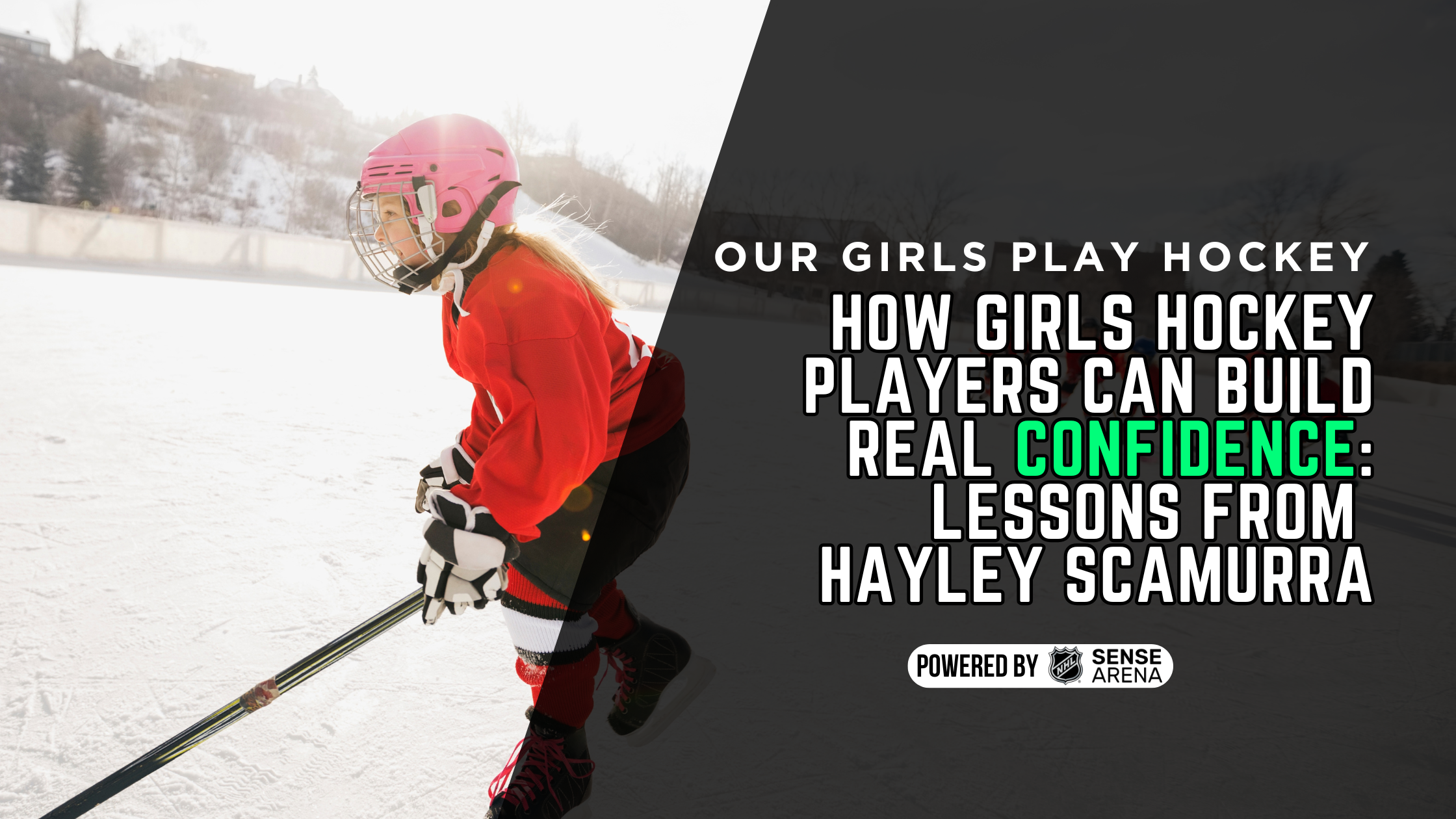
How Girls Hockey Players Can Build Real Confidence: Lessons From Hayley Scamurra
Confidence is one of those words we use constantly in youth sports.
“She needs more confidence.”
“He lost his confidence.”
“Her coach gave her confidence.”
“That mistake destroyed his confidence.”
But what if we’re thinking about confidence the wrong way?
On Our Girls Play Hockey, Olympic gold medalist and Walter Cup champion Hayley Scamurra offered a different way to look at it: real confidence has to come from within.
Parents can encourage it. Coaches can strengthen it. Teammates can support it.
But ultimately, the athlete has to own it.
That distinction matters—especially for young female hockey players who may already feel pressure to please adults, follow instructions perfectly, avoid mistakes, and prove that they belong.
And perhaps the most important lesson from the conversation is this:
Confidence isn’t built by avoiding mistakes. Very often, confidence is built by making them, learning from them, and discovering that you can recover.
The Problem With Borrowed Confidence
Young athletes naturally look toward adults for feedback.
Did Coach think I played well?
Are Mom and Dad happy?
Did my teammates think that was a good play?
Did I make everyone proud?
There is nothing inherently wrong with encouragement or feedback. Athletes need both.
The problem begins when an athlete’s entire opinion of herself becomes dependent on those outside voices.
Hayley described experiencing exactly that as a younger player. Approval from coaches and parents mattered tremendously to her, and negative feedback could send her confidence in the opposite direction.
That creates a difficult cycle.
When the athlete plays well, confidence rises because everybody is happy.
When she struggles, gets less ice time, receives criticism, or senses disappointment, confidence crashes.
Now someone else effectively controls the emotional scoreboard.
Developing stronger confidence means gradually helping athletes change the question from:
“What did everyone else think?”
to:
“What do I think?”
That doesn't mean ignoring coaching. It means developing enough self-awareness to evaluate your own game before outsourcing that evaluation to everyone else.
One Question Hockey Parents Can Start Asking
One of the simplest ideas in the episode may also be one of the most powerful.
Instead of always telling your daughter:
“I’m proud of you.”
Try occasionally asking:
“Are you proud of yourself?”
Parents should absolutely tell their children they're proud of them. The point isn't to eliminate encouragement.
The point is to help young athletes build the habit of checking in with themselves.
What did I like about my effort?
Did I compete the way I wanted to?
What did I learn?
Did I respond well after making a mistake?
What do I want to improve next time?
Those questions help move motivation inward.
Over time, that young player begins developing her own standards instead of constantly waiting for someone else to tell her whether she succeeded.
Mistakes Aren’t the Enemy of Confidence
Parents sometimes assume confidence must be protected from mistakes.
If our daughter feels bad about a turnover, missed shot, or poor shift, our instinct can be to immediately make the uncomfortable feeling disappear.
“You were great!”
“Don't worry about it!”
“That wasn't your fault.”
Those responses come from a loving place. But they can also rob athletes of an important experience: figuring something out.
Imagine a player struggling with a skill.
A good coach doesn't need to tell her everything is perfect. Instead, the coach can help identify one piece that needs to improve, create an achievable next step, and allow the player to experience progress.
Maybe the wrist shot isn't accurate yet—but her weight transfer improves.
Praise the weight transfer.
Then work on the next piece.
Eventually, the player realizes:
I couldn't do this before. Now I can.
That feeling is difficult to manufacture with praise alone.
It is earned confidence.
And earned confidence travels.
Once an athlete has enough experiences where she struggled, adjusted, and improved, she starts approaching unfamiliar challenges differently.
Instead of:
“I don't know if I can do that.”
It becomes:
“I haven't done that yet, but I can probably figure it out.”
That is a major developmental shift.
Give Girls Permission Not to Be Perfect
The conversation becomes especially important when we consider the experience of young female athletes.
Hayley discussed a pressure many girls and women recognize: the feeling that they need to do things correctly, follow instructions exactly, and avoid mistakes.
Of course, this doesn't describe every girl.
But it is common enough that coaches should understand it.
A coach may say, “I never told her she had to be perfect.”
That doesn't necessarily mean the athlete isn't carrying that expectation herself.
For some girls, a drill that a coach intended as an opportunity for creativity can feel like a test with one correct answer.
That means coaches sometimes need to say explicitly:
Try something.
Be creative.
It is okay if this doesn't work.
You will not be punished for experimenting.
Because hockey isn't perfect.
The puck bounces.
Players lose edges.
Passes miss.
Shots get blocked.
Great players make bad reads.
Development depends on athletes having enough freedom to explore those imperfect situations.
If a young girl is constantly terrified of doing the “wrong” thing, she may become technically obedient without becoming creatively confident.
We want both.
Coach the Mistake Without Crushing the Player
Allowing mistakes does not mean refusing to correct them.
Girls don't need dishonest praise. They need useful coaching.
There is a major difference between:
“What was that? That was terrible.”
and:
“That wasn't our best option. What else could you have done there?”
Both acknowledge that the play needs improvement.
Only one invites the player into the learning process.
This is where trust becomes incredibly important.
When athletes trust that coaches are trying to help them improve—not humiliate them—honest feedback becomes far easier to receive.
Hayley emphasized the value of awareness and empathy when coaching girls, including understanding how calling a young athlete out publicly may affect her differently than a quieter one-on-one conversation.
Coaching hard and coaching with empathy are not opposites.
Great coaches understand when athletes need challenge, when they need instruction, and when they simply need the message:
You made a mistake. You're still okay. Now let's learn from it.
A Bad Shift Doesn't Require a Bad Game
Young athletes can turn one mistake into an entire game.
Bad pass.
Then frustration.
Then another mistake.
Then negative self-talk.
Then suddenly the player has mentally carried one 10-second sequence through three periods.
Hayley offered a much simpler reset.
First, recognize that mistakes happen.
Take a breath.
Then give yourself one specific task for the next shift.
Win a puck battle.
Make contact.
Get your feet moving.
Make the simple first pass.
Suddenly the athlete isn't trying to fix her entire identity.
She's trying to execute one controllable action.
That is a much easier place from which confidence can return.
Stop Comparing Your Everyday Hockey to Someone Else's Highlights
Modern athletes face another challenge previous generations experienced differently: constant access to everyone else's best moments.
Open your phone and there is another goal.
Another incredible move.
Another commitment announcement.
Another championship.
Another training clip.
Another player who appears to be ahead.
But highlights are exactly that: highlights.
They don't show every missed pass, bad practice, frustrating weekend, injury, failed drill, nervous moment, or mistake that came first.
Hayley provided a perfect reminder.
Despite becoming an Olympian and reaching the professional level, she described a recent skate where she whiffed repeatedly during one of her first reps.
Olympians whiff pucks too.
That's important for young athletes to hear.
The goal when watching elite players shouldn't be:
“Why am I not already that good?”
A healthier question is:
“What can I learn from this?”
Study the player's movement.
Her decision-making.
Her positioning.
Her habits.
Let elite hockey become information—not evidence that you're behind.
Confidence Doesn't Mean Never Feeling Nervous
Hayley's own journey offers another useful lesson.
As a younger person, public speaking made her extremely uncomfortable. Interviews, speaking in class, and being in front of groups were not areas where she naturally felt confident.
Years later, she's speaking on podcasts and addressing massive crowds.
The transformation didn't happen because fear magically disappeared.
It happened because she increasingly became willing to move toward uncomfortable opportunities.
That same lesson applies to hockey.
Try the move.
Play against the stronger competition.
Speak up.
Ask the question.
Take the shot.
Go to the tryout.
Make the pass.
Sometimes the outcome will be great.
Sometimes you'll whiff.
Neither result defines you.
What Parents and Coaches Can Actually Do
If confidence ultimately belongs to the athlete, adults still have an enormous role.
We create the environment in which that confidence develops.
For parents and coaches, that can mean:
Ask athletes what they thought before giving your evaluation.
Praise specific behaviors and improvements instead of giving vague compliments.
Normalize mistakes without pretending mistakes don't matter.
Help players break difficult skills into achievable steps.
Give girls explicit permission to experiment and be creative.
Correct without humiliating.
Focus attention on controllable actions.
Teach athletes to learn from elite players instead of constantly comparing themselves to them.
Help young players recognize progress they actually earned.
Remember that one performance should never become a verdict on who an athlete is.
Our daughters don't need us to convince them they're perfect.
They need experiences that teach them:
I can struggle and recover.
I can make mistakes and improve.
I can listen to feedback without losing myself.
I can trust what I know.
I can do difficult things.
That is a much stronger form of confidence.
The Goal Isn't a Confident Hockey Player. It's a Confident Person.
Youth hockey eventually ends for everyone.
Even for Olympians.
But learning how to trust yourself, process feedback, recover from mistakes, step outside your comfort zone, and continue when things don't go perfectly?
Those skills go everywhere.
School.
Relationships.
Careers.
Leadership.
Parenthood.
Life.
That's why building confidence in girls hockey is about much more than producing better players.
We're helping young women develop the ability to walk into difficult situations and believe:
Whatever happens here, I can handle it.
And that may be one of the most valuable things this game can ever give them.
🎧 Listen to the full Our Girls Play Hockey conversation with Hayley Scamurra for more on confidence, mistakes, external validation, coaching girls, social media comparison, and the mindset required to continue growing at every level of the game.
Keep encouraging your players to compete, create, make mistakes, learn—and most importantly, discover just how much they are capable of becoming.
Keep playing, keep growing, and keep making space for the next generation of girls to believe in their game.

What NHL Goalie Coaches See That Youth Hockey Often Misses