Want to Try That Hockey Move in a Game? Put in the Reps First
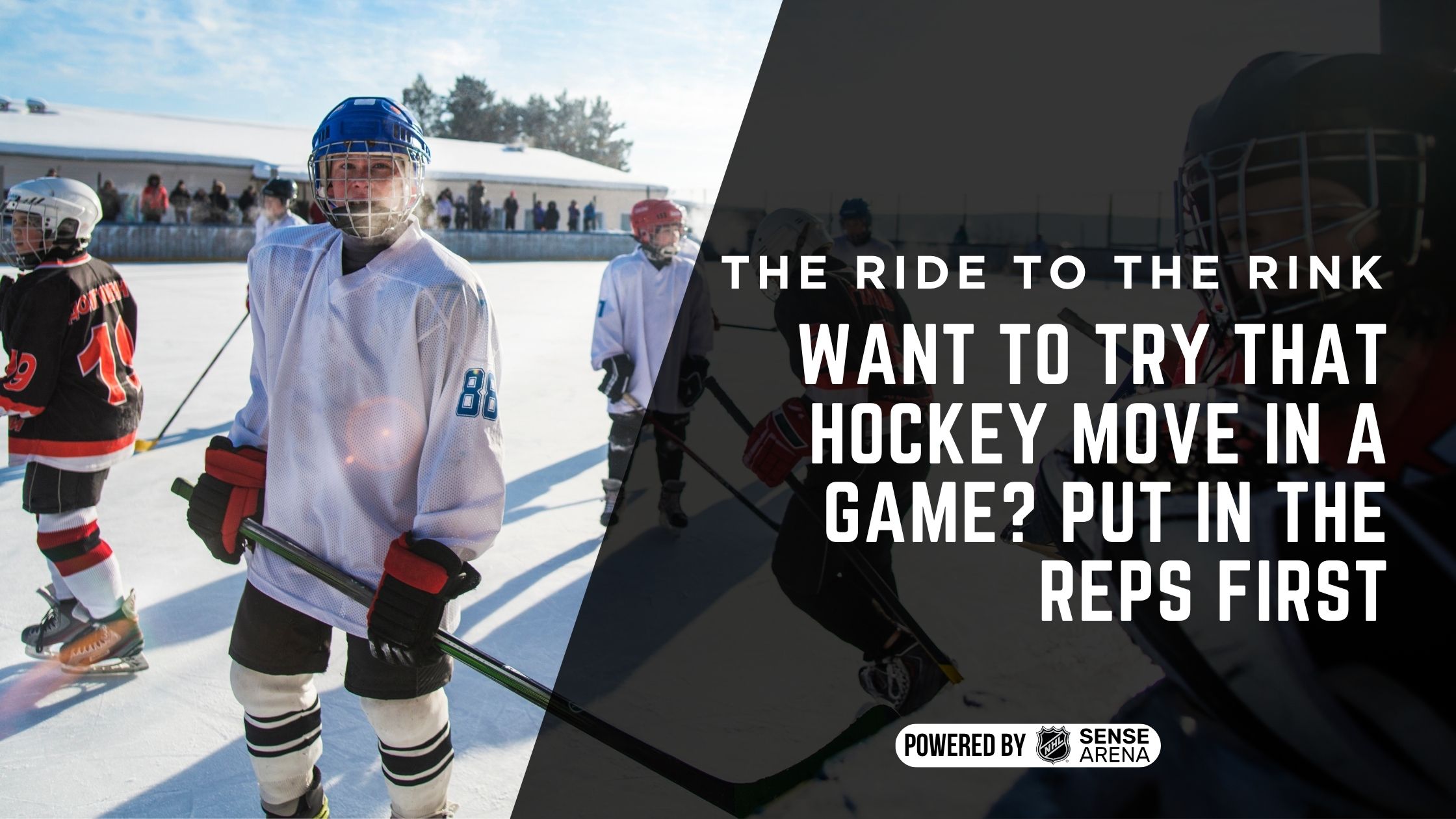
Want to Try That Hockey Move in a Game? Put in the Reps First
Every young hockey player has had this moment.
You’re watching an NHL or PWHL game and one of your favorite players does something incredible.
A toe drag.
A spin move.
A slick backhand.
A lacrosse-style goal.
A creative pass you didn’t even know was possible.
And immediately you think:
“I’m trying that in my next game.”
That excitement is a good thing.
Creativity is part of what makes hockey fun. Trying new things is how players discover skills, develop confidence, and build their own style.
But there’s one important step between seeing a move* and using it successfully in a game.
Practice.
On The Ride to The Rink, Lee Elias and Mike Bonelli talk directly to young players about why repetition matters, how confidence is built, and why the best time to experiment with a new skill usually isn’t during a game.
The lesson is not “don’t take risks.”
It is:
Practice enough that the risk becomes calculated.
Creativity Is Good for Hockey Players
Young players should experiment.
You should try new moves.
You should play around with the puck.
You should watch talented players and wonder if you can learn what they’re doing.
That curiosity is valuable.
In fact, hockey would become a pretty boring game if every player were afraid to try something creative.
But there is a difference between creativity and improvising a skill you have never practiced.
Imagine watching a professional player make an incredible move at the blue line.
You think it looks simple.
Then, in your next game, you attempt it for the first time.
The puck gets turned over.
The opposing team goes the other way.
Maybe they even score.
The problem wasn’t that you were creative.
The problem was that you tried to perform something under game pressure before your body knew how to do it reliably.
That’s where practice comes in.
Build the Skill Before You Need the Skill
A hockey game moves fast.
There isn’t much time to think.
When the puck comes to you, defenders are closing.
Teammates are moving.
The situation is changing constantly.
That means the most effective skills often need to happen instinctively.
Lee describes this through muscle memory.
When you repeat a movement again and again, you become more comfortable with it.
At first, you may have to think:
Where should my hands go?
Where should the puck be?
How far away from my body should I move it?
What angle should my stick blade be?
But eventually, after enough repetition, those thoughts disappear.
The move simply happens.
That is exactly what players want.
You don’t want to enter a game thinking:
“Okay, first I move my top hand here, then pull the puck there, then turn the blade…”
By the time you finish that thought, the defender has already taken the puck.
Practice gives your body the experience it needs so you can react instead of overthink.
There’s a Difference Between a Hockey Risk and a Skill Gamble
Mike makes an important distinction in the episode.
Coaches often encourage players to take risks.
A defenseman might decide to pinch along the boards because they believe they can keep the puck in.
A forward might challenge for a loose puck because they think they can beat an opponent to it.
Those are hockey decisions.
They involve reading a situation and making a choice.
Sometimes the choice works.
Sometimes it doesn’t.
That is different from attempting an advanced puck move that you have never practiced.
One is a calculated decision based on what is happening.
The other may simply be hoping something works.
Young players need both courage and judgment.
You should be confident enough to make plays.
But you also want that confidence to come from preparation.
Practice Is Where Failure Is Supposed to Happen
Nobody enjoys failing.
But practice is exactly where players should be willing to do it.
Lose the puck.
Miss the net.
Mess up the move.
Try it again.
Make an adjustment.
Try it again.
Fail another way.
Try again.
That process matters.
The spectacular skill you see a professional athlete perform may look effortless now, but you usually aren’t seeing all the mistakes that came first.
You aren’t seeing the hundreds—or thousands—of repetitions behind it.
You only see the finished product.
Mike mentions the type of advanced stickhandling content fans see online.
What viewers see is the successful attempt.
They don’t see all the previous attempts that helped create it.
That’s why comparing your first attempt to somebody else’s finished product doesn’t make much sense.
Your first repetition is supposed to look different than their 7,000th.
Start With the Fundamentals and Build
Hockey skills usually don’t develop independently.
One skill supports another.
Before you can confidently execute an advanced move, you may need:
- Strong puck control
- Comfortable skating
- Good balance
- Proper hand positioning
- Awareness of space
- Confidence changing direction
- The ability to protect the puck
That’s why skill development is often a progression.
Get comfortable with one piece.
Add another.
Then another.
Eventually, something that once looked extremely difficult becomes possible because you built the foundation underneath it.
Think about learning to drive.
Nobody hands you a set of keys the first time and says:
“Good luck. Try something creative.”
You learn individual skills.
How to steer.
How to brake.
How to watch your surroundings.
How to control the vehicle.
Then those skills begin working together.
Hockey development works much the same way.
Get More Reps Outside of Practice
Organized practice is incredibly valuable.
But young players can also take ownership of their own improvement.
You don’t always need a rink.
Depending on the skill, you might be able to practice:
- In the driveway
- In the basement
- With a ball
- On synthetic ice
- At an outdoor rink
- With off-ice training equipment
- Through a virtual reality training environment
The important part is intentional repetition.
Lee challenges young players to find **15 minutes** and choose one thing.
That’s manageable.
You don’t need to train for three hours every day.
Pick one move.
One puck-handling pattern.
One shot.
One release.
One type of pass.
Then work on it.
Again.
Again.
Again.
Fifteen focused minutes repeated over weeks can add up to an enormous number of reps.
Coaches Need to Leave Room for Creativity
Players aren’t the only people responsible for creating this environment.
Coaches matter too.
Mike makes the case that players need some practice time where they are allowed to experiment.
If every mistake is immediately corrected or punished, players may become afraid to try anything creative.
That can limit development.
Practice should include structure.
Players need fundamentals.
They need systems.
They need team concepts.
But there also needs to be room to explore.
Let players try the difficult move.
Let them experiment with puck control.
Let them fail safely.
Then help them understand the fundamentals underneath what they are trying to accomplish.
That balance allows creativity and structure to support each other.
Great Players Still Practice Their Best Skills
One of the biggest misconceptions in sports is that elite players stop practicing a skill once they become great at it.
Often, the opposite is true.
The episode references players like **Alex Ovechkin, Sidney Crosby, and Chris Kreider**.
Fans associate these players with specific strengths.
Ovechkin’s shot.
Crosby’s backhand and puck skills.
Kreider’s ability to tip pucks around the net.
But those skills didn’t become elite because the players stopped working on them once they were successful.
They kept practicing them.
That is an important lesson.
Practice isn’t only for fixing weaknesses.
It is also how strengths stay strong.
If you become excellent at something, that does not mean the work is finished.
It may mean you’ve found a tool worth sharpening even more.
Make Repetition Part of Your Identity
Lee shares a story about Crosby finding an outdoor rink because he wanted to get his reps in.
Would missing one day of practice suddenly make a player like Sidney Crosby forget how to play hockey?
Of course not.
That isn’t the point.
The point is the habit.
Elite players often develop routines where practicing doesn’t feel optional.
It becomes part of who they are.
Young players do not need to copy an NHL superstar’s exact routine.
But they can learn from the mindset.
Instead of thinking:
“Do I feel like practicing today?”
Try thinking:
“What small thing can I work on today?”
That question gives you ownership over your development.
When the Game Comes, Trust the Work
Eventually, the moment arrives.
You’ve practiced the move.
You’ve failed at it.
You’ve adjusted.
You’ve repeated it.
You’ve used it successfully during practice.
You’ve become comfortable with it.
Then you’re in a game.
The defender moves a certain way.
The space opens.
And suddenly, without forcing anything, you make the move.
That is the goal.
You didn’t decide before the game that you hadto do it.
You recognized the situation and your body responded.
Practice became performance.
And that is when creativity becomes powerful.
Your Challenge: Pick One Skill
You don’t need to master ten new hockey moves this week.
Choose one.
Spend 15 minutes on it.
Then come back tomorrow or later in the week and do it again.
Keep going.
The goal isn’t to create a highlight immediately.
The goal is to build another reliable tool.
Because every rep adds a little more confidence.
Every mistake teaches you something.
Every repetition makes the movement more familiar.
And eventually, what once felt new can become something you simply know how to do.
🎧 Listen to the full episode of The Ride to The Rink with Lee Elias and Mike Bonelli for more on creativity, calculated risks, practice habits, and why the biggest hockey moves usually start with the smallest repetitions.
Keep experimenting.
Keep practicing.
Keep adding tools to your game.
And when the right moment comes, trust the work you already put in.

Is There a Better Way to Fund Youth Hockey?