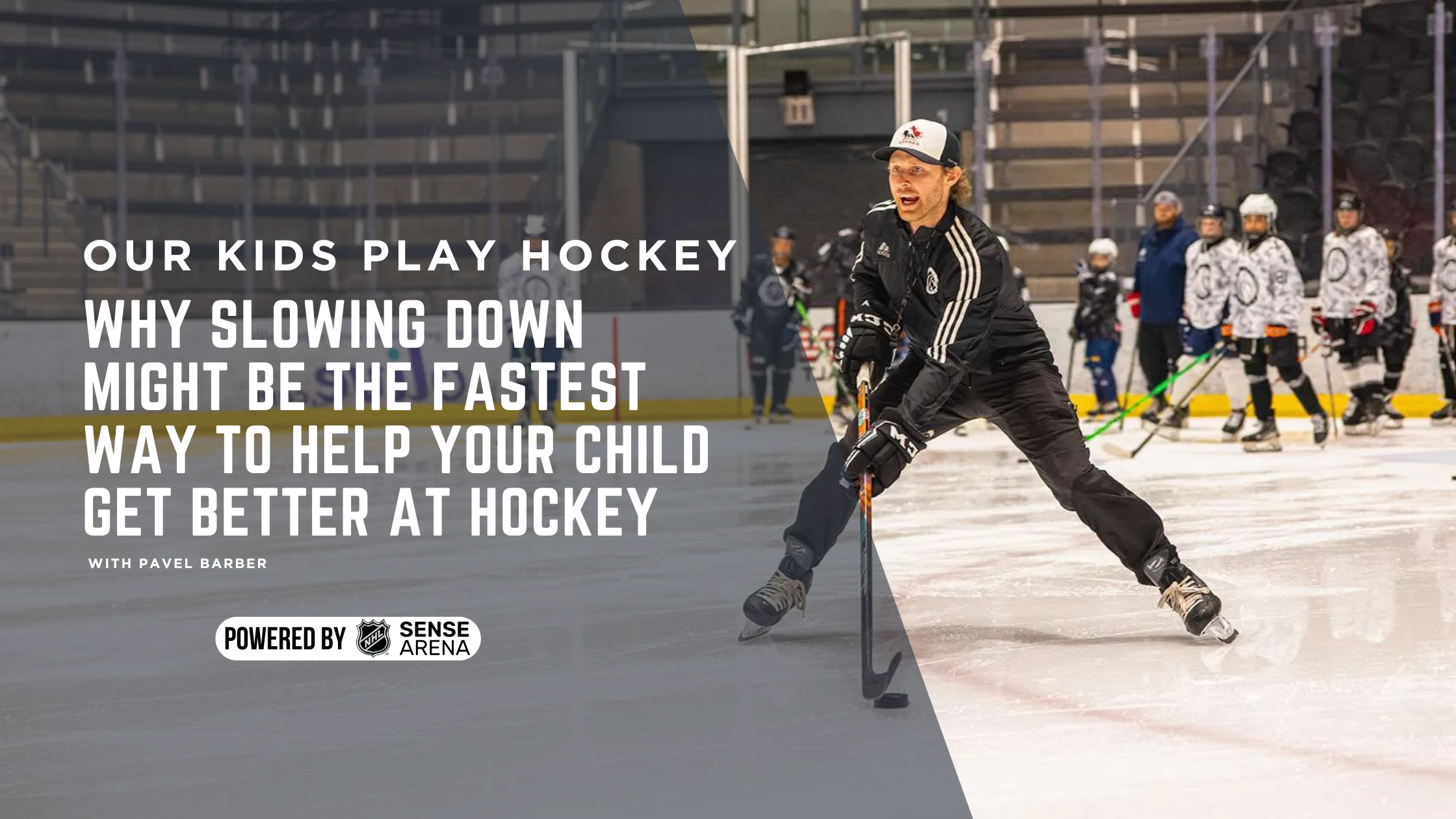
Why Slowing Down Might Be the Fastest Way to Help Your Child Get Better at Hockey
n today’s youth hockey culture, it’s easy to feel like everything is happening at warp speed.
Kids want to learn the Michigan now.
Parents feel pressure to keep up.
Coaches are navigating expectations shaped by social media highlight reels.
But in Part 2 of our conversation with Pavel Barber, one message comes through louder than anything else:
Real development takes patience — and there is no shortcut around the basics.
This episode wasn’t about flashy moves. It was about the process behind them.
The Foundation Comes First (And It Never Goes Away)
One of Pavel’s most important reminders is that elite skills are built on boring, repetitive fundamentals.
Stickhandling off the body
Weight transfer
Blade angle and puck positioning
Head up, eyes scanning
Even the best players in the world still work on these basics every day. Pavel points out that consistency — not creativity alone — is what separates great players from everyone else.
You don’t stop working on the basics. Ever.
Why Going Slow Is a Skill in Itself
A major theme of this conversation is something many young players struggle with: rushing.
Kids want to:
Do skills at full speed too early
Skip steps in progressions
Compare themselves to others
Pavel explains that skill mastery follows a clear progression:
Stationary
Slow movement
Controlled speed
Game-speed application
Skipping steps doesn’t save time — it actually delays growth.
Off-Ice Work: The Most Underrated Advantage
You don’t need more ice time to get better.
Pavel and the hosts emphasize that 10 minutes a day off the ice — with a golf ball, green biscuit, or wooden ball — can completely change a player’s season.
Off-ice work allows players to:
Build reps without pressure
Slow skills down
Develop confidence before adding skating
It also teaches something even more valuable: ownership of development.
Trick Shots, Social Media, and the “Dessert Rule”
Yes — trick shots are fun.
Yes — they can be motivating.
But Pavel offers a simple framework:
Skills are the meal. Trick shots are dessert.
The problem isn’t creativity — it’s when creativity replaces foundational work instead of complementing it.
Social media shows highlights, not habits. What actually builds great players rarely goes viral.
Why Multi-Sport Athletes Win Long-Term
Pavel’s experience representing Team Canada in floorball highlights how other sports develop:
Vision
Spacing
Scanning
Decision-making under pressure
Multi-sport participation also:
Reduces burnout
Prevents overuse injuries
Builds better overall athletes
Sometimes the best thing for a hockey player… is stepping away from hockey for a bit.
Failure, Ego, and the Skill Nobody Teaches
One of the most powerful takeaways from this episode is the idea of ego maintenance.
Development requires:
Looking uncomfortable
Failing publicly
Being willing to look “bad” while learning
The best players don’t succeed despite failure — they succeed because of it.
Kids who never take risks eventually lose opportunity. Growth only happens when failure is allowed.
The Only Comparison That Matters
Pavel leaves listeners with a simple but powerful reminder:
The only player you should compare yourself to is your former self.
When kids focus on progress — not perfection — joy stays in the game, and improvement accelerates naturally.
Final Thoughts for Parents and Coaches
This episode is a reminder that:
Development is not linear
Patience beats pressure
Love of the game matters more than any move
If we can create environments where kids feel safe to fail, free to explore, and encouraged to take ownership of their growth, the ceiling for this next generation of players is incredibly high.
🎧 If you haven’t listened yet, this is an episode worth revisiting — and sharing.
Until next time,
Work hard. Have fun. Get better every day. 🏒💙

Be the Hardest Working Player on the Ice — Advice from Scott Hartnell