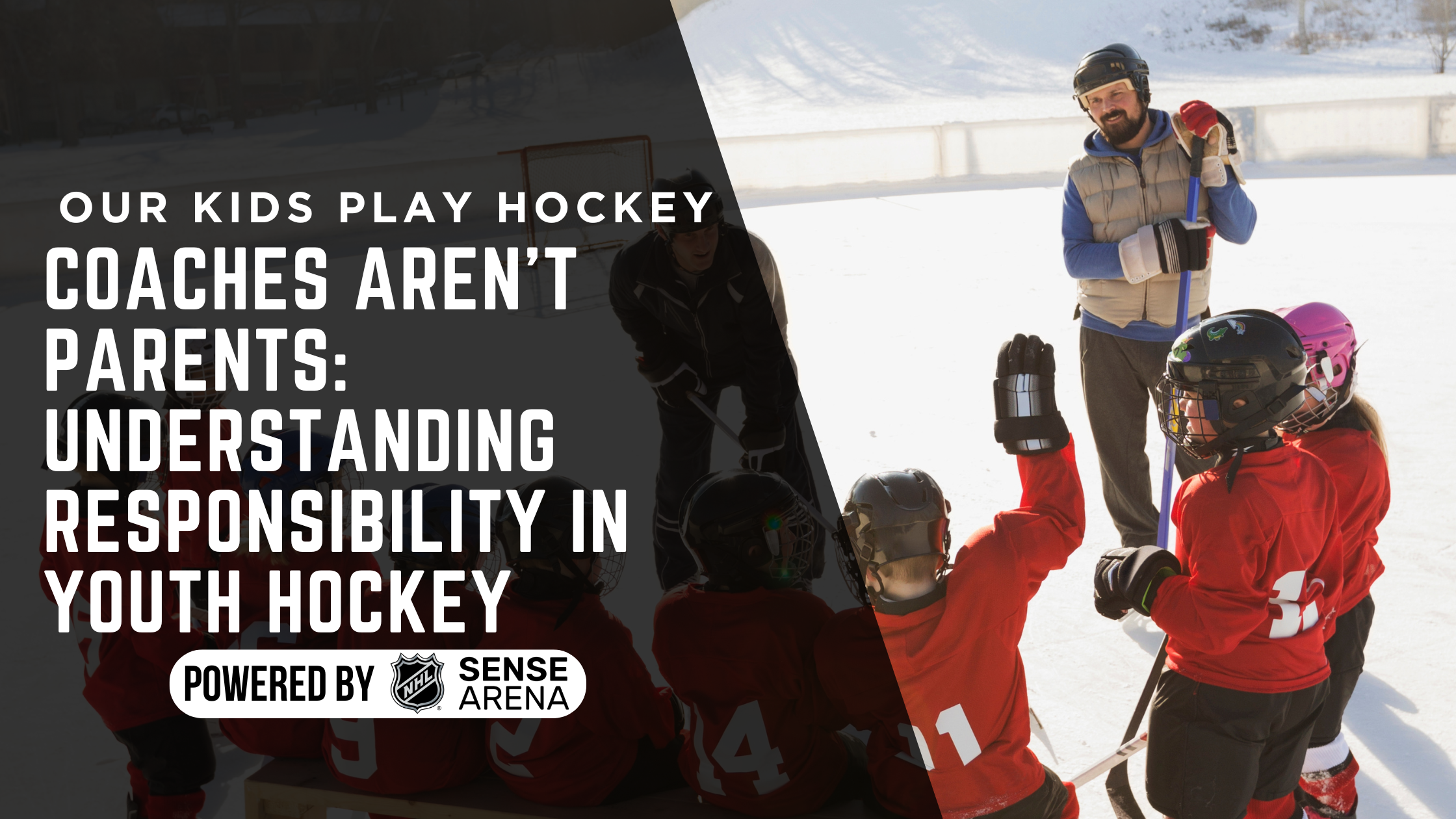
Coaches Aren’t Parents: Understanding Responsibility in Youth Hockey
“Coach, control your kids!”
It is a phrase youth hockey coaches hear more often than they should. A player runs through the rink, acts out in a restaurant, loses control during a game, or makes a poor decision in the locker room—and suddenly everyone looks toward the person standing behind the bench.
The problem is that the players are not actually the coach’s children.
A coach has an important role in a young athlete’s life. Great coaches establish standards, reinforce positive behavior, teach accountability, and help players become stronger teammates and people. But a coach cannot replace the work being done—or not being done—at home.
In this episode of Our Kids Play Hockey, Mike Bonelli and Lee Elias examine the complicated line between coaching and parenting. Their message is not about blaming families or avoiding responsibility. It is about creating clearer roles so coaches and parents can support each other rather than point fingers.
The central idea is one every youth sports community should remember:
It takes a village—but everyone in the village has a different job.
Coaches Establish the Team’s Standards
A coach’s responsibility extends far beyond drawing drills or teaching a forecheck.
Coaches shape the environment surrounding the team. They determine what preparation looks like, how teammates communicate, how players respond to adversity, and what behavior is acceptable on the ice, on the bench, and inside the locker room.
Those standards should be introduced early.
For younger teams, a coach might ask players to be fully dressed ten minutes before practice. That expectation is not simply about starting on time. It can help teach players how to plan backward:
How long will it take to travel to the rink?
How much time is needed to park and carry equipment inside?
How quickly can the player get dressed?
What needs to be packed the night before?
Who should communicate with the coach when a delay occurs?
A small rule about arrival time can become a lesson in preparation, communication, and personal responsibility.
The strongest standards are also clear and purposeful. Asking families to arrive an hour before a game means more when the team has a plan for that hour. Players may need time to settle in, warm up, review the game plan, get dressed, and mentally prepare.
Standards lose credibility when they exist only because “that is how it has always been done.”
A coach should be able to explain what is expected, why it matters, and how the expectation supports the players.
Parents Turn Team Expectations Into Life Lessons
Parents do not lose their influence when their child joins a hockey team.
In many cases, a coach’s standards give parents another tool for teaching responsibility. Instead of repeatedly arguing about when to leave for the rink, a parent can point to the team expectation:
“The coach wants everyone ready ten minutes before practice. What time do you need to leave?”
That approach gradually shifts responsibility toward the player.
The parent still provides transportation and support, especially at younger ages. But the child begins learning to pack a bag, prepare equipment, monitor the schedule, and communicate when something goes wrong.
Problems arise when parents undermine reasonable expectations.
Rolling their eyes because the coach wants players to arrive early sends a message. Complaining about having to be on time tells the child that the standard is excessive or optional. Even when the player eventually arrives on schedule, the parent’s attitude can weaken the lesson the coach is trying to reinforce.
Parents do not need to agree with every decision a coach makes. They should, however, avoid dismissing reasonable expectations in front of their child.
When a standard creates a genuine concern, the better response is a respectful conversation with the coach.
Coaches Manage and Mentor—They Do Not Raise Every Player
One of the most useful distinctions from the episode is the idea that coaches manage, mentor, and guide players.
During practices and games, the coach has direct authority over the team environment. The coach decides where players sit, how they interact with officials, how they respond to opponents, and what consequences follow unacceptable behavior.
If a coach sees that a player is becoming dangerously emotional during a game, intervention is part of the job. The coach may need to sit the player, calm the situation, or prevent behavior that could hurt someone.
That is different from being held responsible for everything a child does.
A coach cannot monitor every hotel hallway, restaurant table, social media account, vending machine, parking lot, or private conversation. Coaches should respond when they witness something serious, but they cannot become the full-time caretaker of an entire roster.
This distinction becomes especially important during tournaments and team travel.
Players may represent their team and organization when they are wearing team apparel. Coaches can explain expectations about respectful behavior and protecting the reputation of the program. But parents remain responsible for supervising and correcting their own children away from official team activities.
A coach can support the lesson. The parent must continue teaching it.
Character Develops When Adults Step Back
Youth hockey players need supervision, but they also need opportunities to make good decisions without a coach standing beside them.
The locker room is one example.
Organizations use locker-room monitors for important safety reasons, but players still need space to develop ownership of their environment. Do they clean up after themselves? Do they include teammates? Do they behave respectfully when the head coach is not present?
Character is often revealed through the choices a player makes when recognition is unlikely.
The player who quietly picks up tape and bottles after a game demonstrates something valuable. The teammate who steps in before a joke becomes bullying is showing leadership. The group that leaves the locker room better than it found it is learning to take responsibility for a shared space.
Coaches can teach and reinforce those behaviors, but the players must eventually choose them.
That is the long-term goal: not constant adult control, but growing personal accountability.
Difficult Situations Require Judgment
There is no perfect rulebook for every interaction between a coach, parent, and player.
The episode includes examples of coaches receiving information about parties, harmful social media behavior, family challenges, and heated confrontations between parents and players.
These situations can place a coach in an uncomfortable position.
A coach may know personal details about a family that other team members do not. Parents may trust the coach to handle sensitive information discreetly. At the same time, coaches must recognize the limits of their role and follow organizational and athlete-safety requirements.
The key question is not always, “Can the coach step in?”
Sometimes the better question is, “Will stepping in make this situation safer or more productive?”
Immediate threats of harm require action. Other situations may call for documentation, a private conversation later, communication with the appropriate adult, or simply careful observation.
Good coaching is not about inserting yourself into every problem. It is about understanding when your involvement can genuinely help.
Officials Are Also Part of the Village
Referees are frequently asked to control emotionally charged moments while making rapid decisions during a game.
The best officials do more than announce penalties. When the situation allows, they explain what happened, tell the player why the action was unacceptable, and communicate with the coach.
That communication transforms a penalty into a teaching opportunity.
The official explains the rule. The coach reinforces the lesson. The parent continues the conversation at home. The player is then more likely to understand both the consequence and the reason behind it.
No single adult carries the entire burden.
That is what the village should look like: different people reinforcing the same values from different positions.
Winning Must Include More Than the Final Score
Strong standards often contribute to successful teams, but success in youth hockey cannot be measured only through wins and losses.
Every team wants to win games. Competition matters, and pretending otherwise does not help young athletes. But coaches should also create additional definitions of winning.
A team can win by:
Improving its passing and communication
Becoming more consistent in preparation
Responding better after mistakes
Supporting teammates during difficult moments
Learning to compete without losing emotional control
Developing stronger habits from the beginning to the end of the season
These goals give players something meaningful to pursue even when the standings are not favorable.
A team can have a mediocre record and still experience an excellent season. Players can improve, enjoy coming to the rink, develop friendships, and become more responsible people.
Conversely, a team can dominate every opponent and learn very little.
Adversity is often where development happens. The difficulty is part of what makes competition meaningful.
Take the Best Lessons From Every Coach
Most players will work with many coaches during their youth hockey years.
Some will be excellent. Some will struggle. Most will fall somewhere in the middle.
Each experience gives families an opportunity to identify useful standards.
Perhaps one coach teaches a player to pack equipment the night before. Another introduces a warmup routine that improves preparation. Another emphasizes cleaning the locker room, communicating with officials, or responding calmly after a loss.
Those habits do not need to disappear when the season ends.
Players and families can build their own collection of standards by keeping what works and learning from what does not.
Over time, the player becomes less dependent on any individual coach. Preparation, discipline, and accountability become personal habits.
That is a major sign of development.
The Best Youth Hockey Environments Share Responsibility
Coaches should coach.
Parents should parent.
Officials should communicate and enforce the rules.
Players should gradually learn to take ownership of their decisions.
These responsibilities overlap, but they are not identical. Confusion begins when the adults expect someone else to do their job—or when one person is blamed for everything that goes wrong.
A healthy youth hockey environment is built through partnership.
Coaches can make parenting easier by providing clear and meaningful standards. Parents can make coaching easier by reinforcing those standards and teaching respectful behavior away from the rink. Together, they give players the consistency needed to grow.
The goal is not to control young athletes forever.
The goal is to guide them until they are prepared to control themselves.
Listen to the full episode of Our Kids Play Hockey, and share the standards that have helped your family or team. Email team@ourkidsplayhockey.com or use the text link accompanying the episode to continue the conversation.
Keep supporting the coaches who teach with purpose, the parents who reinforce positive habits, and the players who are learning to take responsibility one season at a time.

How Young Hockey Players Can Handle Conflict With Teammates, Coaches, and Parents