What “Elite” Really Means in Youth Hockey—and Why Development Matters More
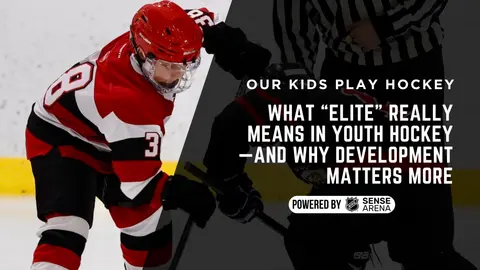
What “Elite” Really Means in Youth Hockey—and Why Development Matters More
Every hockey family eventually hears the same words.
AAA.
Elite.
Showcase.
Premier.
High performance.
Next level.
The labels keep getting bigger.
But do the players actually get better because of them?
In this episode of Our Kids Play Hockey, Lee Elias and Mike Bonelli are joined by Duncan Fletcher, Executive Director of Game Change, former Division I hockey coach, and longtime athlete-development professional.
Together, they challenge one of the biggest assumptions in youth sports:
More hockey does not automatically mean better hockey.
More games do not guarantee development.
More travel does not create skill.
A higher label does not make a player elite.
What matters is far less glamorous.
Practice.
Skating.
Puck handling.
Persistence.
Learning how to fail.
Developing self-awareness.
And staying in the game long enough to actually become good.
So What Actually Separates Players?
At the highest levels, Duncan says the physical difference between players can become incredibly small.
Almost everyone can skate.
Everyone can handle the puck.
Everyone is talented.
At that point, separation often happens mentally.
Persistence matters.
Belief matters.
The willingness to keep going matters.
How players respond when things become difficult matters.
But that conversation changes when we are talking about younger athletes.
Before the mental separator can become important, players need a foundation.
And Duncan believes youth hockey sometimes skips that step.
Start With the Foundation
The questions are not complicated.
Can the player skate?
Can the player control the puck?
Can the player perform those skills while someone is applying pressure?
Can the player maintain balance?
Can the player make decisions at speed?
Those skills create the platform for everything else.
Without them, tactical systems and advanced concepts have nowhere to live.
A coach can explain the perfect breakout.
But if the defenseman cannot skate under pressure or control the puck with her head up, the breakout does not matter.
That is why foundational skill work cannot become optional.
Practice Is Where Players Get Better
One of the strongest messages in this episode is that games are not the primary development environment.
Practice is.
Games test skills.
Practice builds them.
During practice, players can repeat the same movement.
They can fail.
Try again.
Receive feedback.
Slow something down.
Speed it back up.
Experiment.
Games rarely allow that.
The scoreboard is moving.
Opponents are trying to beat you.
Parents are watching.
Coaches are reacting.
Players revert to whatever habits they already have.
That is why repetition matters so much.
North American Hockey Has a Game Problem
Youth hockey schedules can become enormous.
League games.
Tournament games.
Showcases.
Invitational weekends.
Travel.
More travel.
And sometimes even more games squeezed into the same weekend.
That creates an obvious question:
Where is the development time?
Duncan argues that families should be far more concerned with practice-to-game ratio than with how many games are on the calendar.
If players spend most of their hockey hours competing rather than developing, improvement becomes more difficult.
Games Are for Application
Lee describes games as the place where players should apply what they have already practiced.
That distinction is important.
A player should not need to invent an entirely new skill under game pressure.
The skill should already exist.
The repetition should already be there.
The movement should feel familiar.
Then the player can recognize the right moment and use it.
That is muscle memory.
Whether it is a toe drag, a breakout pass, a shoulder check, or simply taking ice instead of panicking with the puck, the behavior needs repetitions first.
Stop Coaching Mistakes Out of Players
Development requires failure.
That sounds obvious until the puck gets turned over.
A young defenseman gets the puck.
Looks up.
Tries to skate.
Loses it.
Goal against.
What happens next?
Too often, adults respond:
“Just get rid of it!”
So next time, the player gets the puck and fires it off the glass.
Problem solved.
Except nothing was developed.
The player has learned how to avoid the mistake rather than how to solve the situation.
Short-term safety can become long-term limitation.
Sometimes You Have to Let the Play Fail
Duncan shares a similar philosophy.
If a player attempts a difficult pass and it does not work, that does not automatically mean the idea was wrong.
Maybe the execution was wrong.
Maybe the timing was wrong.
Maybe the player needs 100 more repetitions.
But if coaches eliminate every risky decision immediately, players stop experimenting.
And when they stop experimenting, creativity disappears.
The Michigan Did Not Appear Out of Nowhere
The group discusses the famous Michigan goal.
A player did not simply arrive at the rink one day and decide to scoop the puck into the top corner during a game.
The move existed in practice first.
Again.
Again.
Again.
Until eventually the player recognized the opportunity and executed it.
That same developmental principle applies to far less flashy skills too.
A defenseman shoulder-checking before retrieving the puck.
A center finding soft ice.
A winger releasing at the right moment.
A player protecting possession instead of throwing the puck away.
Repetition turns thought into instinct.
What Does “Elite” Actually Mean?
Few words in youth hockey are used more aggressively than elite.
Elite camps.
Elite teams.
Elite tournaments.
Elite training.
Elite prospects.
But Duncan challenges families to think about what the word really means.
Making a AAA team does not automatically make a player elite.
A jersey does not create elite ability.
A tournament title does not do it either.
True elite athletes are rare.
Very rare.
They are the players who are clearly and dramatically different from nearly everyone else around them.
That distinction matters because families can make enormous decisions based on a label that may not mean anything.
Your Kid Does Not Have to Be Elite
This may be even more important.
It is completely okay if your child is not elite.
They can still love hockey.
They can still improve.
They can still play meaningful competitive hockey.
They can still become a great teammate.
They can still learn skills that shape their entire life.
Youth hockey does not have to produce a professional athlete to be worthwhile.
Stop Trying to Manufacture Elite
Parents cannot force a child into elite status.
You cannot manufacture love for hockey.
You cannot force internal motivation.
You cannot create long-term persistence simply by adding tournaments.
At some point, the player has to own the journey.
The player has to want to practice.
Want to improve.
Want to solve problems.
Want to come back after disappointment.
Parents can create opportunity.
They cannot create desire.
Multi-Sport Athletes Still Matter
Duncan has spent significant time around professional athletes.
Again and again, he hears similar stories.
They played multiple sports growing up.
Baseball.
Lacrosse.
Soccer.
Other activities.
Different environments.
Different movement patterns.
Different challenges.
And many of those athletes now say they would have struggled with the idea of playing hockey nearly year-round as children.
That message deserves attention.
Playing Another Sport Is Not Falling Behind
Different sports build different tools.
Baseball teaches tracking and reaction.
Lacrosse develops spatial awareness and hand-eye coordination.
Soccer develops movement, conditioning, and field awareness.
Other activities challenge the body and brain differently.
Those skills can eventually support hockey.
The point is not that every athlete must play four sports.
It is that specialization should not automatically be treated as superior development.
There Is a Difference Between Multi-Sport and Overbooked
Mike adds an important caveat.
Playing several sports is not automatically healthy if a child is trying to participate in all of them year-round simultaneously.
That may simply become another version of overload.
Variety should create development and breathing room.
Not another impossible calendar.
The Best Athletes Can Adapt
Broader athletic experiences create adaptability.
That matters later.
As players move up, coaches ask for different things.
One coach wants aggressive puck pressure.
Another wants structure.
One system asks defensemen to activate.
Another may want conservative reads.
Players who have only learned one solution can struggle.
Players with broader skills can adapt.
That adaptability becomes a major advantage.
Hockey IQ Is More Than Following the Puck
Lee describes how he watches hockey differently.
Instead of watching only the puck, he watches the space around it.
Where are the passing lanes?
Where is the open ice?
What is developing away from the play?
Who is anticipating what happens next?
Young players often chase the puck because the puck is the obvious thing to watch.
Advanced players begin seeing the entire picture.
That requires time.
Experience.
Coaching.
And learning how to recognize patterns.
Be Elite at Being a Person
Eventually, the conversation moves away from the hockey definition of elite entirely.
What about being exceptional as a person?
Youth sports offer countless opportunities to practice things that matter outside hockey.
Duncan identifies several:
-
Goal setting
-
Respect
-
Encouragement
-
Handling adversity
-
Moving past frustration
-
Listening
-
Coachability
-
Courage
-
Competition
-
Leadership
Those lessons are not side effects.
They are part of the value.
Sports Do Not Just Reveal Character
There is a popular phrase:
“Sports do not build character. They reveal it.”
Duncan strongly disagrees.
Sports can absolutely help build character.
A player can learn how to handle disappointment.
Learn to communicate.
Learn to work when something is difficult.
Learn how to respond to a teammate.
Learn how to listen to someone they disagree with.
Those are developed skills.
Sports provide a laboratory for practicing them.
Get Comfortable Being Uncomfortable
One lesson runs through nearly every part of this conversation.
Growth is uncomfortable.
Learning something new feels awkward.
Taking the puck under pressure feels uncomfortable.
Speaking in front of teammates may feel uncomfortable.
Trying another sport may feel uncomfortable.
Failing feels uncomfortable.
That discomfort is not automatically a warning to stop.
Sometimes it is evidence that growth is happening.
Self-Awareness Is a Competitive Advantage
Duncan’s professional work with high-level athletes often starts somewhere surprising.
Not with training.
Not with tactics.
With self-awareness.
Who are you?
What are you good at?
What are you naturally drawn toward?
What interests you outside your sport?
Those questions matter even for elite professional athletes.
In fact, Duncan says they may help athletes perform better and sustain longer careers.
Hockey Should Not Be Your Entire Identity
This idea can be introduced far earlier than the professional level.
Young players benefit from understanding that they are more than hockey players.
They can be musicians.
Students.
Artists.
Baseball players.
Readers.
Friends.
Siblings.
Curious people.
Hockey can matter deeply without becoming the only thing that defines them.
Interests Outside Hockey Can Help Hockey
That may sound counterintuitive.
Shouldn't serious hockey players spend every available moment on hockey?
Not necessarily.
Outside interests can create balance.
Perspective.
Creativity.
Confidence.
Recovery.
A stronger sense of identity.
And those benefits can return to the rink.
Try the Other Ice Cream Flavor
Lee uses a simple metaphor.
If you have only ever eaten chocolate ice cream, how do you know whether you like vanilla?
Kids need experiences.
They need chances to try things.
Some will stick.
Some will not.
That is okay.
You do not know what you love until you have had a chance to experience it.
Parents Sometimes Have to Push
Children naturally avoid discomfort.
Adults do too.
A child may say:
“I don't want to try that.”
Sometimes that means the activity is genuinely not for them.
Sometimes it means:
“I’m nervous.”
“I might be bad at it.”
“I don’t know anyone.”
Those situations deserve exploration.
A gentle push into an uncomfortable experience can sometimes open an entirely new part of a child’s life.
Winning at 10 Is Not Development
One of Duncan’s strongest opinions is about youth hockey wins and losses.
If parents are evaluating development by standings when their child is young, the focus is misplaced.
The question is not:
“Did we win?”
Ask:
“Did my child improve?”
“Did they learn?”
“Did they try something difficult?”
“Did they make a mistake and respond?”
“Are their skills getting better?”
Those questions have a much longer shelf life.
Develop the 18-Year-Old, Not the 10-Year-Old
This might be the core philosophy of the entire episode.
What kind of player are you trying to create?
The best 10-year-old?
Or a skilled, adaptable, intelligent 18-year-old?
Those goals may require very different decisions.
The best short-term team may not provide the best long-term development.
More wins today may not create more skill tomorrow.
Parents need to think beyond the next tournament.
Progress Does Not Always Feel Good
Improvement is not always obvious.
Sometimes progress looks like success.
A goal.
A great pass.
A strong game.
Other times progress looks terrible.
A player tries something new five times and fails all five times.
That can still be progress.
The player gathered information.
They discovered what does not work.
They became more comfortable trying.
They moved one step closer.
Hard Practice Can Become Fun
Not every development session needs to feel like recess.
Some things require deliberate work.
Skating repetitions.
Edges.
Puck handling.
Movement patterns.
Those can be difficult.
Duncan explains that players sometimes struggle initially with development-heavy training.
Then something changes.
They notice:
“I’m better.”
The thing they could not do six weeks ago is suddenly possible.
That improvement becomes motivating.
Hard work becomes enjoyable because players can connect effort with growth.
Great Coaches Make Demanding Work Engaging
That still places responsibility on coaches.
Strong practices need energy.
Creativity.
Progression.
Communication.
Coaches need to understand the age group.
They need to know when to push.
When to break things up.
When to add competition.
When to make something silly.
Development does not have to mean boring.
But meaningful development does require intentional planning.
Find a Program With a Philosophy
Parents should ask more questions about development.
Who oversees the program?
What is the philosophy?
How much practice do players receive?
What percentage of that practice focuses on skating and puck skills?
How are mistakes handled?
Are coaches aligned?
What does the organization believe a player should look like several years from now?
Those questions may matter more than tournament schedules.
The Better Your Kid Gets, the Harder the Decision Becomes
One of the strange challenges of development is that successful development often creates outside opportunities.
A player improves.
Another team notices.
A higher-labelled program calls.
Now the family has a decision.
Do we leave the environment that helped create the improvement because something with a bigger label is available?
Sometimes the answer may be yes.
Sometimes it may not.
But families should at least understand what they are leaving behind.
Long-Term Development Requires Patience
Hockey takes time.
Learning to skate alone is incredibly difficult.
Then players add a stick.
A puck.
Speed.
Pressure.
Contact.
Decision-making.
Strategy.
All while moving on blades over ice.
It is an absurdly difficult sport.
That should remind everyone that development cannot be rushed.
Get a Little Better Every Day
The episode ends with a simple idea.
Get a little better every day.
Not every day will look impressive.
Not every improvement will produce a goal.
Not every mistake will feel productive in the moment.
But development is cumulative.
One skating session.
One puck touch.
One difficult conversation.
One mistake.
One adjustment.
One lesson.
Over enough time, those small moments become a player.
And more importantly, they help build a person.
That is the real opportunity youth hockey provides.
Keep listening to Our Kids Play Hockey for more conversations that challenge the noise around youth sports and help families focus on what actually matters: development, perspective, growth, and enjoying the game long enough to see where it can take you.

From Gold Medal to Las Vegas: Hayley Scamurra’s Next Chapter