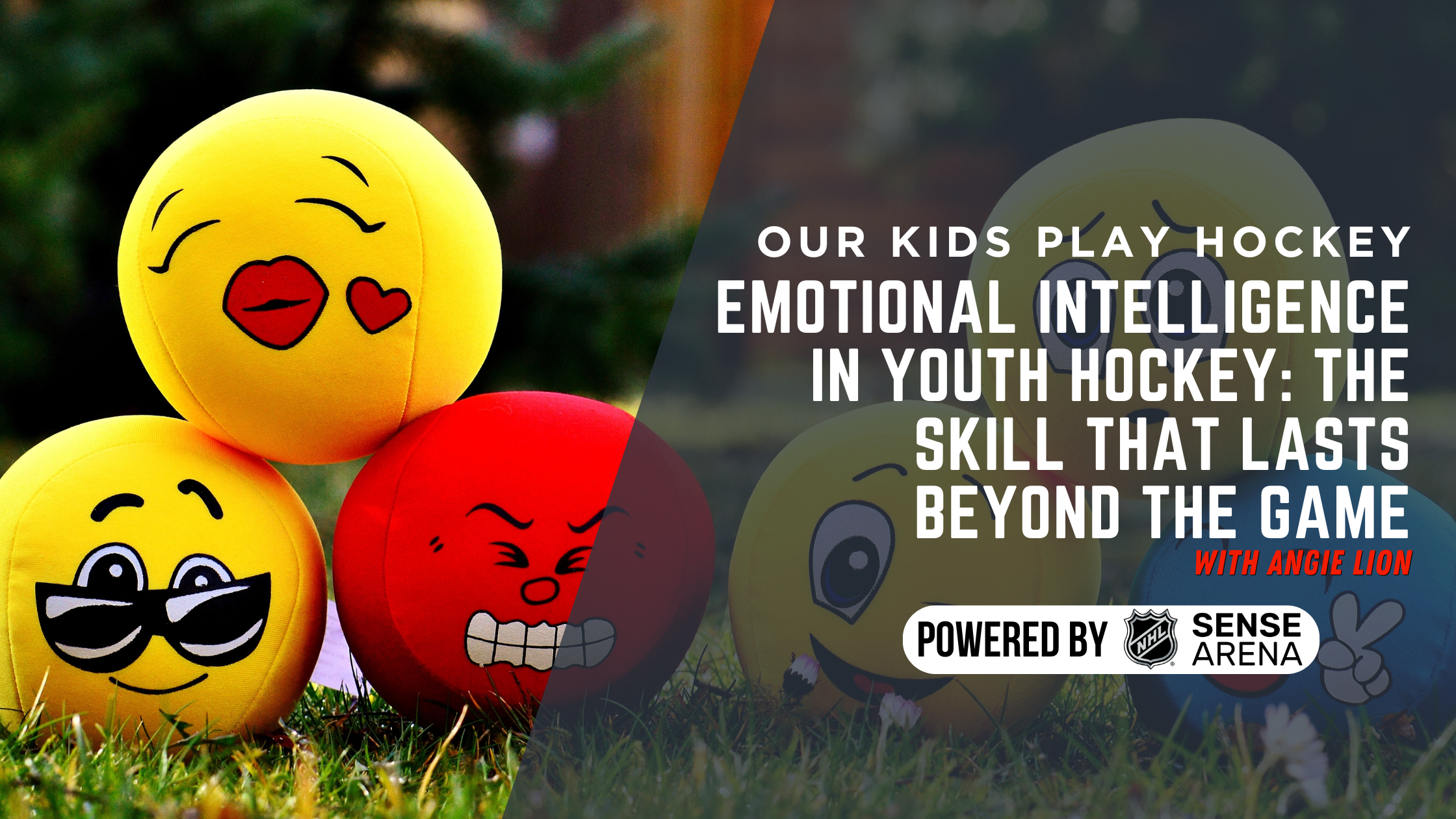
Emotional Intelligence in Youth Hockey: The Skill That Lasts Beyond the Game
Every hockey parent knows the feeling.
Your child comes off the ice upset. Maybe they were pulled off during a shift. Maybe they missed a chance, got yelled at, lost a game, or felt overlooked. As parents and coaches, we often want to fix it immediately. We want to explain, correct, comfort, or sometimes just make the emotion disappear.
But what if those emotional moments are not interruptions to development?
What if they are the development?
On this episode of Our Kids Play Hockey, Lee Elias, Mike Bonelli, and Christie Casciano-Burns sat down with Angie Lion, author of Emerge and co-founder/chief soul officer of Black River Performance Management, to talk about emotional intelligence, transitional intelligence, and the life skills hockey can teach when adults are willing to slow down and pay attention.
The conversation was a reminder that the rink is not just a place where kids learn to skate, pass, shoot, and compete. It is also a place where they learn how to handle frustration, rejection, uncertainty, pressure, change, and accountability.
Those are not “soft skills.”
As Angie explained, they are human skills. And in many ways, they are the hardest skills of all.
Why Emotional Intelligence Matters in Hockey
In hockey, emotions are everywhere.
A player gets benched. A goalie lets in a tough goal. A coach shortens a shift. A teammate says something the wrong way. A parent watches from the stands and assumes the worst. A young athlete moves from one team to another and suddenly has to figure out where they fit.
All of these situations create emotion.
The question is not whether emotions will show up. They will.
The real question is: Do our kids have the tools to understand and manage them?
Angie made a key point early in the conversation: emotional intelligence is not a fixed personality trait. It is a buildable skill. That matters because it means kids, parents, and coaches can all improve.
Emotional intelligence helps athletes:
- Recognize what they are feeling
- Understand what triggered the feeling
- Separate emotion from action
- Communicate more clearly
- Recover from mistakes faster
- Build stronger relationships with teammates and coaches
- Handle pressure without falling apart
For young hockey players, that can become a true performance advantage. A player who can reset after a bad shift is better prepared for the next one. A player who can communicate instead of explode becomes a better teammate. A player who understands disappointment can keep growing through it instead of being defined by it.
And for parents, this is where the bigger return on youth sports shows up.
The skating eventually slows down. The playing days eventually end. But the ability to manage emotions, navigate change, and respond with maturity can serve a child for the rest of their life.
Emotions Are Data, Not Directives
One of the strongest ideas Angie shared was this:
Emotions are data. They are not directives.
That distinction is incredibly important for hockey families.
A child may feel anxious before practice. That does not automatically mean they should skip practice. A player may feel angry after being taken off the ice. That does not mean they get to throw their stick, snap at a coach, or blame a teammate. A parent may feel frustrated watching from the stands. That does not mean they need to confront the coach immediately after the game.
The emotion is information.
It may be telling us something important. Anxiety may show that a player cares deeply about how they perform. Anger may reveal that a child feels embarrassed, overlooked, or not good enough. Disappointment may show that something mattered.
But the emotion itself does not have to be in charge.
This is where adults can help kids pause and ask better questions:
- What am I feeling?
- What triggered this?
- What story am I telling myself?
- Is that story true?
- What is a more helpful response?
- What do I need right now to move forward?
That is emotional intelligence in action.
It is not about ignoring emotion. It is about learning how to work with it.
The Power of Naming Emotions
Angie discussed the importance of giving kids a stronger emotional vocabulary. Many young athletes know they feel “mad,” “bad,” or “fine,” but those words often do not tell the full story.
A player who says they are angry may actually feel embarrassed.
A player who says they are annoyed may actually feel insecure.
A player who says they do not care may actually be protecting themselves from disappointment.
When kids can name what they are feeling more accurately, they can begin to understand it. Angie referenced the idea of “name it to tame it,” which is especially useful in youth sports. The more specific a child can be, the more likely they are to regulate the feeling instead of simply reacting to it.
For coaches, this can start with simple check-ins.
A mood meter in the locker room. A thumbs-up, thumbs-middle, thumbs-down before practice. A quick question: “Where are you today?”
That does not mean every practice becomes a therapy session. It means coaches are gathering information. They are learning where their team is emotionally before asking them to perform physically.
That is not soft.
That is smart coaching.
Trigger Journals: A Practical Tool for Players and Teams
One of the most practical ideas Angie shared was the use of a trigger journal.
A trigger journal helps players identify the moments that consistently set them off. Maybe it is being corrected in front of teammates. Maybe it is getting pulled off the ice. Maybe it is a teammate yelling for the puck. Maybe it is a parent’s comment in the car after the game.
The goal is not to shame the player.
The goal is awareness.
Because as Angie explained, if athletes do not understand their triggers, other people can control them through those triggers.
For a young hockey player, a trigger journal might include:
- What happened?
- What did I feel?
- What did I do?
- What story did I tell myself?
- What could I try next time?
This gives coaches and parents a way to move from punishment to development.
Instead of simply saying, “Stop acting like that,” adults can help the player understand what is underneath the behavior.
That does not mean every behavior is acceptable. Angie made an important distinction: emotions are allowed, but certain behaviors are not.
A child can be disappointed. They cannot abuse a teammate.
A player can be frustrated. They cannot throw equipment.
A parent can be upset. They cannot lose control in the stands.
Emotional intelligence does not remove accountability. It strengthens it.
Coaches Have More Influence Than They Realize
One of the most important reminders from this episode was how much influence coaches have.
Angie pointed out that as kids get older, they often listen to coaches, mentors, and peers differently than they listen to parents. Any parent-coach has seen this firsthand. Your own child may ignore your advice, then listen intently when another coach says the exact same thing.
That influence is a responsibility.
Coaches are not just teaching systems, breakouts, skating patterns, and special teams. They are modeling how to handle pressure, disappointment, conflict, and accountability.
A coach who screams at every mistake is teaching something.
A coach who blames referees constantly is teaching something.
A coach who owns mistakes, communicates clearly, and helps players work through frustration is also teaching something.
The lesson is always happening.
That is why Angie encouraged coaches to set the standard early. If emotional intelligence is going to be part of the team culture, say so at the beginning of the season.
Tell families:
“This season, we are going to work on becoming better players and better people. That means we are going to work on emotional regulation, accountability, communication, and resilience.”
Then build simple tools into the culture:
- Mood check-ins
- Trigger journals
- Team conversations
- Shared language
- Start-stop-continue reflections
- Parent and player expectations
- Reframing exercises
Coaches do not need to be therapists. They can be facilitators. They can create space, set expectations, model accountability, and guide the team toward better habits.
Transitional Intelligence: Helping Kids Navigate Change
Angie also introduced the idea of transitional intelligence, which is the ability to navigate change and transition with awareness and resilience.
Hockey is full of transitions.
A child moves from house league to travel hockey. A player changes teams. A goalie loses a starting role. A family moves to a new association. A teenager deals with puberty, school pressure, changing friendships, and a new coach all at the same time.
To adults, some of these changes may seem small.
To kids, they can feel enormous.
Angie explained that every transition has three stages:
1. An ending
Something is over. A season, a role, a team, a relationship, a familiar identity.
2. The messy middle
This is the uncertain space where a child is no longer who they were but not yet settled into who they are becoming.
3. A new beginning
Eventually, the athlete starts to adjust, grow, and see new possibilities.
The messy middle is where many kids struggle. It can feel lonely, confusing, uncomfortable, and even scary. But it is also where growth happens.
Parents and coaches can help by normalizing that discomfort.
Instead of saying, “You’ll be fine,” try saying:
“I can see this is hard. It makes sense that you feel unsettled. Let’s talk through what changed and what you can control next.”
That kind of response helps kids understand that struggle does not mean something is wrong with them. It means they are in transition.
And transition is part of life.
Let Kids Build Resilience
A major theme of the conversation was the need for parents to let kids experience discomfort.
That does not mean abandoning them. It does not mean ignoring real problems. It means resisting the urge to helicopter every hard moment away.
If a child is disappointed, they need support.
But they also need the chance to feel disappointment and learn how to move through it.
If a child has a difficult conversation with a teammate, they may need guidance.
But they also need the opportunity to have the conversation.
If a child fails, gets cut, loses ice time, or struggles with a new role, parents can help them process it without immediately trying to rescue them from it.
This is difficult because parents feel their children’s pain. But resilience is not built by avoiding every hard thing. It is built by facing hard things with support, tools, and perspective.
As Angie and the hosts discussed, over-parenting can be just as damaging as under-parenting. The goal is to find the “messy middle” of parenting: present, supportive, and loving, but not controlling every outcome.
A Simple Team Exercise: Start, Stop, Continue
One of the most useful takeaways from the episode was Angie’s suggestion to use a Start, Stop, Continue exercise.
This can work for teams, families, coaching staffs, or organizations.
Ask:
What do we need to start doing?
Maybe the team needs to start checking in emotionally before practice. Maybe parents need to start waiting 24 hours before emailing coaches after games.
What do we need to stop doing?
Maybe players need to stop blaming each other after goals against. Maybe coaches need to stop assuming a player’s behavior is just “attitude” without looking deeper.
What do we need to continue doing?
Maybe the team already supports each other well. Maybe parents are doing a good job encouraging effort over outcome.
The key is that everyone has a voice.
When players help create the standards, they are more likely to own them. When parents understand the expectations, they are more likely to support them. When coaches listen, they get a clearer picture of the culture they are building.
This is how emotional intelligence becomes part of the team—not a one-time speech, but an ongoing practice.
The Bigger Purpose of Youth Hockey
At its best, youth hockey is about far more than wins, rankings, tournaments, and trophies.
It is about helping kids become people who can handle life.
People who can work with others.
People who can recover from setbacks.
People who can communicate honestly.
People who can manage pressure.
People who can move through change without losing themselves.
Angie Lion’s message is a powerful reminder that emotional intelligence and transitional intelligence are not extras. They are central to the youth sports experience.
Every game gives kids chances to practice them.
Every tough shift gives kids chances to practice them.
Every disappointment, role change, team change, and hard conversation gives kids chances to practice them.
The adults in the room do not need to be perfect. In fact, one of the best things a parent or coach can say is:
“I’m working on this too.”
That kind of honesty models growth. It tells kids that emotional intelligence is not something you either have or do not have. It is something we build, together, over time.
And that may be one of the greatest gifts hockey can give.
Final Thought
The next time your child comes off the ice upset, try to see the moment differently.
Not as a problem to erase.
Not as a behavior to immediately shut down.
Not as proof that they are too emotional, too sensitive, or too difficult.
See it as an opportunity.
An opportunity to help them name what they feel. Understand what triggered it. Reframe the story. Choose a better response. And slowly, with support and practice, become more resilient.
That is where hockey becomes bigger than the game.
And that is why these conversations matter.
For more conversations that help families get the most out of the youth hockey journey, keep listening to Our Kids Play Hockey—and keep helping your kids grow through the game, not just in it.

What NHL Goalie Coaches See That Youth Hockey Often Misses