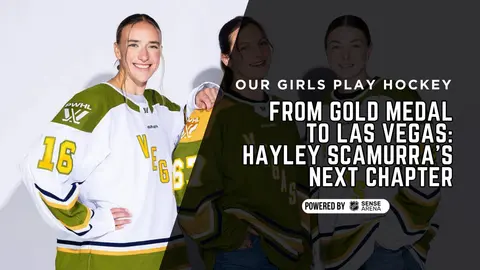
From Gold Medal to Las Vegas: Hayley Scamurra’s Next Chapter
What do you do after one of the biggest years of your hockey life?
For most people, that sounds like a hypothetical question.
For Hayley Scamurra, it is very real.
Olympic gold.
A Walter Cup championship.
A season filled with some of the biggest moments a hockey player can experience.
And now?
Another season begins.
In the first installment of Our Girls Play Hockey: Day in the Life 2026–27, Hayley joins Lee Elias and Mike Bonelli to talk about what it feels like to move forward after a year that would be nearly impossible to script.
The answer says a lot about elite athletes.
You do not erase the past.
You do not minimize it.
You appreciate it.
Then you keep going.
You Do Not Have to “Top” Everything
One of the first questions Hayley addresses is one she has already heard many times:
How are you going to top last year?
It sounds harmless.
But it creates a strange kind of pressure.
How do you “top” Olympic gold?
How do you “top” a championship?
And does every year even need to be compared that way?
Hayley’s answer is refreshingly grounded.
She is grateful for everything that happened.
She appreciates the magnitude of the season.
But she is not treating the future as a competition with the past.
There are new goals.
New challenges.
New teammates.
New opportunities.
Success can look different.
That is an important lesson for young athletes too.
Your next season does not have to be “better” than your previous season in every measurable way.
It needs to move you forward.
The Journey Is Bigger Than the Milestones
Lee describes the gold medal and Walter Cup as stops on the journey rather than the final destination.
That framing matters.
Athletes naturally chase goals.
Make the team.
Win the championship.
Earn the medal.
Reach the next level.
Those goals provide direction.
But if all the joy comes from the final outcome, a sports career becomes a series of very short celebrations surrounded by long stretches of pressure.
The journey contains the real substance.
Training.
Teammates.
Travel.
Adversity.
Relationships.
Improvement.
Leadership.
Those pieces are what build the athlete and the person.
Women’s Hockey Has Changed Fast
There is also a historic layer to Hayley’s year.
Lee points out that only a few years ago, winning an Olympic gold medal and a Walter Cup in the same year was not even possible.
The Walter Cup did not exist.
The professional structure did not exist in its current form.
Now, women can compete for major professional and international championships in the same era.
That is a remarkable shift.
And Hayley is living directly inside that growth.
Her next challenge reinforces it even more:
A new professional team in Las Vegas.
Saying Goodbye to Montreal
Before moving forward, Hayley still had to close out the previous chapter.
She and her husband, Nick, returned to Montreal at the end of August to move their belongings.
While there, Hayley trained with former teammates and participated in an event connected to Laura Stacey’s foundation.
It gave her a chance to reconnect with the city and fans before leaving.
That mattered.
Transitions can be exciting and emotional at the same time.
Athletes move often.
New teams.
New cities.
New coaches.
New locker rooms.
But leaving does not erase what came before.
That time in Montreal became part of her story.
Bringing the Walter Cup Home
Then came another special moment.
Hayley received the Walter Cup on September 1.
She opened the case with her father and brother.
She shared it with young players she and Nick mentor.
She brought it around family.
Her nieces and nephews got to see it.
Friends and relatives celebrated alongside her.
That is one of the best parts of winning something significant:
You rarely win it only for yourself.
The people who drove you.
Supported you.
Watched you.
Believed in you.
They become part of the celebration too.
Celebrating the Gold Medal Again
Hayley’s mother also hosted a gold medal celebration for family and friends.
There were displays documenting different parts of the journey:
Her Montreal season.
The Olympics.
Family memories.
Celebrations after the Games.
It created another opportunity to slow down and recognize what had happened.
Elite sports moves quickly.
One season ends.
Training starts again.
Another camp appears.
Another tournament is coming.
Sometimes athletes barely have time to process major accomplishments.
These family celebrations gave Hayley a chance to do that before turning the page.
Then Comes Real Life: Packing
Championships do not make moving easier.
After the celebrations came packing.
And repacking.
And deciding what stays in Maryland.
What moves to Las Vegas.
What needs to be accessible for the next month.
What goes into storage.
What gets shipped.
Hayley describes the period as a bit of a “limbo state.”
That may be one of the most relatable aspects of the episode.
Even Olympic champions have boxes.
Even professional athletes have logistics.
Life does not stop because something incredible happened.
The Excitement of Only Thinking About Hockey
One of the moments where Hayley visibly lights up in the conversation is when she talks about Team USA camp.
Not because it is glamorous.
Because it is simple.
For one week, she gets to focus on hockey.
No packing.
No moving.
No shipping.
No organizing a cross-country transition.
Just hockey.
Training.
Friends.
Competition.
Improvement.
That excitement reveals something important.
After everything she has accomplished, she still loves the work.
Why the World Championships Matter So Much
For women’s hockey, the World Championships have long been one of the sport’s biggest stages.
Hayley explains that for generations of players, making a World Championship roster was one of the highest achievements available.
It also became a major stepping stone toward Olympic selection.
Even with the growth of professional women’s hockey, the tournament still matters enormously.
It is elite competition.
It is national pride.
It is a chance to compete for another gold medal.
And it brings another challenge:
Everyone wants to beat the team on top.
Winning Again Is Harder
Winning changes the way opponents see you.
You become the target.
Teams circle the matchup.
Players bring their best.
Every opponent wants to be the team that knocks off the champion.
Hayley embraces that.
She says the challenge can become fuel.
Success does not reduce her desire to win.
It creates motivation to prove the standard again.
That is one of the defining mental challenges of elite sport.
Winning once is difficult.
Winning again requires resisting complacency.
The Hidden Cost of Winning
Mike adds another important layer.
Champions often play longer than everyone else.
They have fewer recovery days.
They have more media obligations.
More events.
More celebrations.
More travel.
Meanwhile, the teams that lost may already be training.
Resting.
Recovering.
Studying what went wrong.
That helps explain why repeating championships can be so difficult.
Success takes something out of you.
Then you have to rebuild.
The Margin for Error Is Tiny
At the elite level, the difference between winning and losing is often not dramatic.
It may be one mistake.
One missed assignment.
One rebound.
One defensive rotation.
One moment of extra space.
That is why teams cannot simply rely on:
“We won last year.”
The small details still have to be executed.
The preparation still matters.
The standard still matters.
Then Comes the Road Trip
After Team USA camp, Hayley returns briefly to Maryland.
Then she and Nick begin their cross-country drive to Las Vegas.
This is not simply a straight-line trip.
They plan to experience the country along the way.
Stops include Vail, Colorado, and Moab, Utah.
Their dog, Lexi, is coming too.
They are considering audiobooks and podcasts for the longer stretches.
It is part hockey move, part life adventure.
And it represents something bigger:
The beginning of a completely new chapter.
Las Vegas Becomes Home
Hayley has already been through one new-team experience in Ottawa.
But this feels different.
This time, she is arriving as a veteran.
She has more experience.
More visibility.
More responsibility.
She is not simply entering the room.
She is expected to help shape it.
That is a meaningful transition for any athlete.
Leadership Changes With Experience
Hayley recognizes that her role has changed.
She is appearing prominently in Las Vegas marketing.
She is being presented as one of the recognizable veteran players.
She sees that.
But she also makes an important point:
The team cannot become about only a few players.
Once everyone arrives, every teammate needs to feel important.
That is culture-building.
Leadership is not simply standing in front.
It is helping everyone else feel like they belong in the group too.
Building a Team From Scratch
Expansion teams offer something rare.
There is no established identity.
No old locker-room culture.
No longstanding hierarchy.
Everything is being created.
How does the team communicate?
How does it respond to adversity?
How welcoming is the room?
How does it handle younger players?
What standards matter?
Who speaks up?
What does being a Las Vegas player mean?
Those answers will develop over time.
Hayley is excited to play a role in creating them.
Young Players Will Matter
The roster includes a number of younger players.
Hayley understands that the team will rely on them too.
That creates another responsibility for veterans.
Help younger players adjust.
Bring them into the group.
Build confidence.
Create standards without making the environment intimidating.
The strongest teams often combine experienced leadership with young energy.
Vegas has an opportunity to build that combination from day one.
Las Vegas Could Be Special
The city itself brings another layer of excitement.
Las Vegas has quickly developed a strong hockey identity.
The new PWHL team will enter a market that already understands hockey culture and big-event atmosphere.
Hayley expects that excitement to carry into the new team.
Packed buildings.
A loud fan base.
Community involvement.
A new identity.
All of those elements can help make a new organization feel established quickly.
And Then She Flies Back Across the Country
Of course, the schedule remains completely normal for a professional athlete.
Meaning not normal at all.
After completing the drive across the country and arriving in Las Vegas, Hayley is scheduled to take a red-eye flight to Toronto for a PWHL photo shoot.
Then back to Vegas.
Then another Team USA camp.
Then the World Championships.
Then PWHL training camp.
Then the season.
The calendar alone explains why elite athletes need systems, routines, and adaptability.
The Next Chapter Is Already Moving
This first episode of the new Day in the Life series captures Hayley in a transition point.
The previous season still feels close.
The medals and championship are still fresh.
But the next season is already moving.
New city.
New teammates.
New expectations.
New international opportunities.
New leadership responsibilities.
There is very little time in professional sports when everything feels settled.
Maybe that is part of the journey too.
A Message for Young Athletes
There is something valuable here for young players.
You do not need to constantly ask:
“How do I beat what I did last year?”
Try asking:
“What can I learn next?”
“What opportunity is in front of me?”
“How can I help this team?”
“What kind of teammate do I want to become?”
“What can I appreciate right now?”
Those questions create room for growth without turning every season into a comparison.
Gratitude and Ambition Can Coexist
Hayley is proud of what she accomplished.
She is grateful.
She celebrates it.
And she still wants more.
Those things do not contradict each other.
You can appreciate the past without living in it.
You can be proud without becoming complacent.
You can chase another championship without pretending the previous one did not matter.
That balance is one of the healthiest messages in this episode.
The Journey Continues
Last year’s Day in the Life series followed Hayley through a remarkable season.
This year begins differently.
She is no longer entering the year under the radar.
She is an Olympic champion.
A Walter Cup champion.
A veteran leader.
A central piece of a new franchise.
But she is still doing the same thing that every athlete has to do.
Showing up.
Training.
Learning.
Moving forward.
The next chapter will not erase the last one.
It will add to it.
And that is exactly what makes following the journey so compelling.
Keep following Our Girls Play Hockey as Hayley Scamurra takes us behind the scenes of Team USA, the World Championships, life in Las Vegas, and another season of professional women’s hockey.
What Really Makes a Great Young Goalie? Lessons from Andrew Raycroft