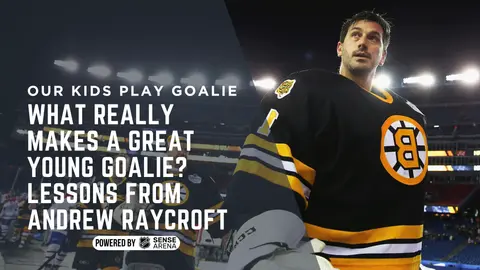
What Really Makes a Great Young Goalie? Lessons from Andrew Raycroft
Ask ten hockey parents what makes a great goalie and you may hear ten different answers.
Size.
Reflexes.
Technique.
Glove hand.
Positioning.
Mental toughness.
Former NHL goaltender and Calder Trophy winner Andrew Raycroft has seen the position from almost every angle imaginable.
He played more than a decade in the NHL.
He has coached and worked with developing goaltenders.
He watches young goalies constantly.
And one of the first things he says young players need is not complicated:
Keep showing up.
Perseverance, skating, belief, resilience, and a genuine love for the position matter enormously.
That message sits at the heart of this episode of Our Kids Play Goalie.
Perseverance Comes Before Perfection
Andrew looks back on his own journey and says many of the lessons are clearer now than they were when he was living them.
As a kid, he was not consciously thinking about development models or mental skills.
He was playing.
Trying to win.
Getting upset when he lost.
Coming back the next day.
That last part matters.
For goalies especially, opportunities can be limited.
There is only one net.
Only one goalie can play at a time.
That makes persistence especially important.
The goalie who keeps showing up, keeps working, and keeps finding ways to improve gives herself a chance to develop.
That may sound simple.
It is not always easy.
The First Thing Andrew Notices: Skating
One of the most interesting observations from the episode is how quickly Andrew notices a young goalie’s skating.
Not glove position.
Not save percentage.
Skating.
He loves seeing young goalies who are athletic, active, and comfortable moving around the crease.
That is a useful reminder because youth hockey sometimes puts too much emphasis on how much space a goalie fills.
A larger young goalie may naturally cover more net.
That can produce immediate results.
But immediate results and long-term development are not always the same thing.
Bigger Is Not Automatically Better
Andrew openly worries that youth hockey can sometimes shrink the goalie pool by choosing the biggest player rather than developing the most athletic or interested player.
That is especially concerning at younger ages.
An eight-, nine-, or ten-year-old is not a finished physical product.
A smaller child may grow.
A bigger child may not remain bigger relative to everyone else.
And body size alone tells coaches very little about how a player will eventually process the position.
Coaches should be looking for:
-
Athleticism
-
Skating
-
Competitiveness
-
Effort
-
Movement
-
Curiosity
-
Love for the position
Young goalies deserve an opportunity to develop before adults decide what they are capable of becoming.
Winning Cannot Be the Only Goal
Andrew questions why winning sometimes becomes more important than development so early.
At older and more competitive levels, results naturally matter more.
But at 8U, 10U, or 12U?
The mission should still include:
-
Growing the game
-
Giving kids opportunities
-
Building skills
-
Having fun
-
Learning the position
If one goalie plays every game because that gives the team the best chance to win, what happens to the other goalie?
She gets fewer repetitions.
Less confidence.
Less opportunity.
And potentially leaves the position entirely.
A short-term win can create a long-term loss.
Some Kids Are Simply Wired for the Position
Goalie is mentally different.
Everyone notices when the puck goes in.
There is no hiding.
A winger can make a mistake and watch several other things happen before the mistake becomes a goal.
A goalie’s mistake may immediately change the scoreboard.
Some young players handle that more naturally than others.
Andrew describes the child who loses 10-0 and gets in the car saying:
“Did you see that save I made?”
That tells you something.
The player has found a way to separate the experience of playing goalie from the outcome of the game.
That quality matters.
Goalies Might Need to Be a Little Delusional
One of the most memorable ideas in the conversation is that goalies may need to be a little delusional.
Not disconnected from reality.
Not unwilling to learn.
But capable of believing:
“I can do this.”
even when the evidence is temporarily painful.
A goalie gets scored on.
She has to believe she can stop the next one.
She has a bad game.
She has to believe she can play well next weekend.
She gets overlooked.
She has to believe another opportunity is coming.
That belief is a survival skill at the position.
Small Nets, Big Nets, and Age-Appropriate Success
The group also discusses net size at young ages.
A full-size net can make a six-year-old goalie look like a soccer goalkeeper trying to cover an enormous space.
That can produce a lot of goals.
Smaller nets can make the position more realistic.
But Andrew adds an interesting counterpoint:
Scoring needs to remain fun too.
If nobody can score because the net is too small and the goalie equipment fills everything, the experience may become less enjoyable for everyone.
The bigger principle is this:
Design the environment around development, not around pretending young kids are already NHL players.
Youth sports should look like youth sports.
That is okay.
When a Goalie Is Struggling, Do Not Panic
Every goalie has bad stretches.
Sometimes it is one game.
Sometimes it is several weeks.
Sometimes an entire season feels difficult.
Parents naturally want to help.
But the first thing Andrew recommends is not turning the car ride home into a postgame breakdown.
Your goalie already knows what happened.
She probably remembers every goal.
There is little benefit in immediately replaying all of them.
Give it space.
Then come back to development when emotions have settled.
Eventually, Goalies Have to Own Their Mistakes
Support does not mean removing responsibility.
As players get older, Andrew believes it becomes increasingly important for them to recognize when they simply were not good enough.
Sometimes the defense made a mistake.
Sometimes there was a breakaway.
Sometimes there was nothing the goalie could realistically do.
And sometimes the goalie should have made the save.
That is okay.
Owning that does not have to destroy confidence.
It can build it.
A player who can say:
“I need to be better there.”
has something to work on.
A player who always says:
“That was someone else’s fault.”
eventually stops growing.
Hockey Builds Scar Tissue
Andrew talks about sports as an opportunity to build resilience.
Failure creates what he describes as scar tissue.
You experience something difficult.
You survive it.
You learn from it.
The next time adversity arrives, you are a little more prepared.
That is one of the biggest benefits of the goalie position.
Goalies repeatedly practice the ability to recover.
The puck goes in.
Ten seconds later, they need to be ready again.
That lesson will matter long after hockey ends.
Change the Definition of Winning
Lee shares a useful question he asks goalies:
“Did you keep your team in a position to compete?”
That is far more productive than simply asking:
“Did you win?”
A goalie may play extremely well in a loss.
Another goalie may win while barely being challenged.
The scoreboard does not always explain performance.
Youth goalies need ways to evaluate themselves that reflect what they actually controlled.
Ask:
Did I compete?
Did I make the saves I should make?
Did I give my team a chance?
What can I improve?
Those questions encourage honest development.
Elite Goalies Believe They Belong
Andrew’s own career is a perfect example.
He was not always the obvious future NHL goaltender.
He was not huge.
He was not necessarily at the top of every ranking.
He barely got drafted into junior hockey.
But once hockey became serious for him, he believed he was on a path forward.
The path did not have to look like someone else’s.
He just believed there was a path.
That matters.
He did not spend every night calculating the impossible odds.
He focused on getting better and reaching the next level.
Then he reached the NHL.
And instead of looking backward at everyone he had passed, he looked forward toward the best goalies in the world.
Your Path Does Not Need to Look Like Anyone Else’s
This lesson matters even more today because young goalies can see everyone else’s development.
Social media makes every path visible.
Or at least it appears that way.
A goalie sees:
-
Someone’s huge glove save
-
A tournament shutout
-
A commitment announcement
-
A highlight reel
-
A new training session
-
A championship
And the natural thought becomes:
“Am I behind?”
Maybe not.
Maybe you are simply looking at somebody else’s highlight.
Social Media Is Not Reality
Andrew is especially direct about social media.
It is mostly the good stuff.
Nobody posts every goal they allowed.
Nobody posts every bad practice.
Nobody posts every moment when they doubted themselves.
Kids end up comparing their complete reality to someone else’s best 15 seconds.
That is an impossible comparison to win.
Goalies may be particularly vulnerable because failure is such a normal part of the position.
If every goalie online appears perfect, a young goalie may begin believing:
“Everyone is better than me.”
That simply is not true.
Parents Need to Be the Gatekeepers
Andrew places significant responsibility on parents.
Parents cannot eliminate social media.
They can help frame it.
If your child shows you an incredible save from another goalie, you can respond with:
“You've made saves like that.”
“You can do that.”
“Remember that game when you made one just like it?”
That turns comparison into confidence.
The goal is not to tell your child that every other goalie is bad.
The goal is to remind them that one highlight does not define an entire player.
Do Not Turn Other Kids Into the Standard
Parents sometimes unintentionally hurt confidence by constantly showing their child somebody else.
“Look how good this goalie is.”
“Look where she committed.”
“Look at this training session.”
“You need to do that.”
That message may be intended as motivation.
But the child may hear:
“You are not good enough.”
That is a dangerous cycle.
Development requires challenge.
It also requires enough belief to keep going.
Hockey IQ Becomes the Separator
As players get older, athletic differences begin to narrow.
Everybody at the top can skate.
Everybody is technically strong.
Everybody has experience.
Then hockey IQ becomes increasingly important.
How quickly does the goalie process the play?
Can she predict where the puck will go?
Does she understand tendencies?
Can she read the entire game rather than reacting late?
Andrew says this becomes a major separator at the highest levels.
Want Better Hockey IQ? Watch Hockey
One simple way to improve hockey IQ is to actually watch games.
Not highlights.
Full games.
Watch what happens before the scoring chance.
Watch how the goalie moves.
Watch where the puck goes.
Watch how the players rotate.
Watch the setup.
Goalies and parents can do this together.
Ask:
“Where do you think the puck is going next?”
“What did the goalie see?”
“Why did they move there?”
“What happened before the save?”
Over time, those patterns begin to live in the player’s mind.
Stop Living in Next Season
One of the themes near the end of the conversation is how difficult it has become for parents to stay present.
It is September.
People are already discussing next season.
Tryouts.
Teams.
Summer training.
Where everyone is going next.
That pressure is constant.
But the player in front of you is playing hockey today.
Enjoy that.
Andrew encourages parents to trust themselves and pay attention to something much simpler:
Is your child happy going into the rink?
Are they happy coming out?
Those questions tell you a lot.
You Cannot Force Development
This may be the most important lesson of the entire episode.
You cannot force it.
You cannot guarantee that extra ice creates an NHL goalie.
You cannot guarantee that every camp creates improvement.
You cannot manufacture a professional athlete through scheduling.
One goalie may train more in August and look better in September.
Another may rest and become better by March.
Development is messy.
There is no perfectly correct route.
The Greatest Return Is Bigger Than Hockey
Goalies learn extraordinary life skills.
They fail publicly.
They recover quickly.
They take responsibility.
They learn to focus on the next moment.
They experience pressure.
They learn how to believe in themselves.
They find out that one mistake does not have to become the next mistake.
Those lessons matter whether a child reaches the NHL or eventually becomes a beer-league goalie.
The hockey outcome is not the only return.
The person being developed matters more.
The Message for Goalie Families
Give young goalies a chance.
Do not decide their future based on size.
Let them skate.
Let them compete.
Let them fail.
Help them recover.
Protect them from constant comparison.
Teach them to own mistakes without becoming defined by those mistakes.
Watch hockey together.
Celebrate effort.
Celebrate growth.
And keep the focus on the child rather than the outcome.
As Andrew Raycroft reminds us, the path is different for everybody.
Your goalie does not have to look like the goalie on Instagram.
They do not have to develop on someone else’s timeline.
They need to keep showing up, keep learning, and keep believing.
And parents?
Enjoy watching them play.
That time in the rink is more valuable than any ranking, roster, or highlight reel.
Keep listening to Our Kids Play Goalie for more conversations designed to help young goalies—and the families supporting them—develop with confidence, perspective, and a genuine love for the position.
How to Be More Coachable—and Learn More From Every Hockey Shift