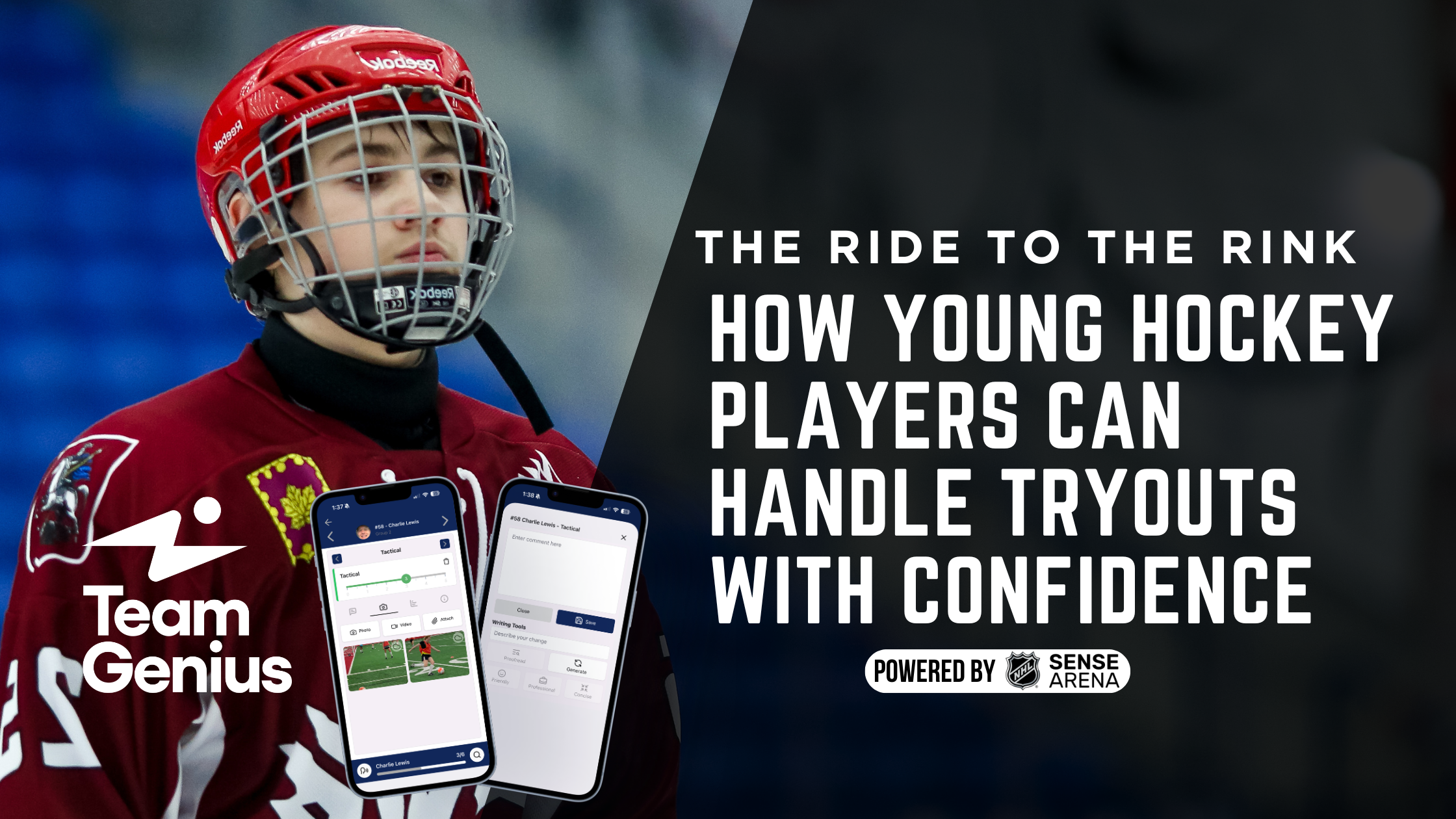
How Young Hockey Players Can Handle Tryouts With Confidence
Tryouts can make even the most confident hockey player feel nervous.
You may start thinking about who is watching, how many spots are available, what happens if you make a mistake, or whether one difficult drill could cost you a place on the team. Before long, you are focusing more on the evaluation than on playing hockey.
In this episode of The Ride to the Rink, Lee and Christie speak with Gabe Malinsky of Team Genius, an evaluation expert who helps hockey organizations create better tryout experiences.
His message to young players is reassuring: you have already done the work. When the tryout begins, your job is not to suddenly become a different player. Your job is to breathe, trust your preparation, and play.
Your Preparation Happened Before the Tryout
The most important work usually takes place long before an evaluator begins taking notes.
Every practice, game, lesson, workout, and backyard shooting session has helped prepare you for the moment. By the time you arrive at the rink, you cannot rebuild your entire game in the dressing room.
You can, however, give yourself the best possible chance to perform well by taking care of the basics:
- Get a good night of sleep.
- Eat food that gives you energy.
- Drink enough water.
- Check your equipment before leaving home.
- Arrive with enough time to get comfortable.
- Take a few deep breaths before stepping onto the ice.
These actions may sound simple, but they help you arrive ready to play rather than rushed, tired, or distracted.
Once the tryout starts, trust what you have already learned. The people watching from the stands do not change the game. The ice is still the same size. The puck still moves the same way. The skills you use in practice are the same skills you will use during the evaluation.
Treat Each Drill as a New Opportunity
Almost every player will make a mistake during a tryout.
You might lose an edge, miss a pass, mishandle the puck, misunderstand a drill, or shoot wide. The mistake itself is rarely as important as what happens next.
Gabe encourages players to “reset every time.” Each new drill gives you another opportunity to show your effort, skill, focus, and attitude.
A reset routine can help you move forward instead of replaying the mistake in your head. Your routine does not have to be complicated. You might:
- Brush the snow from your stick.
- Clear the snow from your skates.
- Roll your shoulders.
- Take one slow breath.
- Repeat a positive phrase to yourself.
- Look toward the coach and prepare for the next instruction.
The best time to develop this routine is during normal practices. When resetting becomes a habit, it will feel more natural during a tryout, game, or other high-pressure moment.
Evaluators Know Mistakes Happen
Young players sometimes imagine evaluators as people waiting for them to do something wrong.
That is usually not a helpful way to think about the process.
As Gabe explains, evaluators are people, too. Many of them have played hockey, attended tryouts, made mistakes, and experienced disappointment. They understand that one fall or one bad repetition does not tell the complete story of a player.
A coach may even notice that something unusual is affecting your performance. Perhaps your skates do not feel right, or you are struggling with an equipment issue.
In that moment, the evaluator may become interested in more than your skating. They may watch how you respond.
Do you become angry and blame your equipment? Do you stop competing? Or do you stay composed and give the best effort you can under difficult circumstances?
Your reaction can reveal resilience, maturity, and determination.
Coaches Are Evaluating Teammates, Too
Tryouts are competitive. Every player wants to perform well and earn a position.
But competing does not mean ignoring or discouraging everyone around you.
Coaches are not simply choosing the fastest skaters or the players with the hardest shots. They are building a team. That means they may also notice communication, encouragement, effort, body language, and how players interact with one another.
A quick glove tap after a drill can matter. So can encouraging another player to work harder on the next repetition. These actions show that you can compete while still helping create a positive environment.
You do not need to cheer after every pass or become someone you are not. Simply look for small opportunities to demonstrate that you care about the group as well as your own performance.
Ask yourself:
- Am I listening when the coach speaks?
- Am I ready when my turn begins?
- Do I compete until the drill is finished?
- How do I react when another player succeeds?
- How do I respond when I struggle?
- Would a coach want me in the dressing room all season?
Your hockey skills matter, but the kind of teammate you are matters, too.
Ask Questions That Help You Improve
Good communication can make the tryout process more useful, regardless of the final result.
Before or during an evaluation, you can ask a coach what is expected from the players. After the evaluation, you can ask where you need to improve.
The question does not need to be complicated. A simple “What can I work on?” can give you something valuable to carry into your next practice or season.
You might also ask:
- What did you want to see during the drills?
- Which part of my game should I focus on?
- What does this team need from its players?
- How can I become a better teammate?
- What should I practice before my next evaluation?
The purpose of asking is not to argue with the coach or convince them to change a decision. It is to learn.
Whether you make the team or not, useful feedback can help you take your next step.
A Team Selection Does Not Define Your Future
Making a team can feel exciting. Not making one can feel deeply disappointing.
But neither result tells the full story of who you are as a hockey player.
A roster decision reflects what a particular group of evaluators decided at a particular moment for a particular team. It does not determine how much you can improve or what opportunities may become available later.
You may need time to feel disappointed. That is normal. Afterward, return to the questions that help you grow:
- What did I learn?
- What can I improve?
- What did I handle well?
- What will I do differently next time?
- How can I continue enjoying the game?
Adversity is part of every hockey journey. Learning to face it, respond constructively, and keep moving can help you far beyond the rink.
Let Your Love of Hockey Show
Tryouts can become so serious that players forget why they started playing.
You are allowed to enjoy the experience.
Skate hard. Chase the puck. Compete. Communicate. Celebrate a good play. Encourage another player. Let the evaluators see your energy and your love of the game.
You will not control every drill, every evaluator, or every roster decision. You can control your preparation, attitude, effort, response, and willingness to keep learning.
Before your next tryout, take a deep breath and remember:
You have prepared for this moment. One mistake will not define you. One team will not determine your future. Every drill gives you another chance to reset, compete, and show who you are.
No matter where you are in your hockey journey, keep working, keep learning, and keep believing in yourself.
Listen to the full episode of The Ride to the Rink with Gabe Malinsky of Team Genius, then share it with a young player who could use a little extra confidence before their next evaluation.

What Really Makes a Great Young Goalie? Lessons from Andrew Raycroft