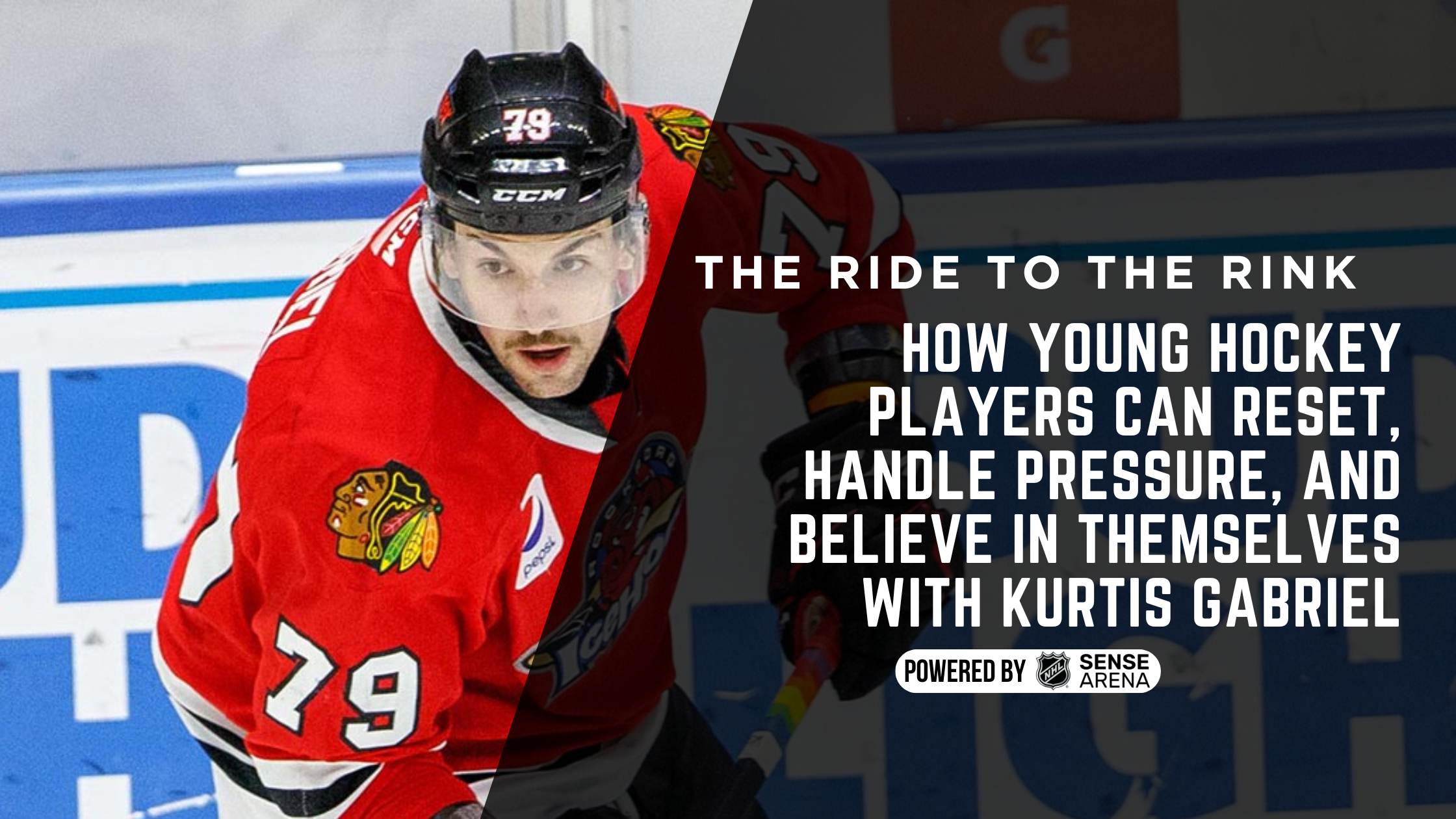
How Young Hockey Players Can Reset, Handle Pressure, and Believe in Themselves with Kurtis Gabriel
A turnover happens.
You miss an assignment. You have a rough shift. A coach corrects you. You make a mistake during a drill you normally execute without thinking.
And suddenly, instead of focusing on the next play, your mind is still stuck on the last one.
For young hockey players, learning how to move through those moments can be every bit as important as learning to skate, shoot, pass, or defend.
On The Ride to the Rink, Lee Elias and Mike Bonelli sat down with former NHL player Kurtis Gabriel to give young athletes practical tools for handling the emotions that come with competition.
The biggest lesson?
You may not be able to control everything that happens in hockey, but you can train how you respond to it.
And that training can begin with something as simple as one breath.
Your Next Shift Matters More Than Your Last One
Every hockey player makes mistakes.
The difference is often what happens mentally after the mistake.
A player makes a turnover and immediately thinks:
I can't believe I did that.
Then:
Coach is probably mad at me.
Then:
What if I do it again?
Before long, the player isn't reacting to what is actually happening on the ice anymore. They're reacting to a conversation taking place inside their own head.
Kurtis offered players a practical way to interrupt that cycle: a breathing technique called the psychological sigh.
He describes taking a strong inhale through the nose, adding a second shorter inhale, and then breathing out slowly through pursed lips.
For Kurtis, the value is in creating a small amount of separation between the emotion you're experiencing and the next action you need to take.
He used the technique on the bench toward the end of his professional career when he was struggling.
That's an important point for young players.
Mental skills aren't only for people who are struggling emotionally. They are performance skills.
The goal isn't to make sure you never feel nervous, disappointed, excited, angry, or frustrated.
The goal is to recognize what you're feeling without allowing it to decide your next move for you.
Learn to Map Your Emotions
Kurtis gives young players a great analogy for developing emotional awareness.
Think about exploring a map in a video game.
At first, much of the map is hidden. You don't know what's there because you haven't explored it yet.
As you move through the game, more areas become visible.
Kurtis encourages athletes to approach their emotions the same way.
Ask yourself:
- What does being nervous actually feel like?
- Where do I feel fear in my body?
- Does my chest tighten?
- Does my jaw tense?
- What happens when I'm really excited?
- How does my body feel immediately after scoring?
- What happens when I'm afraid of making a turnover?
- What happens when I think a coach is disappointed in me?
Instead of labeling emotions as simply “good” or “bad,” you begin learning what they feel like.
That's incredibly valuable because awareness gives you options.
If you've learned, When I'm nervous, my chest gets tight and my breathing changes, you may recognize that pattern earlier the next time it happens.
Then you can respond.
You can breathe.
You can reset.
You can remind yourself where you are.
And you can get ready for the next play.
Pressure Can Feel Very Real in Your Body
Lee shared a story during the conversation that demonstrates just how physical pressure can become.
During a high-level game, the pressure became so intense that while sitting on the bench, Lee felt as though his legs weighed 1,000 pounds.
He even told a teammate that he couldn't move them.
Of course, nothing physical was holding his legs down.
The pressure he was experiencing mentally was creating a very real physical sensation.
Once Lee became more aware of what was happening, however, his relationship with pressure began to change.
Instead of thinking of pressure only as something negative, he eventually learned to reframe it.
I'm feeling pressure because I care.
I'm feeling pressure because this moment matters.
How great is it that I'm in a position where this matters to me?
Nothing about the game had changed.
His interpretation of the moment had.
That distinction can be incredibly powerful for a young athlete.
You Don't Need to Eliminate Pressure
Players often think confidence means never feeling nervous.
It doesn't.
They may think elite athletes never feel fear.
They do.
They may believe mentally tough players don't get frustrated.
Of course they do.
The goal isn't necessarily to eliminate those feelings.
It's to become better at recognizing them, understanding them, and continuing to perform while they're present.
Imagine heading onto the ice for an important shift and feeling butterflies.
One interpretation is:
I'm nervous. Something is wrong.
Another is:
I'm nervous because I care about this. I'm ready.
Same butterflies.
Different story.
That story can influence what happens next.
Staying Even-Keeled Is a Hockey Superpower
Kurtis also reminds players that the farther they progress in hockey, the more complicated the sport can become.
Competition increases.
Decisions become tougher.
There are lineup changes, evaluations, roster decisions, coaches' opinions, teammates battling for opportunities, great games, bad games, injuries, successes, setbacks, and plenty of things players cannot control.
Being able to remain steady through those experiences matters.
Kurtis describes staying even-keeled through the ups and downs as a superpower.
That doesn't mean becoming emotionless.
It means avoiding a situation where every good moment sends you flying to one extreme and every mistake sends you crashing to the other.
You scored?
Enjoy it. Then get ready for the next shift.
You made a mistake?
Learn from it. Then get ready for the next shift.
You had a great practice?
Fantastic. Come ready to work tomorrow.
You had a terrible practice?
Okay. Come ready to work tomorrow.
Consistency is not only physical.
It is emotional, too.
Break Out of the “Cringe Prison”
One of the most memorable phrases Kurtis uses in the episode is the “cringe prison.”
Young players often know something could help them but resist doing it because they're worried about what someone else might think.
Maybe breathing exercises feel weird.
Maybe visualization seems strange.
Maybe asking questions feels embarrassing.
Maybe giving maximum effort during a seemingly insignificant drill feels “too serious.”
Maybe teammates would rather joke around.
Kurtis's challenge is simple: don't allow someone else's opinion to determine how seriously you take your own development.
He remembers practices where the coach would tell players to skate two laps between drills.
Kurtis didn't treat those laps like filler.
He attacked them.
His attitude was essentially: if we're skating two laps, I'm going to compete.
Why?
Because intention matters.
That doesn't mean disrespecting teammates or announcing that you're more committed than everyone else.
It means understanding that someone else's journey doesn't have to dictate yours.
Your teammates can make their choices.
You can make yours.
Confidence Starts With Belief
There is another important distinction for young players and families.
Believing in yourself does not require believing you are better than everyone else.
Healthy confidence isn't:
I'm better than my teammates.
It's:
I believe I can grow.
I believe I can handle difficult moments.
I believe I can learn from mistakes.
I believe this uncomfortable feeling doesn't have to control me.
I believe one bad shift does not define me.
Hockey constantly gives players opportunities to practice this type of belief.
Sometimes that opportunity arrives after a goal.
Sometimes it arrives after getting scored on.
Sometimes it appears after making the team.
And sometimes it appears after getting cut.
The situation changes.
The underlying challenge doesn't:
Who are you going to choose to be in the next moment?
A Simple Routine Young Players Can Practice
Mental performance doesn't need to become complicated.
Players can start with a simple routine.
When something difficult happens:
- Notice it.
What am I feeling right now? - Find it.
Where do I feel that emotion in my body? - Breathe.
Create enough separation to interrupt the immediate reaction. - Name it.
I'm nervous. I'm frustrated. I'm excited. I'm feeling pressure. - Reframe it.
What else could this feeling mean? - Return to the present.
What does my team need from me on the next shift?
That final step matters.
Not next week.
Not the third period.
Not whether you're going to make the team next season.
The next shift.
That's something a player can act on.
Parents Can Practice This Too
Although this episode speaks directly to young players, the lesson isn't limited to kids.
Parents experience plenty of hockey emotions themselves.
There are stressful games, close scores, questionable calls, team decisions, ice-time concerns, difficult conversations, and long drives home.
The same awareness players are developing can help parents, too.
In fact, families can practice some of these skills together away from the rink.
Ask each other what nervousness feels like.
Talk about how your body reacts when you're frustrated.
Discuss what pressure feels like before an important event.
The goal doesn't have to be fixing every emotion.
Sometimes simply developing the vocabulary to recognize what's happening is a major step forward.
And when young players see the adults around them practicing emotional awareness rather than just preaching it, the lesson becomes even more powerful.
You Are More Than One Hockey Moment
Kurtis gives young players another message worth remembering:
No matter what happens, you're okay.
Hockey can feel enormous when you're in the middle of it.
A mistake can feel enormous.
A tryout can feel enormous.
A coach's decision can feel enormous.
And while those moments can matter deeply, they don't define the entirety of who you are or who you can become.
You are developing as a player and as a person.
Learning how to handle disappointment matters.
Learning how to manage excitement matters.
Learning how to work through fear matters.
Learning how to perform under pressure matters.
And learning how to continue believing in yourself when someone else doesn't understand your journey may matter most of all.
Take This With You on Your Next Ride to the Rink
Before your next practice or game, try asking yourself one question:
When things don't go my way today, how do I want to respond?
You don't need to predict every mistake.
You don't need to guarantee a perfect game.
You don't need to eliminate nerves.
Just remember that when an emotion arrives, you can notice it.
When pressure appears, you can reframe it.
When a mistake happens, you can breathe.
And when your next shift begins, you can play the shift you're in instead of the one that's already over.
That is a skill.
And just like everything else in hockey, it gets stronger when you practice it.
Wherever you are on your hockey journey, keep learning, keep competing, and keep believing in the player—and person—you're becoming.
Listen to this episode of The Ride to the Rink with Kurtis Gabriel, share it with a young player who could use the reminder, and keep the conversation going on your next trip to the rink.
Skate hard, have fun, and keep growing—one shift at a time.
#TheRideToTheRink #KurtisGabriel #YouthHockey #HockeyMindset #HockeyConfidence #MentalToughness #HockeyDevelopment #YouthSports #OurKidsPlayHockey

Prepare, Believe, Reset: Steve Briere’s Lessons for Young Hockey Players