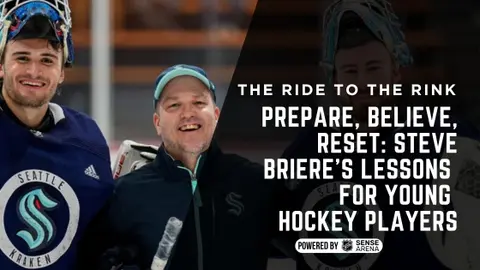
Prepare, Believe, Reset: Steve Briere’s Lessons for Young Hockey Players
Every young hockey player wants to know what they can do to become better.
Skate faster. Shoot harder. Make more saves. Get stronger. Practice more.
Those things matter.
But former NHL goalie coach and current NCAA Division I goalie coach Steve Briere believes some of the biggest differences between developing players and high-level athletes come from what happens between the ears.
Preparation. Confidence. Emotional control. Repetition. Gratitude.
In this episode of The Ride to The Rink, Steve joins Lee Elias and Mike Bonelli for a conversation filled with lessons that apply far beyond the crease. Whether you are a goalie, forward, defenseman, or simply a young athlete trying to improve, these are habits you can begin building today.
1. Great Practices Start Before You Step on the Ice
Steve’s first lesson is simple:
Have a plan.
Young players often arrive at practice and wait for the coach to tell them what to work on. Steve encourages players to take more ownership of their development.
Before practice, ask yourself:
-
What am I trying to improve today?
-
What part of my game needs attention?
-
How can I challenge myself?
-
What can I do away from the rink that helps me on the ice?
For a goalie, that might mean working on reflexes, hand-eye coordination, flexibility, or footwork.
For a skater, it might mean focusing on puck protection, shooting, passing, edge work, or decision-making.
The specific drill matters less than developing the habit of intentionally thinking about your own game.
When you know what you are trying to improve, practice becomes more than simply completing drills. It becomes an opportunity to develop something specific.
2. Improvement Doesn’t Require Complicated Training
One of the best parts of Steve’s advice is how accessible it is.
You do not always need expensive equipment or professional training facilities to improve.
Want better hand-eye coordination? Juggle tennis balls.
Want to improve footwork? Work with a soccer ball.
Need more flexibility? Stretch while watching hockey.
Want to improve your hockey IQ? Watch players at your position and study what they do.
The internet has given today’s young players access to an incredible amount of hockey footage. You can watch NHL players, college players, professional goalies, skill breakdowns, game clips, and instructional videos whenever you want.
But watching alone is not enough.
Watch with a purpose.
Study how a goalie tracks the puck. Watch how a defenseman handles pressure. Pay attention to how a forward creates space before receiving a pass.
Then bring one of those ideas into your next practice.
3. Make Practice Competitive—and Fun
Development should not feel like punishment.
Steve encourages young players to create small competitions for themselves during practice.
A goalie might decide:
I’m not letting this player score on me today.
A shooter might decide:
I’m hitting the net on every shot in this drill.
A defenseman might challenge themselves to make a clean first pass every time they retrieve a puck.
Those little competitions create focus.
They also make practice more fun.
Better yet, competing harder helps your teammates improve. When a goalie makes scoring difficult, shooters have to become better. When forwards attack harder, defensemen have to defend better.
Everyone grows together.
4. Elite Athletes Build Confidence Through Repetition
Steve has coached and worked around athletes at hockey’s highest levels.
One trait stands out.
They believe in their abilities.
Not casually.
Deeply.
That type of confidence can sometimes be mistaken for arrogance, but Steve draws an important distinction. Confidence is a strong belief in what you can do. Arrogance begins when that belief comes at the expense of the people around you.
Young players should understand something else about confidence:
It is built.
Confidence does not magically appear when you make a select team, score an important goal, or receive praise from a coach.
You build it through repetition.
You take the shot again and again.
You practice the save again and again.
You work on the pass again and again.
Eventually, your brain starts saying:
I know I can do this because I have done it before.
That is where belief comes from.
The work creates the evidence.
The evidence creates confidence.
5. Hockey Will Challenge That Confidence
The higher players climb, the more competition they encounter.
Someone else wants your ice time.
Another player wants your roster spot.
You may hear criticism.
You may get compared to someone else.
You may have a bad game at exactly the wrong moment.
That is why developing confidence early matters so much.
Players cannot control every opinion around them.
They can control how much preparation they put into their game.
They can control their response to adversity.
And they can build a foundation of belief strong enough to survive the inevitable ups and downs of competitive hockey.
6. Learn to Separate One Mistake From the Next Play
Perhaps Steve’s most powerful advice came when he was asked what he would tell his younger self.
His answer centered on emotion.
Hockey matters deeply to players. That passion is part of what makes the sport special.
But strong emotions can also interfere with performance.
A goalie allows a goal and starts replaying it mentally.
How did I let that happen?
Then another shot comes.
Instead of reacting freely, the goalie is still thinking about the previous goal.
A shooter misses an open net.
The next time the puck comes to them, they hesitate.
Instead of shooting naturally, they double-clutch because the previous miss is still in their mind.
One mistake becomes two—not because the player's skill disappeared, but because their attention never returned to the present moment.
That is a skill every young athlete needs to practice:
Reset.
The previous play is finished.
The next one deserves your full attention.
7. Emotional Control Doesn’t Mean You Stop Caring
Separating emotion from performance does not mean becoming emotionless.
Young players should care.
They should celebrate great plays.
They should feel disappointed when things do not go well.
The goal is learning not to let one emotional moment dictate the next decision.
That takes practice too.
After a mistake, create a reset routine.
Take a breath.
Tap your stick.
Say a short phrase to yourself.
Refocus on the puck.
Whatever works for you, make it simple enough that you can repeat it every time.
Eventually, resetting can become as automatic as any physical hockey skill.
8. Don't Forget How Lucky You Are to Play
One of the closing lessons of the conversation was gratitude.
Youth hockey can become intense.
There are tryouts, evaluations, rankings, tournaments, travel, statistics, roster decisions, and expectations.
Sometimes players become so focused on what comes next that they forget what is happening right now.
You are playing hockey.
You are stepping onto the ice.
You are spending time with teammates.
You are playing a game you love.
Before practice or a game, take a moment to recognize that.
Gratitude does not lower competitive standards.
It gives those standards perspective.
You can want to become a great player while still appreciating how special it is to play today.
Preparation + Repetition + Belief
There is no shortcut to becoming a better hockey player.
But improvement also does not have to be complicated.
Steve Briere’s advice gives young players a simple framework:
Prepare with intention.
Know what you want to improve.
Practice with purpose.
Create challenges and make development fun.
Repeat the skills you want to trust.
Confidence comes from evidence.
Reset after mistakes.
The next play matters more than the last one.
Stay grateful.
Never become so focused on where hockey might take you that you forget to enjoy where you are today.
Those habits can help a goalie make the next save, a shooter take the next shot, or any young athlete continue growing through the inevitable highs and lows of sports.
Most importantly, they can help young players build something that lasts far beyond a single game or season: genuine belief in themselves.
🎧 Hear the full conversation with Steve Briere on The Ride to The Rink, and encourage your young player to choose one lesson from the episode to bring into their next practice.
Keep learning, keep competing, and keep enjoying every chance you get to step onto the ice.
What NHL Goalie Coaches See That Youth Hockey Often Misses