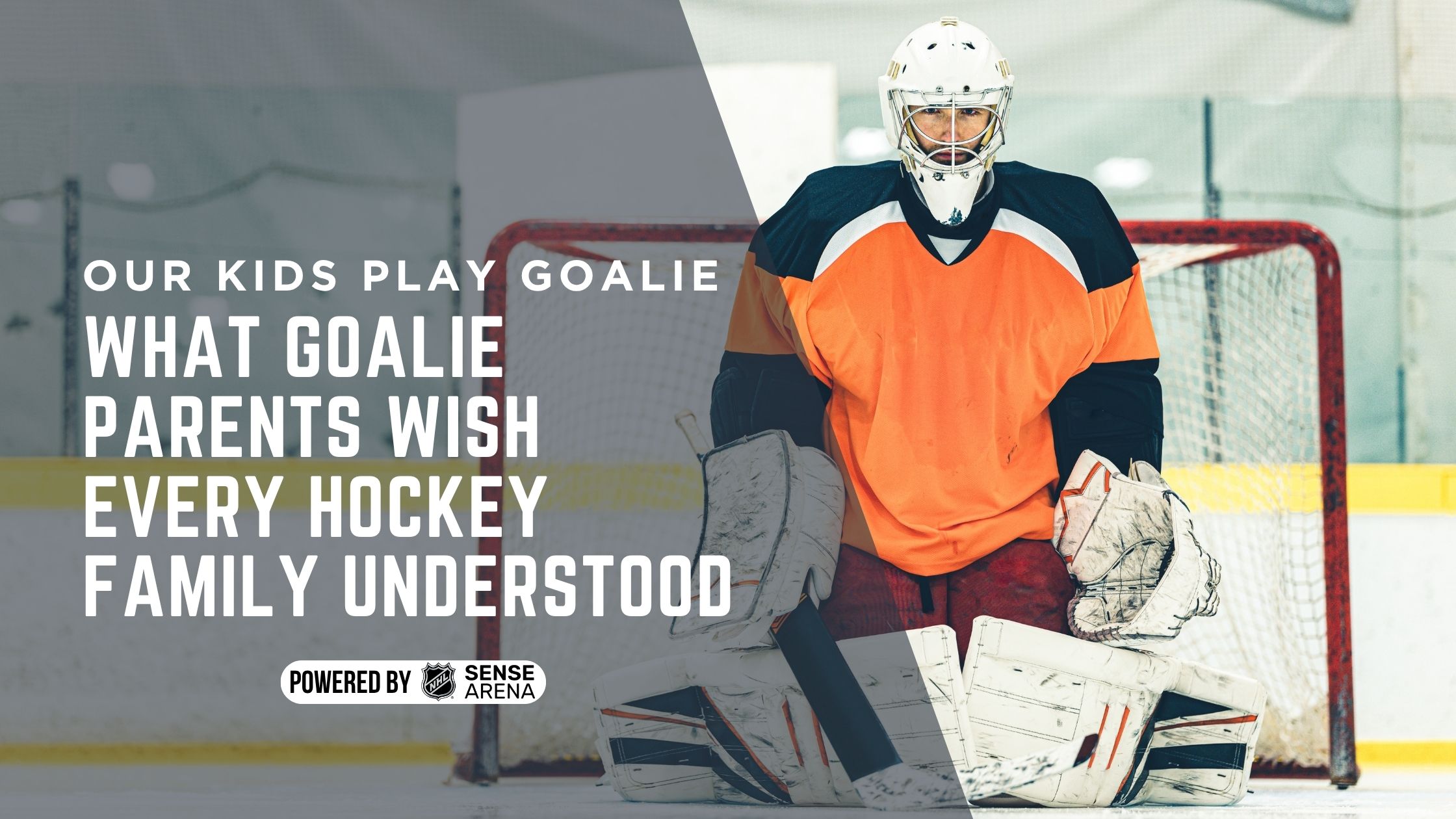
What Goalie Parents Wish Every Hockey Family Understood
Ask a hockey parent what it’s like to watch their child play, and you’ll get a hundred different answers.
Ask a goalie parent, and there’s a good chance the answer includes elevated blood pressure.
On an episode of Our Kids Play Goalie, we posed a simple question to our community:
What is the one thing you wish skater parents understood?
We expected a few responses.
We received more than 210.
That response alone tells us something important. There is a side of youth hockey that goalie families experience differently—and much of it isn’t obvious unless your child has actually stood between the pipes.
The goal of this conversation isn’t to argue that goalies deserve special treatment. Goalies need coaching, accountability, development, and honest feedback just like every other player.
But they also play a completely unique position.
Understanding that position a little better can make us better parents, coaches, teammates, and hockey communities.
Here are some of the biggest lessons that emerged.
A Goal Against Is a Team Event
One of the most common themes from goalie parents was simple:
It takes six players to allow a goal.
That doesn't mean the goalie can never make a mistake. Of course they can.
Sometimes a goalie wants a shot back. Sometimes positioning is wrong. Sometimes a puck gets through that should have been stopped.
But goals rarely exist in isolation.
Before the puck ever reaches the net, there may have been:
-
A missed assignment in the offensive zone
-
A turnover through the neutral zone
-
A missed backcheck
-
A lost battle
-
A defensive breakdown
-
An uncovered player
-
A screen
-
A failed rebound clearance
And then comes the shot everyone remembers.
That final moment is easy to isolate because it changes the scoreboard.
The five events that preceded it usually don't.
That’s an important perspective for hockey families. Instead of immediately asking, “How did the goalie let that in?”, we can teach players to think about how the entire sequence unfolded.
The same philosophy applies to success.
When a team records a shutout, that isn't just a goalie accomplishment. Strong defense, blocked shots, good backchecking, smart puck management, and rebound support can all contribute.
Hockey remains a team sport all the way to the crease.
Warm Up Your Goalie—Don't Try to Score on Them
Few topics generated as much agreement as pregame warmups.
The warmup is not the moment for every skater to demonstrate their best breakaway move.
It is not time to triple-deke a goalie who has barely moved yet.
It is definitely not time to rip unpredictable shots while multiple players are attacking the net simultaneously.
The warmup should help the goalie feel the puck and prepare to play.
That can mean controlled shots toward:
-
The glove
-
The blocker
-
The pads
-
The body
As the goalie becomes comfortable, the warmup can progress based on what that particular goalie needs.
And that's an important distinction: talk to your goalie.
Different goalies have different routines. Older and more experienced goalies may have very specific preferences. The objective isn't to create one universal warmup. It is to recognize that the warmup should actually help the person you're supposedly warming up.
There is also another benefit for shooters.
Aiming for a goalie's glove or pad still requires precision. You're still practicing putting a puck exactly where you intend to put it.
Good warmups can help everybody.
If the Goalie Isn't Looking at You, Don't Shoot
This should be one of the simplest pieces of hockey etiquette we teach young players.
If the goalie isn't facing you and ready for the shot, don't shoot the puck.
Goalie equipment is designed primarily to protect the front of the body.
The back does not provide the same protection.
A goalie fixing the net, retrieving something, adjusting equipment, or simply looking toward another shooter should never have to worry about a teammate firing a puck into them from behind.
The same concept applies when two skaters approach simultaneously.
If the goalie is squared up to the other player, don't decide that your shot deserves to happen anyway.
Safety requires awareness.
And awareness is something young hockey players can absolutely learn.
When Your Goalie Says “I Can't See,” Listen
Goalies have a perspective on the ice that no other player has.
They're watching plays develop from behind everyone else. They can often see pressure arriving, passing lanes opening, and threats developing that a defenseman may not recognize.
And sometimes, they can't see anything at all.
Traffic is part of hockey, and goalies ultimately need to learn how to find sightlines around screens.
But teammates also need to understand that accidentally screening their own goaltender can turn an otherwise manageable shot into a very difficult save.
Communication solves much of this.
If your goalie calls:
“Can't see!”
That information matters.
The goal should be for players to learn how to communicate with the goalie—and for goalies to learn how to communicate effectively with teammates.
This isn't about a goalie barking orders at everyone.
It's about five skaters and a goalie operating as one defensive unit.
The Mental Challenge of Goaltending Is Different
When a winger makes a poor pass, play can continue.
When a defenseman misses a read, the team may recover.
When a goalie makes a mistake?
A red light might turn on.
A horn may sound.
The scoreboard changes.
Then everybody lines up for a faceoff while the goalie remains exactly where they were.
That's one of the biggest mental differences between goalies and skaters.
A skater who has a rough shift can return to the bench, take a breath, talk to a coach, get some water, and wait before going back onto the ice.
The goalie doesn't get that luxury.
The next faceoff may happen seconds later.
That's why learning a reset process is such an important part of goalie development.
In the episode, Lee discusses using roughly a 10-second reset with his son:
-
Allow a few seconds to feel the emotion
-
Briefly understand what happened
-
Mentally prepare for the next play
-
Be ready when the puck drops again
Young goalies don't need to pretend they feel nothing.
They need tools for moving forward.
That ability to reset may eventually become one of the most valuable things hockey teaches them.
Goalie Parents May Be Experiencing the Game Differently Too
One response summed up goalie parenting beautifully:
“We are not anti-social parents. We are in cardiac arrest.”
It's funny because for many goalie families, it feels surprisingly accurate.
A parent watching their son or daughter play goal knows their child can be involved in virtually every scoring opportunity.
Even when the puck is 180 feet away, you're waiting.
Then suddenly there's a turnover.
A rush develops.
Everyone starts skating toward your child.
It can create a very different viewing experience.
Some goalie parents talk throughout the game.
Others sit alone.
Some pace.
Some barely breathe.
And that's okay.
We can also remember that our own anxiety can affect our children.
If a young goalie looks into the stands after giving up a goal and sees a parent visibly unraveling, that reaction can add another layer to an already emotional moment.
Goalie parents cannot control every feeling.
But we can work on controlling what our children see from us.
Your Goalie Already Knows the Puck Went In
Another recurring point from goalie families was that young goalies are often harder on themselves than anyone else could possibly be.
They don't need someone announcing that the goal was bad.
They know.
They were there.
What they need after a goal depends on the individual.
One goalie might appreciate a teammate skating over and tapping their pads.
Another may have a specific reset routine and want to be left alone.
That's why coaches and teammates should know their goalie.
Support does not always mean talking.
Sometimes support means allowing the goalie to go through the process they've developed and getting ready to play the next shift.
Rebounds Are a Shared Responsibility
“Make the first save.”
It's a phrase goalies hear constantly.
And it's good advice.
But what happens next belongs to everybody.
Young goalies should absolutely learn rebound control and compete for second and third saves.
At the same time, defenders cannot become spectators after the first shot.
When a rebound appears, the defensive unit needs to react.
Find the puck.
Find opposing players.
Clear dangerous areas.
Support the goalie.
High-level goalies can intentionally steer rebounds into safer areas, but that's an advanced skill. Expecting every developing goalie to perfectly control every rebound isn't realistic.
The first save may belong primarily to the goalie.
What happens around the crease afterward is a team responsibility.
Goalie Statistics Need Context
Save percentage and goals-against average are easy to read.
They're much harder to interpret.
Twenty routine shots and twenty breakaways are both recorded as 20 shots.
But they tell completely different stories.
A goalie playing behind a dominant team may face fewer high-quality scoring opportunities.
Another goalie could make tremendous save after tremendous save while playing behind a team that routinely gives up odd-man rushes, backdoor opportunities, screens, and rebounds.
The stat sheet doesn't explain all of that.
This becomes increasingly important as players get older and people begin evaluating performance more seriously.
Numbers can provide information.
They should not replace watching how a goalie actually plays.
Look at positioning.
Look at movement.
Look at competitiveness.
Look at decision-making.
Look at how they respond after goals.
Look at the quality of chances they're facing.
Context matters.
Coaches: Your Goalies Must Be Part of Practice
One of the most important coaching points from the conversation is also one of the simplest.
After writing a practice plan, look at every drill and ask:
What is my goalie doing?
Not every drill needs to revolve around the goaltender.
But a goalie shouldn't spend large portions of practice standing in the crease waiting while everybody else develops.
If you're running a passing drill that barely involves the net, can the goalie work on skating, puck handling, movement, or another position-specific skill?
When drills do finish with shots, are the repetitions useful?
Are they game-like?
Are you creating traffic?
Are you teaching rebound situations?
Are you giving your goalie realistic reads?
Ice time is too valuable—and goalie development is too important—to treat the position as an afterthought.
Goalies are not simply targets at the end of your drills.
They're hockey players who need development too.
Most Importantly, Goalies Want to Be Teammates
Goalies may wear different equipment.
They may train differently.
They may occasionally need specialized coaching.
But they aren't living on what the episode jokingly described as “Solitude Island.”
They want to be part of the group.
Young players should grow up learning to support their goalie—not because the goalie is fragile, but because that's what teammates do.
Celebrate saves.
Clear rebounds.
Listen to communication.
Give them a proper warmup.
Protect them when appropriate.
Include them.
And when something goes wrong?
Reset together.
Because perhaps the biggest message from more than 200 goalie parents is also the simplest:
The person wearing the mask is still a kid playing hockey.
They'll make great saves.
They'll make mistakes.
They'll steal games.
They'll have difficult days.
And like every other young athlete on the ice, they'll develop best when they're challenged, coached, supported, and treated as part of the team.
If this conversation gave you a different perspective on the position, share the episode with another hockey parent, coach, or player. Sometimes becoming a better teammate starts simply by understanding what the person standing next to you—or behind you—is experiencing.
🎧 Keep listening to Our Kids Play Goalie for more conversations designed to help goalie families navigate the position, support development, and enjoy the incredible ride that comes with raising a goaltender.
Keep cheering for the saves, learning from the goals, and remembering that great goalie development is always a team effort.
#OurKidsPlayGoalie #GoalieParents #YouthHockey #HockeyGoalie #GoalieLife #HockeyParents #GoalieDevelopment #HockeyCoaching #YouthSports

How Young Hockey Players Can Handle Conflict With Teammates, Coaches, and Parents