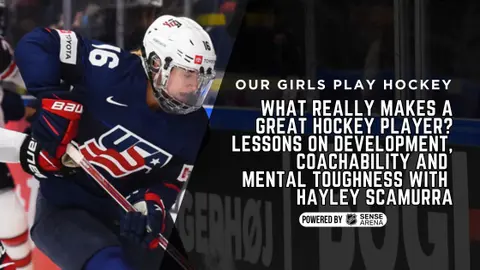
What Really Makes a Great Hockey Player? Lessons on Development, Coachability and Mental Toughness with Hayley Scamurra
Ask young hockey players what they need to do to get better and you'll probably hear plenty about skating, shooting, stickhandling, and scoring.
Those skills matter. A lot.
But what if some of the qualities that ultimately separate players aren't quite as easy to measure?
In a special Q&A episode of *Our Girls Play Hockey*, Hayley Scamurra joined Lee Elias and Mike Bonelli to answer questions submitted by young players, parents, and coaches. The conversation covered everything from Hayley's earliest days on the ice to coachability, hockey IQ, mental preparation, developing strengths, and returning from injury.
And throughout the conversation, one theme kept surfacing:
**Becoming a better hockey player is about much more than becoming better at hockey skills.**
It's about learning how to think, compete, receive feedback, understand yourself, support your teammates, and keep growing—even when things don't go according to plan.
Here are some of the biggest lessons young players and their families can take from the conversation.
## Your Best Skill Might Not Be a "Skill"
Hayley started playing hockey at three years old.
Her father had played for the Washington Capitals, and when the family lived in Buffalo, one of his requirements for their home was the ability to build a backyard rink. With three older brothers already getting on the ice, Hayley naturally wanted to join them.
There was just one small motivational tool involved at first: M&Ms.
Eventually, the candy wasn't necessary.
What might surprise young players, though, is Hayley's answer when she was asked which skating skills separated her from other players growing up.
She didn't point to a specific edgework technique or skating move.
Instead, she pointed to **work ethic and hockey IQ**.
That's an important distinction for young athletes.
You absolutely need to develop your skating. You need puck skills. You need to shoot, pass, defend, and understand your position.
But as players advance, nearly everyone around them becomes skilled.
That's when other qualities can become increasingly important:
- How hard do you compete?
- How quickly do you process the game?
- Do you keep working when a play breaks down?
- Can you anticipate what happens next?
- Do you understand where teammates and opponents are going?
- How do you respond when you're challenged?
The lesson isn't to ignore skill development. It's the opposite.
**Develop your skills while also developing the player—and person—who uses them.**
## Don't Train Only What You're Bad At
One young listener asked a fantastic question: *What's one thing I can do every day to improve my skills?*
Hayley's answer wasn't to perform 500 repetitions of one drill.
Instead, she emphasized becoming a well-rounded player.
Players naturally have things they do well and areas that need more attention. Development means working on both.
If your shot is a strength, don't stop shooting because you're already good at it.
If your edgework needs improvement, dedicate time to it—but don't abandon everything else.
That creates a healthier development mindset:
**Improve your weaknesses while continuing to sharpen your strengths.**
A few focused minutes of intentional work each day can add up over a season. More importantly, players can learn to take ownership of their development instead of waiting for a coach to tell them what to practice.
That curiosity itself is valuable.
The player asking, *"How can I get better?"* has already taken an important step.
## Coachability Starts With How You Receive Feedback
What makes a player coachable?
Hayley's answer should resonate with players at every level.
**Don't immediately take feedback personally.**
When a coach points out something you can improve, the natural reaction can be defensive:
*Do they think I'm bad?*
*Why are they picking on me?*
*Why aren't they saying this to somebody else?*
But there is another way to interpret the same moment:
**This coach sees something in my game that can get better.**
That shift changes everything.
A coachable athlete becomes curious. Instead of treating feedback like an attack, they try to understand it.
What did the coach see?
Why does it matter?
What can I change?
How will that change help my game?
Of course, coaches also have a responsibility to communicate effectively. Caring about a player doesn't require screaming in their face or embarrassing them.
But useful coaching isn't always going to feel comfortable, either.
Sometimes development requires hearing something you don't necessarily want to hear.
The question is what you do next.
## Eventually, Players Need to Understand What Makes Them Different
Youth hockey development should expose young athletes to the entire game.
A 10-year-old with a great shot shouldn't decide she's "only a shooter." A young player who sees the ice well shouldn't stop developing her skating.
Early specialization in a hockey identity can create limitations before a player has had the opportunity to discover what she can become.
But as players get older, something changes.
They begin to recognize the qualities that make them especially valuable.
For Hayley, strengths like wall play, puck protection, and physicality have become important parts of her game.
And she still works on them.
That's the key.
**Your strengths aren't finished products.**
If you're an excellent skater, how can you become an even better one?
If you protect the puck well, how can you become harder to separate from it?
If you're a playmaker, how can you see options even earlier?
At higher levels, players often fill roles because of the things they do exceptionally well. Understanding those strengths doesn't mean ignoring weaknesses. It means recognizing your hockey identity and continuing to expand it.
## Professional Players Are Still Working on Their Games
One of the most useful things young athletes can hear is that elite players aren't "finished."
Hayley discussed wanting to improve her agility, escapability, deception, and ability to get out of turns more quickly.
Think about the lesson there.
A player can reach an elite level and still look at her game and say:
**There's another level here.**
That's what development looks like.
The goal isn't to become a player without weaknesses. That player doesn't exist.
The goal is to continually recognize opportunities to evolve.
Sometimes that means noticing something another player does effectively. Sometimes it means seeing a situation repeatedly appear in your own games and realizing you could handle it differently.
The best development isn't always about fixing something that's "bad."
Sometimes it's about asking:
**What could make me more dynamic?**
That's a powerful question for any athlete.
## Mental Preparation Is Personal
A 15-year-old goalie asked Hayley how she stays mentally prepared and focused before and during games.
Her answer revealed something important: **there isn't one perfect pregame routine for everyone.**
Hayley likes consistency on game days. She has routines. She tapes her stick. She enjoys competitive games with teammates. She uses some visualization.
But she also knows herself well enough not to overdo the mental preparation.
If she becomes too locked in, she can start overthinking and gripping the stick too tightly.
So she stays loose.
During games, she communicates with her linemates about what they're seeing and experiencing on the ice.
For another athlete—especially a goalie—the ideal approach could look completely different.
Some goalies may thrive on communication.
Others may need quiet and intense focus.
Neither approach is automatically right or wrong.
The important question is:
**What helps you remain present?**
Players can experiment with routines, visualization, breathing, music, communication, or quiet preparation. Then pay attention to the result.
Did you feel ready?
Did you feel loose?
Were you focused on the game—or trapped inside your own thoughts?
Mental preparation should help you play the game, not become another thing you feel pressured to perfect.
## Visualization Can Help Players See Success Before It Happens
Visualization came up more than once in this conversation, including when discussing injuries.
It doesn't need to be complicated.
A player can simply take a few minutes to picture herself performing actions successfully.
See yourself skating.
See yourself protecting the puck.
See yourself making the pass.
See yourself battling.
See yourself scoring.
For an injured player who can't physically participate in everything, visualization can also provide another way to remain mentally connected to hockey.
That connection matters.
Because injuries don't only affect the body.
They can disrupt routine, confidence, identity, friendships, and the feeling of belonging to a team.
## An Injury Doesn't Have to Stop Development
For young athletes, being injured can be especially frustrating.
Your teammates are practicing.
Games continue.
You want to play—and you can't.
Hayley's advice was to look for what **is** possible.
Depending on the injury and the medical guidance surrounding it, perhaps there are skills that can still be practiced safely. A lower-body injury might create opportunities to focus elsewhere once appropriate. A player may discover a part of her game she never would have emphasized otherwise.
But development during injury doesn't have to be physical.
Stay connected with teammates.
Attend appropriate team activities.
Watch games.
Observe details you may miss when you're playing.
Learn.
Support your teammates.
And when possible, find ways to remain part of the group.
At the same time, families shouldn't feel like an injured youth player must attend every single hockey obligation to prove she's committed.
There can be balance.
Missing an exhausting road trip while injured doesn't suddenly make someone a bad teammate. Staying connected to the team matters, but recovery—and life outside the rink—matters too.
## Parents Need Support During Injuries, Too
There's another side of youth sports injuries that doesn't get discussed enough:
**They're difficult for parents.**
Parents don't want to see their children hurt.
And when a child is sidelined for weeks or months, the entire family's hockey routine can change.
There may still be practices, games, rehabilitation, appointments, travel, school, work, and everything else that already filled the calendar.
Families have to find the approach that works for them.
If your player desperately wants to attend a game, perhaps a teammate can provide a ride.
If attending certain events helps her feel connected, that's valuable.
If skipping a long road trip gives everyone a needed break, that can be valuable too.
Supporting an injured athlete doesn't mean pretending the situation isn't difficult.
It means helping them navigate it without allowing hockey to become their entire identity.
## The Bigger Lesson: Development Is More Than Hockey
This Q&A started with questions about becoming a better hockey player.
But the answers kept returning to qualities that extend far beyond the rink.
Work ethic.
Curiosity.
Self-awareness.
Communication.
Resilience.
Being receptive to feedback.
Supporting teammates.
Learning from adversity.
Those qualities can help a young athlete become a better hockey player—but they can also help her become a more capable person.
That's one of the greatest opportunities sports can provide.
The objective isn't simply to create players with better shots or faster feet.
It's to help young athletes learn how to challenge themselves, respond when things get difficult, recognize what they do well, work on what needs improvement, and keep moving forward.
And perhaps that's the biggest takeaway from Hayley Scamurra's answers:
**No matter how far you go in hockey, there is always something to learn.**
This was only Part One of the *Our Girls Play Hockey* Q&A with Hayley, with more listener questions still waiting to be answered.
🎧 Listen to the full episode of *Our Girls Play Hockey*, share it with a player, parent, or coach who could benefit from the conversation, and keep bringing your questions to the show.
Keep learning, keep competing, and most importantly, keep enjoying the opportunity to grow through the game. We'll see you at the rink.
How to Be a Better Teammate to Your Hockey Goalie