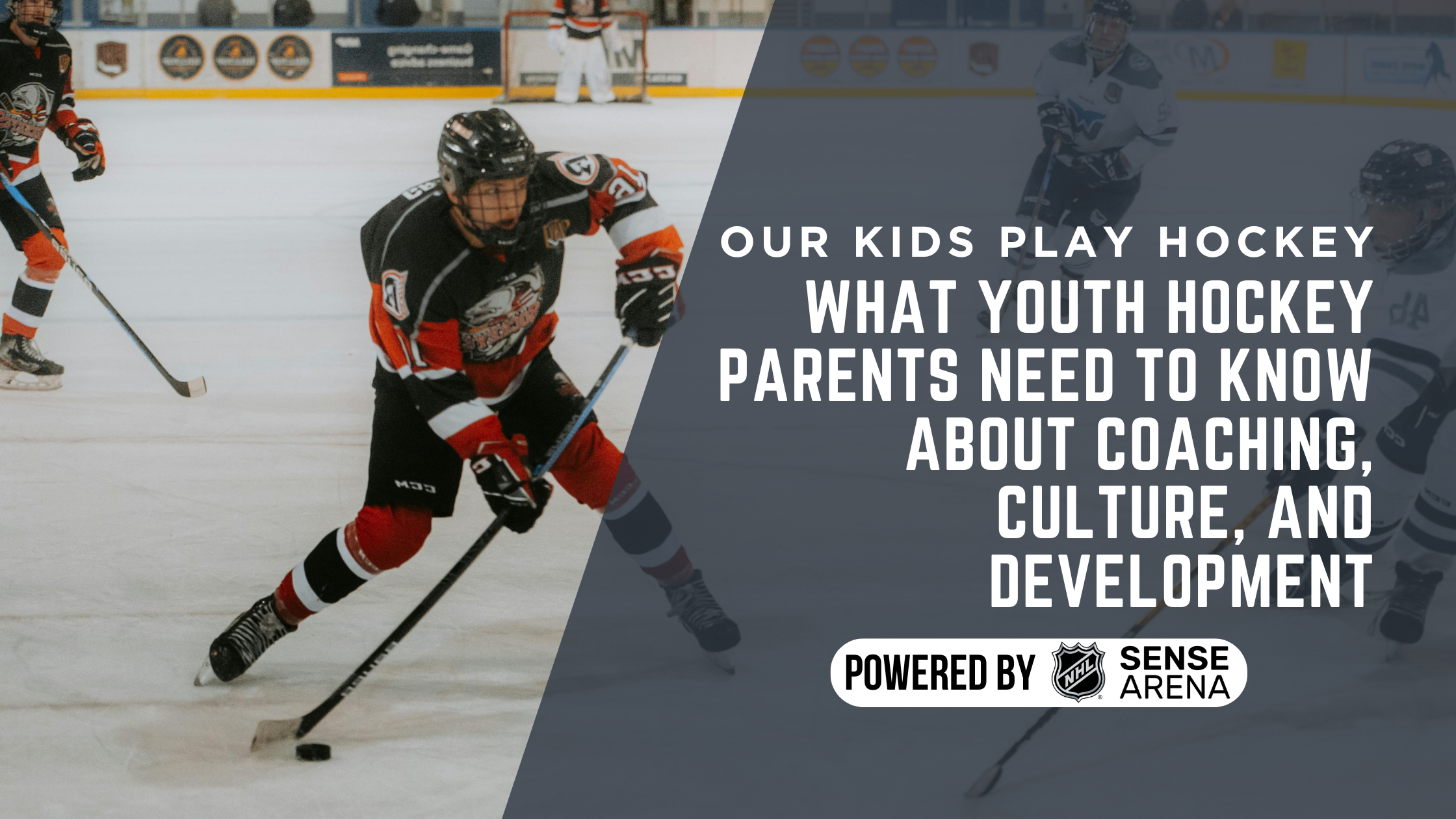
What Youth Hockey Parents Need to Know About Coaching, Culture, and Development
Youth hockey is full of big emotions.
There are early mornings, late nights, expensive tournaments, long drives, tryout pressure, hotel weekends, team drama, player development questions, and the constant balancing act of trying to help kids succeed without stealing the joy from the game.
That’s why conversations with coaches who are truly living it matter so much.
On this episode of Our Kids Play Hockey, Lee Elias, Mike Bonelli, and Christie Casciano-Burns welcome Coach Tre Berg, a youth hockey coach, hockey dad, police officer, former junior and college player, and someone who understands the game from nearly every angle. Tre coaches with the Syracuse Nationals and Syracuse Galaxy AAU program, serves as the Mid-State MITE coordinator, runs skills clinics, and works with players from A to AAA.
But what makes this conversation so valuable is not just Tre’s hockey résumé. It’s his perspective.
He is a coach in the trenches. He is balancing work, family, hockey, expectations, budgets, and the responsibility of helping young players grow. And his message to parents and coaches is clear: youth hockey should develop better players, but more importantly, it should help build better people.
The Work Parents Don’t Always See
One of the most important themes from this episode is the amount of work that happens before a coach ever steps on the ice.
To many parents, a practice may look like something that simply happens. The coach opens the gate, players jump on the ice, drills begin, and the hour moves along.
But good coaching takes preparation.
Tre explains that coaches need to put real time into planning practices, organizing drills, understanding the needs of the team, and making sure players are engaged from start to finish. A coach who is not prepared will be noticed quickly by both players and parents.
That preparation matters because families are investing time, money, and trust. At the youth level, especially in travel and AAA hockey, parents are making real sacrifices. Coaches owe those families a thoughtful, prepared, development-focused experience.
The takeaway for parents: great coaches are doing much more than what you see during the one hour of practice or the three periods of a game.
The takeaway for coaches: preparation is part of the job, even when the job is volunteer.
Fun Comes First, But Fun Does Not Mean Easy
One of Tre’s strongest coaching beliefs is that kids need to have fun if they are going to learn.
That does not mean every practice is silly. It does not mean competition does not matter. It does not mean winning is irrelevant.
It means that players are more engaged when they enjoy the environment. When kids are engaged, they listen better, try harder, ask questions, and absorb more.
The group spends time unpacking an important question: What does “fun” actually mean in youth hockey?
For some parents, fun can become tied to winning. If the team wins, it was fun. If the team loses, it was a failure.
But for kids, fun often means something different:
- Playing with friends
- Competing hard
- Getting better
- Feeling included
- Being challenged
- Having a coach who cares
- Enjoying hotels, mini sticks, road trips, and team memories
- Feeling proud of effort, not just the final score
Lee shares a great example from a tournament where a team had a high-pressure five-on-five competition and a more open three-on-three format. Even after losing games in the three-on-three event, one goalie said it was the most fun he had ever had playing hockey.
That says a lot.
Sometimes the structure, freedom, pace, and creativity of the environment can bring kids back to the reason they started playing in the first place.
Winning Matters, But It Is Not the Whole Point
Everyone in the conversation agrees on one thing: competitive people want to win.
Coaches want to win. Players want to win. Parents want to win.
But at the youth level, winning should not be the only measure of whether a season is successful. Tre points out that losing to a strong opponent can still be valuable if the players are challenged, learning, and developing.
That is a hard lesson for young players, and sometimes an even harder lesson for parents.
A team can lose and still grow. A player can struggle and still improve. A hard weekend can become a turning point if the coach frames it correctly and the parents support the process.
At eight, nine, or ten years old, development is not always linear. A player may look great one month and lost the next. A team may start slow and become strong later. A difficult tournament may reveal exactly what needs to be taught in practice.
The scoreboard tells part of the story. It does not tell the whole story.
Coachability May Matter More Than Talent
One of the strongest messages from this episode is the importance of being coachable.
Tre says he looks for players who are engaged, paying attention, and willing to learn. Talent matters, especially at higher levels, but talent alone is not enough.
A highly skilled player who cannot listen, focus, or respect the environment may not be the right fit for a team. Meanwhile, a player who asks questions, works hard, and wants to improve can become a coach’s dream.
Parents can help tremendously here.
Instead of coaching from the glass or giving conflicting instructions from the car ride home, parents can reinforce a simple message:
Be coachable. Listen. Ask questions. Try what your coach is teaching.
That mindset helps young players in hockey, but it also helps them in school, relationships, jobs, and life.
Coaches are teachers. The best players are not just the ones who can skate, shoot, and score. They are the ones who are willing to be taught.
Tryouts Are About More Than Skill
Tryouts are one of the most stressful parts of youth hockey. Parents wonder where their child fits. Players feel pressure. Coaches are trying to evaluate skill, maturity, attention, attitude, and team needs in a limited amount of time.
Tre’s advice to families is simple: do your research before tryouts.
Do not show up just looking for cheap ice or chasing a logo. Understand the program. Understand the coach. Understand the level of commitment. Understand whether the environment is actually right for your child.
The group also discusses a truth that many families overlook: the most skilled player is not always the best fit.
At young ages, some players may have high-end ability but may not yet be ready for a highly structured environment. That does not make them bad players. It simply means the fit may not be right at that moment.
This is where parents need honesty. Not every opportunity is the right opportunity. Not every team is right for every child. A good fit can help a player thrive. A bad fit can create frustration for the player, coach, and family.
Parent Behavior Can Affect Player Opportunity
Tre closes the episode with a direct message to parents: do not ruin it for your kids.
That may sound blunt, but it is an important reality in competitive youth sports.
At higher levels, parent behavior can influence decisions. Coaches and organizations are paying attention to whether families support the team culture or constantly disrupt it. A talented player can be affected by a parent who creates too much conflict, pressure, or negativity.
The phrase “parent cuts are real” comes up in the episode, and it is something every hockey parent should take seriously.
This does not mean parents should never ask questions or advocate for their child. Communication matters. But there is a difference between healthy communication and behavior that damages the team environment.
Parents should ask themselves:
- Am I helping my child enjoy the game?
- Am I supporting the coach’s message?
- Am I making the season better or harder for my player?
- Am I creating pressure my child did not ask for?
- Am I modeling the behavior I expect from my kid?
The best hockey parents are not silent. They are supportive, respectful, realistic, and focused on the long game.
Setting Standards Early Builds Better Culture
Tre’s coaching approach includes clear expectations from day one.
Players are expected to be respectful. They are expected to represent the logo on their jersey. They are expected to behave properly in their own rink and in other facilities. They are expected to clean up after themselves in locker rooms.
That is culture.
Culture is not just a slogan. It is the standard a team lives by every day.
Lee and Mike point out that teams can fall apart quickly when coaches either fail to set standards or set standards and then abandon them. If a coach tells families that everyone will play, then shortens the bench immediately, trust erodes. If a coach talks about respect but does not hold players accountable, the message loses meaning.
Kids need structure. They may not ask for discipline, but they benefit from it.
The key is that discipline does not have to mean yelling. Tre makes it clear that he is not a coach who screams in kids’ faces. He builds relationships. He jokes with players. He jumps into drills. He has fun with them.
But he also sets expectations.
That balance is what strong youth coaching looks like.
The Cost of Hockey Is a Real Concern
The episode also addresses one of the biggest challenges facing hockey families: cost.
Ice time, tournaments, hotels, travel, equipment, team fees, and gas all add up. In some areas, ice time has become shockingly expensive. The group discusses how rising costs can threaten the accessibility and long-term health of the sport.
Tre explains that his team works to keep costs manageable through sponsorships and player fundraising goals. Families still have to invest, especially at the AAA level, but coaches and programs should be mindful of the financial burden.
This is an important point: if families are investing heavily, they should expect development, preparation, and a quality environment in return.
That does not mean every child is guaranteed a certain outcome. It does mean coaches should take the responsibility seriously.
Youth hockey cannot become a sport only for families who can absorb unlimited costs. Coaches, associations, and hockey leadership all have a role to play in keeping the game accessible.
The 8U AAA Debate Is Complicated
One of the liveliest parts of the conversation centers on 8U AAA hockey and full-ice versus half-ice development.
Tre sees value in both half-ice and full-ice hockey. He acknowledges the research and benefits behind smaller-area games, especially when it comes to puck touches and engagement. At the same time, he notes that many AAA programs around the country have 8U full-ice teams, and players entering squirts with full-ice experience may appear more prepared in certain situations.
Mike pushes back from a broader development and accessibility standpoint, arguing that the system often creates more cost and more pressure than necessary. Lee adds nuance, recognizing that some older mite players may be ready for more, but warning about the fear-of-missing-out culture AAA can create among parents.
The most important point is this: development happens primarily in practice.
Tre’s players skate multiple times per week and get a lot of puck touches through the way practices are structured. That matters more than simply playing full-ice games without enough meaningful involvement.
For parents evaluating a program, the question should not only be, “What level is this team?”
Better questions include:
- How are practices structured?
- How many puck touches will my child get?
- Is the coach prepared?
- Is there skill development?
- Is there small-area play?
- Is the environment healthy?
- Is this team right for my child emotionally, socially, and developmentally?
The label matters less than the experience.
Coaches Care More Than Parents May Realize
A powerful theme near the end of the episode is how much coaches genuinely care about the kids.
Tre says plainly that he loves the players and cares about them. That is why he puts in the time. That is why he prepares. That is why he makes himself available. That is why he sees hockey as fun, not just another obligation.
Lee and Mike echo that sentiment. Most coaches are not doing this because they do not care. They are doing it because they do.
They care about the player who is struggling. They care about the player who asks questions. They care about the player whose parent may be difficult. They care about the group, the culture, and the experience.
That does not mean every coach is perfect. Coaches can make mistakes. Some are inexperienced. Some have egos. Some need to communicate better.
But most youth coaches are trying.
And when parents remember that, the relationship between families and coaches can become much healthier.
Final Takeaway: Keep the Game Bigger Than the Scoreboard
This episode is a reminder that youth hockey is about much more than goals, wins, rankings, and team labels.
It is about kids learning how to compete. It is about coaches teaching fundamentals through fun. It is about parents supporting the process. It is about building communication skills, discipline, respect, resilience, and friendships.
It is about helping young players become better athletes and better people.
Coach Tre Berg represents the kind of coach every hockey community needs: prepared, humble, invested, honest, and committed to the kids.
For hockey parents, the message is clear: support your child, encourage coachability, respect the team culture, and do not let adult pressure take away a kid’s love for the game.
For coaches, the message is just as clear: prepare, communicate, set standards, care deeply, and remember that the players are watching everything you do.
At the end of the day, they will remember far more than the final score.
They will remember how the game made them feel.
🎧 Listen to the full episode of Our Kids Play Hockey and share it with a coach, parent, or hockey family who wants to help make the game better for every kid on the ice.

How to Be More Coachable—and Learn More From Every Hockey Shift