What NHL Scouts Really Look For in Young Hockey Players
Youth hockey families are constantly being told to do more.
More practices. More private lessons. More spring tournaments. More showcases. More travel. More exposure.
The pressure can make parents feel as though every missed skate is a missed opportunity—and every decision could determine their child’s hockey future.
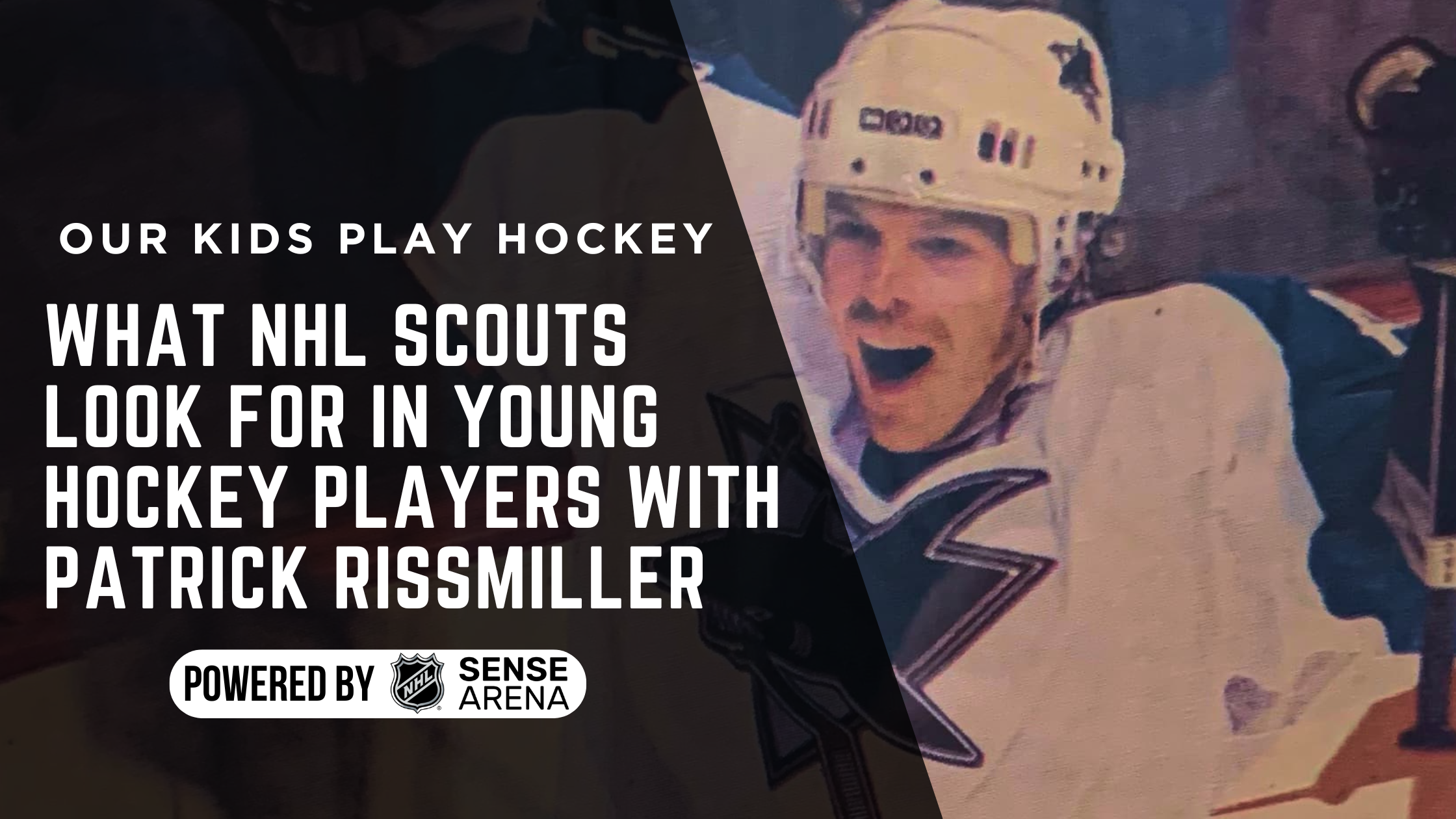
But according to former NHL player, longtime development coach, and Anaheim Ducks scout Patrick Rissmiller, development rarely works that way.
Patrick’s own career was built gradually. He was undersized during his early high school years, attended prep school, played college hockey at Holy Cross, went undrafted, and entered the professional game through a tryout. He earned an American Hockey League contract and eventually worked his way into the NHL.
His path is proof that hockey development does not follow one universal timeline.
The most important lesson for families may be this: You cannot fast-forward a young athlete’s development.
Every Player Develops on a Different Timeline
Patrick entered high school at roughly 5-foot-2 before eventually growing to 6-foot-4. He was not viewed as an obvious future NHL player, and he did not have a long list of schools competing to recruit him.
He needed an opportunity.
Holy Cross coach Paul Pearl was willing to give him one, and that belief helped open the next door in Patrick’s career.
That experience offers an important reminder for coaches: Sometimes the most powerful thing you can give a player is not a drill, a lineup promotion, or extra ice time. It is the knowledge that you believe in them.
Young athletes develop physically, mentally, and emotionally at different rates. The dominant 10-year-old will not automatically become the best 18-year-old. The smaller player who struggles today may grow, gain confidence, improve coordination, or develop a deeper understanding of the game later.
Parents often become anxious when they compare their child’s progress with another player’s progress. But those comparisons ignore one of the central truths of youth sports: Development is individual.
The goal should not be to make a child look advanced as early as possible. The goal should be to help that child continue learning long enough to discover what they can become.
More Hockey Is Not Always Better Hockey
One of Patrick’s biggest concerns about modern youth hockey is the belief that more is always better.
Families may feel they need to add another clinic, team, tournament, or private instructor to keep pace. While extra training can have value, constant hockey can also reduce creativity, limit broader athletic development, and increase the possibility of burnout.
Patrick is a strong supporter of multi-sport participation and time away from the rink.
Playing baseball develops hand-eye coordination. Soccer teaches spacing, footwork, movement without the ball, and reading the field. Lacrosse develops body positioning, passing, catching, and decision-making. Even riding a bike, playing in the backyard, or organizing an unstructured game with friends can help build athleticism.
These experiences are not distractions from hockey. They can become part of a player’s hockey development.
A multi-sport athlete regularly encounters new problems. They must adjust to different coaches, teammates, rules, movements, and tactical situations. That adaptability can become a significant advantage later.
Scouts and coaches can teach technical details. It is much harder to manufacture broad athletic instincts in a player who has never been encouraged to explore.
Patience Is a Competitive Advantage
Youth hockey often creates artificial urgency.
Families worry that their child must make a certain team now, attend a certain event now, or gain recognition now. But Patrick’s experience as a scout allows him to see development across a much wider age range.
In college hockey, he evaluates athletes who may range from their late teens into their early twenties. Many are still getting stronger, improving their skating, learning new roles, and becoming more complete players.
That matters because hockey development does not end at 12, 14, or 16.
A player’s current performance is only one part of the evaluation. Scouts are also trying to project what that athlete may become.
They may notice a tall, lean player who has not filled out physically. They may see a skater whose technique is sufficient but whose hockey intelligence is exceptional. They may identify a competitive player whose role could translate to a higher level even though that player is not currently producing the most points.
Parents see today’s game.
Scouts are often trying to imagine tomorrow’s player.
That is why patience matters so much. A rushed decision made to improve a child’s status today may not improve their long-term development.
What Scouts Evaluate Beyond Goals and Points
It is easy to identify the player who scores repeatedly or skates faster than everyone else.
Scouting becomes more complicated when evaluating how a player’s tools may translate to the next level.
Patrick discussed several qualities that help separate prospects:
- Skating: Not every NHL player is the fastest athlete on the ice, but players must move efficiently enough to compete at the required pace.
- Hockey sense: Does the player anticipate where the puck is going, or do they chase where it has already been?
- Competitiveness: Higher levels are filled with talented players competing for limited roles. Internal drive is essential.
- Character: How does the player respond to coaching, adversity, mistakes, and changing responsibilities?
- Versatility: Can the player contribute in different positions, situations, or roles?
- Specialized value: Does the player possess a skill—shooting, penalty killing, faceoffs, defending, puck protection—that fills an organizational need?
Every player has weaknesses. Scouts are not necessarily searching for someone without deficiencies. They are evaluating whether a player’s strengths, mindset, and projected development can outweigh those deficiencies.
A player does not have to be elite in every category. But they need to bring something valuable—and they need to remain willing to improve.
Versatility Creates Opportunity
Patrick’s professional career provides one of the episode’s clearest examples of adaptability.
Early in his career, he was more of an offensive player. He was not initially known as a strong defensive forward or penalty killer.
When he received an NHL opportunity, however, a coach asked whether he could play right wing and kill penalties.
Patrick said yes.
Penalty killing eventually became an important part of his NHL role.
That lesson should resonate with every young player who insists, “I am a center,” “I only play left wing,” or “I am a defenseman.”
At the youth level, positions should not become identities.
Hockey becomes increasingly fluid once the puck is dropped. A center may become the first forechecker. A winger may be the last player back. A defenseman may activate into offensive space. Players must read, react, cover for teammates, and understand the entire game.
Learning multiple positions can help a player:
- Better understand spacing and team structure
- Anticipate what teammates need
- Improve decision-making
- Become more useful to coaches
- Create additional opportunities for ice time
- Discover strengths they did not know they had
A player who can only perform one role becomes easier to replace. A player who can solve several problems becomes difficult to remove from the lineup.
Accepting a Role Is Not Giving Up
As players advance, they eventually encounter teammates who may be better in certain areas.
A player who has always scored goals may no longer be placed on the top power-play unit. A lifelong center may be asked to move to the wing. An offensive player may be asked to become more reliable defensively.
That can be difficult for both athletes and parents.
But accepting a different role does not mean a coach has stopped believing in the player. It may mean the coach sees another way for that player to contribute.
A fourth-line forward who becomes excellent on faceoffs can earn more minutes. A winger who learns to kill penalties can become essential late in games. A player who can move throughout the lineup can remain useful when injuries or matchup changes occur.
The question is not always, “Am I getting the role I want?”
A better question is, “How can I become valuable in the role the team needs?”
Players who embrace that mindset frequently create opportunities that were not available before.
Youth Hockey Coaches Must Develop Every Player
Professional coaches are judged heavily on winning because professional hockey is a business.
Youth hockey coaches have a different responsibility.
Their job is to teach.
Patrick compared youth coaching to a classroom. A teacher does not select the ten strongest students and teach only them. The teacher is responsible for helping every student improve.
The same principle should apply to hockey.
At younger ages, coaches do not know which players will mature early, which players will grow later, who will continue playing, or who may eventually become the strongest athlete on the team.
That is why youth coaches must resist the temptation to create permanent power-play units, shorten the bench constantly, or reserve important moments for the same small group of players.
Children need opportunities to experience pressure. They need the chance to succeed, make mistakes, defend a lead, take a faceoff, play special teams, and learn from difficult situations.
A player cannot develop a skill they are never allowed to practice.
Redefining What It Means to Win
Winning is fun. Competition matters. Players and coaches should want to perform well.
But a youth hockey team’s definition of winning must be broader than the final score.
A successful game may include:
- A hesitant player making a confident play
- A developing skater successfully defending a late-game shift
- A player trying a new position
- A child recovering from a mistake instead of shutting down
- Teammates celebrating someone else’s breakthrough
- Every player leaving the rink excited to return
Patrick shared a baseball memory involving a child who had struggled to get a hit throughout the season. In the final game, that player finally recorded one, and the entire dugout erupted.
Years later, that was the moment the children still remembered.
They did not remember the standings. They remembered their teammate succeeding.
Those moments build confidence, belonging, and connection. They remind children why they play sports in the first place.
Great Teammates Keep Getting Opportunities
One of Patrick’s strongest messages was the importance of becoming a great teammate.
Great teammates are coachable. They compete. They encourage others. They accept responsibility. They are willing to play somewhere new when the team needs help.
This does not mean young athletes should avoid ambition or stop advocating for themselves. It means their individual goals should exist alongside a willingness to support the group.
At every level, coaches want players who make the team environment better.
Talent may get a player noticed. Being dependable, adaptable, competitive, and enjoyable to coach can help that player remain in the lineup.
These qualities also extend well beyond hockey.
Learning how to contribute within a group, accept feedback, recover from mistakes, and support others prepares children for school, future careers, relationships, and adulthood.
What Parents Can Do Right Now
Parents do not need to design a perfect hockey path.
They can focus on creating an environment where growth remains possible.
That can mean:
- Allowing children to play other sports
- Protecting time for rest and unstructured play
- Praising effort, courage, and coachability
- Avoiding constant comparisons with teammates
- Supporting coaches who develop the entire roster
- Letting children experience different positions
- Resisting the urge to solve every difficult moment
- Keeping postgame conversations positive and child-led
- Remembering that youth hockey should serve the child—not consume the child
The objective is not to remove competition or lower standards.
It is to create the conditions in which young athletes can remain motivated, curious, resilient, and healthy long enough to reach their own potential.
Development Is a Journey, Not a Race
Patrick Rissmiller’s hockey journey was not built through early certainty.
It was built through opportunity, patience, adaptability, good coaching, hard work, and a willingness to accept new roles.
That should be encouraging for families.
Your child does not need to have everything figured out today. They do not need to specialize in one position, play hockey every month of the year, or dominate every game to have a meaningful future in the sport.
They need room to grow.
They need adults who believe in them without rushing them. They need coaches willing to teach them. They need teammates who celebrate their progress. And they need the freedom to discover what kind of player—and person—they can become.
Listen to the full episode of Our Kids Play Hockey for more from Patrick Rissmiller on NHL scouting, youth development, coaching, versatility, and helping young athletes build a lifelong love of the game.
Keep supporting the journey, celebrating the small wins, and helping every young player leave the rink excited to come back.

How to Coach a Youth Hockey Bench Without Overcoaching the Game