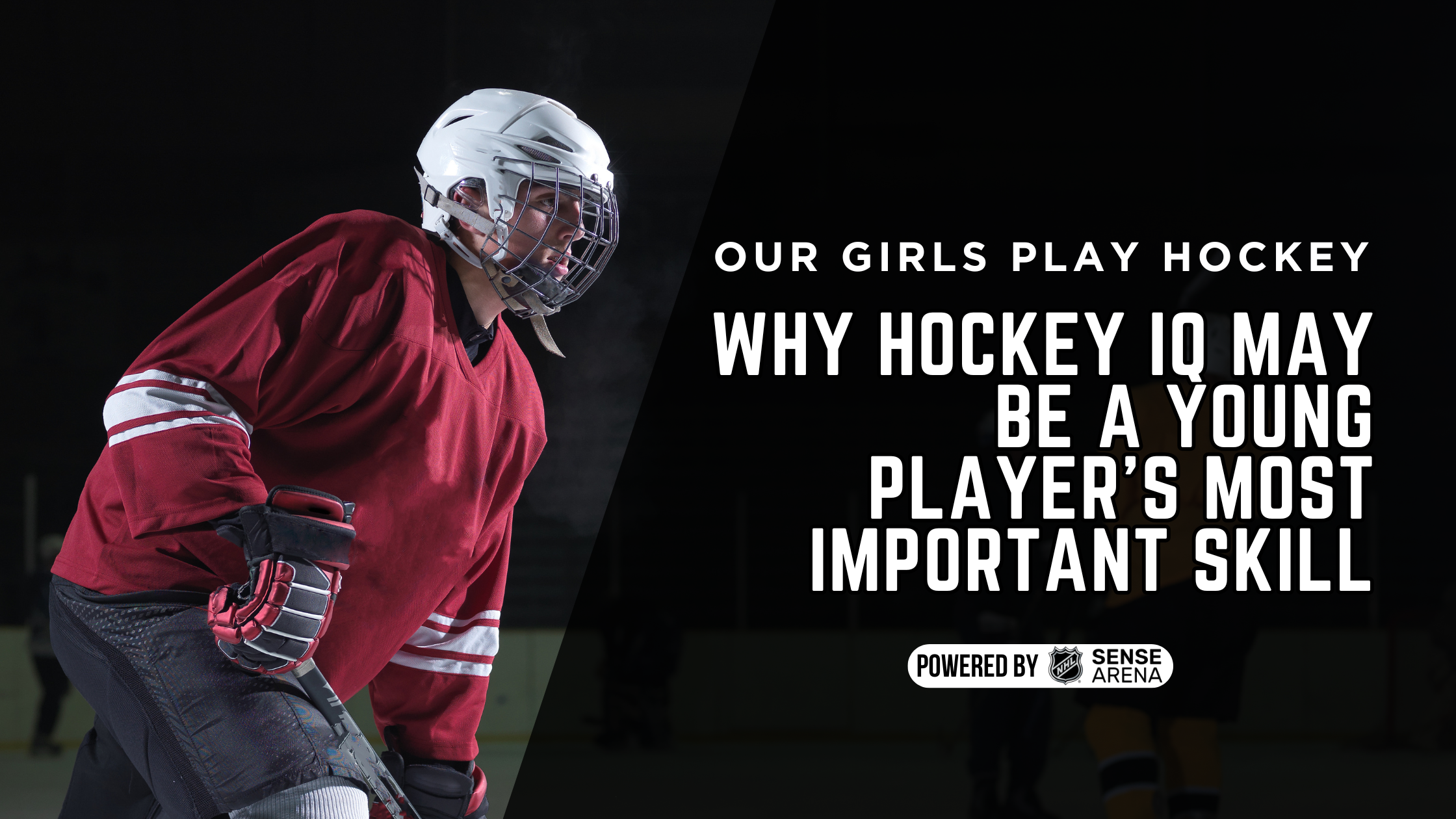
Why Hockey IQ May Be a Young Player’s Most Important Skill
A great shot is easy to notice. So is a smooth set of hands, explosive skating, or a creative move around a defender.
Hockey IQ is different.
It often appears in the moments that happen before the goal, away from the puck, or outside the highlight reel. It is the player recognizing pressure before receiving a pass. It is a forward arriving at the net at exactly the right time. It is a defender closing a lane before the opposing player realizes it was available.
It is also the teammate communicating from the bench, the penalty killer anticipating a pass, and the forechecker forcing a puck carrier toward an area where support is waiting.
In this episode of Our Girls Play Hockey, Team USA gold medalist and PWHL Walter Cup champion Hayley Scamurra explores why hockey IQ matters, how it develops, and why it can be more valuable than elite skill without strong decision-making.
Her message is especially important for young girls navigating a sport that can sometimes place too much attention on goals, points, rankings, and highlight-reel skills.
Those things can matter. But they do not tell the whole story of a player.
What Is Hockey IQ?
Hockey IQ is a player’s ability to understand what is happening, recognize what may happen next, and make an effective decision quickly.
It includes:
- Reading pressure
- Recognizing open space
- Understanding teammates’ positioning
- Anticipating an opponent’s next move
- Knowing when to attack and when to delay
- Arriving at the right place at the right time
- Making decisions with and without the puck
- Communicating useful information
- Adjusting when a play changes
A player with strong hockey IQ does not merely follow the puck. She understands how the players around the puck are influencing the play.
That awareness allows her to move earlier, support more effectively, and make the game feel slower—even when it is moving quickly.
Reaction Versus Anticipation
One of the clearest signs of developing hockey IQ is the transition from reacting to anticipating.
Reaction happens after the player sees the play unfold.
Anticipation happens when the player recognizes clues and begins moving before the outcome is obvious.
Young players naturally spend a great deal of time reacting. They are learning the game, improving their skating, managing the puck, and processing several pieces of information at once. That is a normal part of development.
The goal is not to criticize a player for reacting. The goal is to gradually help her recognize patterns.
For example, a young player can learn to ask:
- Where is the pressure coming from?
- Where is my support?
- What space is opening?
- What will the defender probably do?
- Where could the puck go next?
- What can I do before I receive the puck?
Over time, those questions become quicker and more instinctive.
Why Hockey IQ Can Outweigh Elite Skill
During the conversation, Hayley is asked to choose between two hypothetical players:
One has elite skills and average hockey IQ. The other has average skills and elite hockey IQ.
Her answer is the player with elite hockey IQ.
Why?
Technical skills can often be isolated and practiced. A player can improve her shot, puck control, edges, passing, and strength through repetition and focused instruction.
Hockey IQ can also improve, but it requires players to connect many different parts of the game. They must observe, experiment, make mistakes, receive feedback, recognize patterns, and understand why one choice worked better than another.
A highly skilled player may be able to beat an opponent one-on-one. But if she repeatedly attacks three defenders without recognizing an open teammate, her skill is not creating maximum value.
A smart player understands when to challenge, when to pass, when to protect the puck, and when to create time for someone else.
The best outcome, of course, is not choosing one or the other. Players should pursue both skill and hockey IQ.
The larger lesson is that skill becomes more effective when a player knows how and when to use it.
Hockey Is Not Just Played With the Puck
Young players often evaluate themselves through their puck touches.
Did I score? Did I get an assist? Did I carry the puck? Did I make a move?
But any one player possesses the puck for only a small portion of the game. That means much of her impact is created without it.
Strong off-puck players:
- Become available for passes
- Pull defenders away from teammates
- Protect dangerous areas
- Support puck battles
- Close passing lanes
- Create layers of pressure
- Communicate with teammates
- Anticipate rebounds
- Force opponents into difficult decisions
These actions may not always appear on the scoresheet, but coaches notice them.
They are also the actions that make a player dependable in close games, defensive situations, special teams, and important late-game moments.
Timing Can Be More Important Than Speed
One of Hayley’s most valuable examples involves her timing around the net.
She felt she was playing well but was not consistently finding opportunities to produce. After reviewing video with a coach, she discovered that she was arriving near the crease too early.
By getting there early, she gave the defender time to locate her and establish coverage.
The adjustment was not necessarily to skate faster or work harder. It was to change the timing of her arrival.
That is hockey IQ.
Players are often told to “go hard” or “get to the net.” Those instructions may be directionally correct, but they do not always explain how to succeed.
A player must learn to recognize:
- When the puck carrier has control
- Whether a passing lane is likely to open
- Where the defenders are looking
- When to accelerate into space
- Whether to stop, delay, or continue through the area
Being first is not always the goal. Being available at the right moment is.
The Hidden Value of Disrupting a Play
Not every valuable play results in a clean takeaway.
Sometimes a forechecker only needs to touch the puck, alter the pass, force a defender toward the boards, or delay the breakout for a fraction of a second.
That disruption can give teammates time to recover, close space, or regain possession.
At higher levels, players are expected to avoid allowing clean plays. A pass that goes untouched through pressure can create speed and space for the opponent. A small deflection or forced hesitation can break the rhythm of an entire attack.
Young players can begin developing this habit by learning to:
- Approach with an effective angle
- Lead with an active stick
- Take away the middle of the ice
- Force the puck toward support
- Continue through the play
- Recognize where the next layer of pressure should be
This is where a simple coaching phrase such as “go hunting” can be effective.
It encourages players to pursue possession with purpose instead of waiting passively to see what happens.
Once players understand the attacking mindset, coaches can add more detail about angles, support, spacing, and layered pressure.
Different Roles Build Smarter Players
Hayley’s development did not begin with the expectation that she would always be the top scorer.
As a young player, she valued penalty killing, forechecking, battling, and creating opportunities for her team’s leading offensive players.
Later, her role changed. She played higher in the lineup, received power-play opportunities, transitioned into girls hockey, and eventually learned to play center in college.
Each experience expanded her understanding of the game.
This is an important message for young players: Your current role is not a permanent label.
Playing different positions and situations can make you more complete.
A winger who learns center may better understand defensive support. A scorer who kills penalties may become more aware of passing lanes. A defender who occasionally plays forward may develop a new appreciation for timing and puck support.
Versatility is not a consolation prize. It is a competitive advantage.
Watching Hockey With Purpose
Watching more hockey can improve hockey IQ, but only when players learn to watch beyond the highlight.
A spectacular goal may be the final action in a sequence that began much earlier.
Instead of only watching the puck carrier, young players can choose one player and follow her through the entire shift.
Watch how she:
- Finds open space
- Checks her surroundings
- Supports the puck
- Changes speed
- Communicates
- Tracks back defensively
- Positions her stick
- Adjusts after a turnover
- Creates room for a teammate
Parents and coaches can pause a clip before the outcome and ask the player what she thinks will happen next.
That transforms video from entertainment into an opportunity to practice anticipation.
Better Questions Create Smarter Players
When a young player makes a mistake, adults often provide the answer immediately.
“Do not pass there.”
“Get the puck deep.”
“Cover the player in front.”
Direct instruction has a place, particularly when safety, structure, or an urgent correction is involved. But players also need opportunities to think.
Questions can help them develop ownership of their decisions.
Try asking:
- What did you see?
- What were your options?
- Where was your support?
- What did the defender take away?
- What could you try next time?
- When did the space open?
- What happened before the turnover?
The objective is not to interrogate the player after every shift. It is to help her connect decisions with outcomes.
A player who understands why an option works is more likely to recognize it independently in the future.
Multi-Sport Athletes Can Develop Better Awareness
Hayley also credits soccer with helping her understand spacing, movement, and playing the ball or puck into open areas.
Other sports give young athletes new movement problems to solve. They may develop balance, coordination, creativity, communication, and spatial awareness in ways that transfer back to hockey.
A soccer player learns to move into passing lanes. A basketball player learns to create space and read defensive help. A lacrosse player learns to cut, support, and change the point of attack.
For many young athletes, playing multiple sports is not a distraction from hockey development. It can be part of hockey development.
Three Ways Players Can Start Building Hockey IQ
Hockey IQ takes time, but players can begin working on it immediately.
1. Watch one complete shift
Do not focus only on the player with the puck. Choose one position and follow that player’s decisions from beginning to end.
2. Ask one useful question after practice
Ask a coach about a specific situation: “Where should my support have been on that breakout?” Specific questions create more useful answers.
3. Record one lesson
Write a short note in a journal or phone after a game. It could be a pattern you noticed, a coach’s cue, or one decision you want to try differently.
Small observations accumulate. Eventually, they become recognition. Recognition becomes anticipation, and anticipation leads to faster decisions.
A Player’s Value Is Bigger Than the Scoresheet
Goals and assists deserve to be celebrated. So do creativity, confidence, and technical growth.
But young players should also learn to recognize the value of a strong forecheck, a smart line change, a blocked passing lane, a well-timed net drive, or clear communication from the bench.
Those plays help teams win.
They also help coaches trust players in more situations.
For girls developing in hockey, this can be an empowering shift in perspective. A player does not have to lead the team in scoring to be important. She can contribute through awareness, effort, reliability, physicality, communication, and intelligent decisions.
The game needs different types of players.
The most effective teams are not collections of identical athletes. They are groups of players who understand their own strengths, appreciate their teammates’ strengths, and know how to combine them.
Keep Learning the Game
Hockey IQ is not something a player either has or does not have.
It can be developed through experience, thoughtful coaching, video, conversation, multiple sports, mistakes, and curiosity.
Encourage young players to work on their hands, skating, shot, and strength. But also encourage them to watch, listen, ask questions, and study what happens away from the puck.
The goal is not simply to play harder.
It is to play with greater purpose.
🎧 Listen to the full episode of Our Girls Play Hockey for more insight from Hayley Scamurra on anticipation, timing, versatility, communication, and becoming a player who can contribute in every situation.
Keep asking questions, keep learning, and keep creating space for the next generation of girls to understand—and love—the game at a deeper level.

How to Be More Coachable—and Learn More From Every Hockey Shift