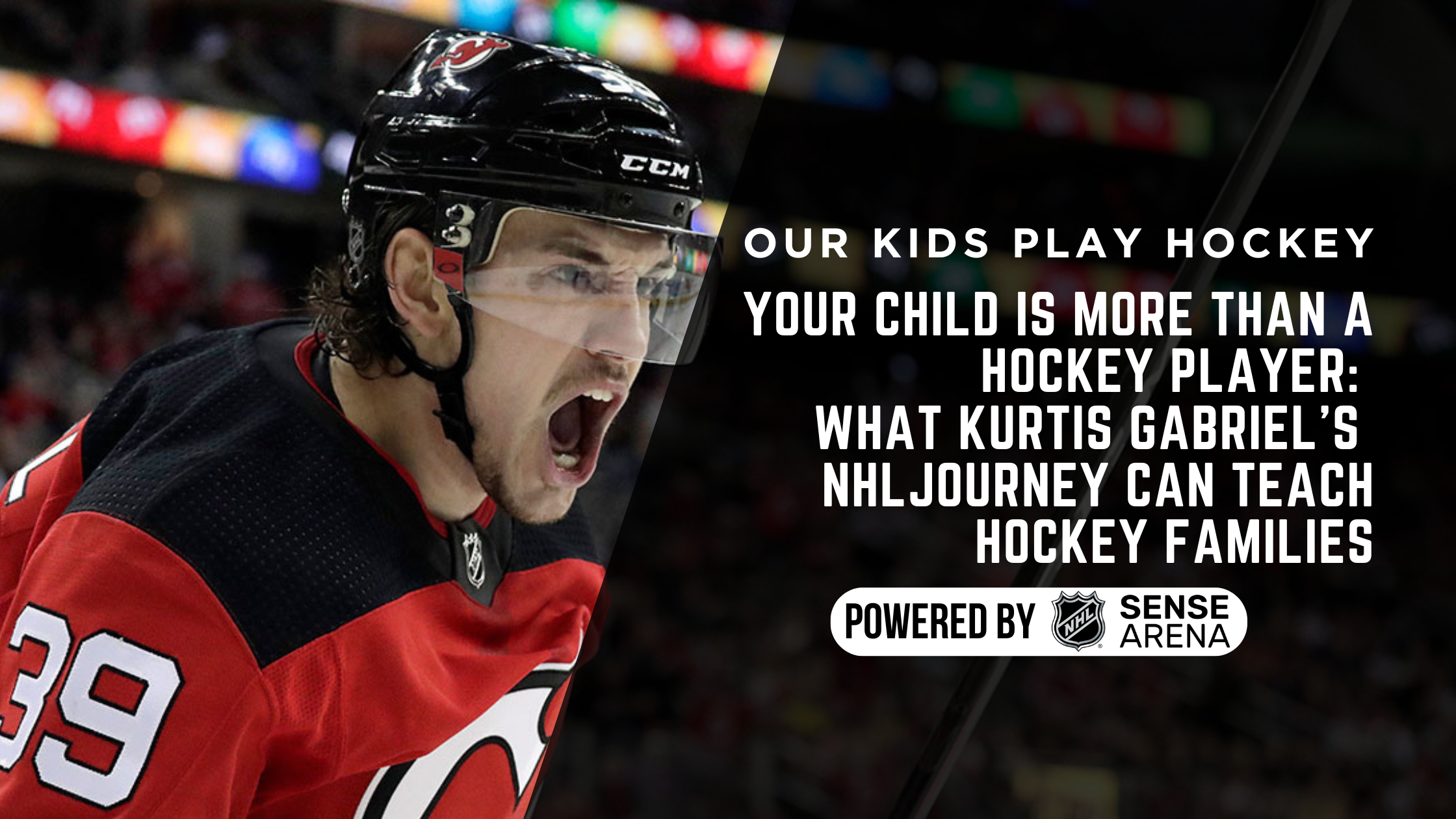
Your Child Is More Than a Hockey Player: What Kurtis Gabriel’s NHL Journey Can Teach Hockey Families
Every Kid Should Be Allowed to Dream
Ask enough young hockey players what they want to be when they grow up, and eventually you're going to hear it:
“I want to play in the NHL.”
For parents, that answer can create a complicated mix of emotions.
You want your child to dream. You love their enthusiasm. You might even admire their confidence.
But another part of you knows how difficult the road is.
So when should you encourage the dream? When should you inject a little “reality”? How much sacrifice is healthy? And what happens when a young player's goals become so intertwined with hockey that the game starts determining how they feel about themselves?
Former NHL player Kurtis Gabriel has lived both sides of that conversation.
His path to professional hockey was anything but predictable. He wasn't sitting at home at 16 years old wondering why NHL scouts weren't calling him.
He was playing AA hockey and wondering whether his hockey journey might be ending.
Then something changed.
After attending a junior hockey tryout, Kurtis made a decision: he was going to play in the NHL.
He didn't know exactly how.
He didn't need to know exactly how.
He simply decided he was going to pursue it.
That belief helped take him from relative obscurity to junior hockey, the OHL, professional hockey, and eventually the NHL.
But years later, Kurtis can also see something his younger self couldn't.
The same relentless drive that helped propel him toward his dream also contributed to tying his identity and self-worth almost completely to the game.
And that's where his story becomes especially important for hockey families.
Belief Can Be Powerful—But It Needs a Healthy Foundation
One of the most compelling pieces of Kurtis's story is the sheer conviction he had in himself.
He wasn't waiting for someone else to tell him he was an NHL prospect.
He didn't need a scout's ranking to give him permission to work.
He decided what he wanted and started organizing his life around becoming the player he believed he needed to be.
He trained.
He worked on his skills.
He changed the way he played when a coach told him he would need to find a different role.
And when unexpected opportunities presented themselves, he treated them seriously.
A skate he easily could have viewed as meaningless became another opportunity to compete. Someone happened to be watching. One opportunity led to another.
There is a tremendous lesson here for young athletes.
You cannot control who is watching. You can control how you show up.
Young players often become consumed with questions such as:
Who is scouting me? Why did that player make the team? Why didn't I get invited? Who is getting noticed?
Kurtis's path provides a different perspective.
Instead of obsessing over whether someone was watching, he became obsessed with becoming better.
That's an important distinction.
The healthiest version of belief isn't, “Someone owes me an opportunity.”
It's:
“I'm going to keep preparing so that when an opportunity appears, I'm ready for it.”
Parents Don't Have to Manufacture Their Child's Motivation
Kurtis offered hockey parents another important reminder: if your child truly wants something, you probably won't need to convince them to want it.
The player chasing the highest levels is often the player asking for more ice.
They're carrying the hockey bag.
They're thinking about the game.
They're looking for ways to improve.
That doesn't mean every highly motivated player will reach the NHL. And it doesn't mean a child who isn't obsessed with hockey is somehow doing youth sports incorrectly.
Quite the opposite.
One of the healthiest things parents can do is notice what genuinely excites their children instead of deciding what should excite them.
Your child may love hockey.
They may love hockey today and something else three years from now.
They may enjoy playing without wanting to build their entire life around the sport.
All of those paths are valid.
A parent's role isn't to create the dream.
It's to help provide an environment where a child feels safe enough to discover one.
Model the Life You Want Your Kids to Live
Parents spend a tremendous amount of time talking to their kids.
Work hard.
Treat people well.
Be a good teammate.
Take care of your body.
Have interests outside hockey.
Give back.
Kurtis challenged parents to think beyond those words.
Children are constantly observing how we live.
If we tell them hockey shouldn't define their entire identity while allowing our own careers, achievements, or status to determine our worth, they're going to notice.
If we tell them to be present but spend every game worrying about the next tryout, ranking, tournament, or roster decision, they're going to notice that too.
The question becomes:
Are we modeling the perspective we're asking our children to have?
That doesn't require perfection.
It requires awareness.
Let your kids see you pursue something because you enjoy it.
Let them see you handle a mistake.
Let them see you take care of relationships.
Let them see you contribute to your community.
Let them see you enjoy something without needing recognition for it.
We don't need to lecture kids into becoming balanced human beings.
We can show them what that looks like.
Home Should Be the Safe Landing Place
Perhaps the most practical takeaway for hockey parents came from the discussion around what happens after games.
Young athletes already experience enormous amounts of feedback.
Their coaches are talking to them.
Their teammates are reacting.
They know when they made a mistake.
They see the scoreboard.
They know when they missed an opportunity.
They don't always need one more evaluator waiting in the parking lot.
Lee shared a story about someone asking why he wasn't immediately correcting something his son—a goaltender—was doing incorrectly.
His answer was simple:
His son would figure it out.
And if his son wanted advice, he could ask.
That distinction is enormous.
The goal isn't to stop parenting. It's not to pretend mistakes didn't happen or avoid difficult conversations forever.
The goal is to make sure your child understands one thing beyond any doubt:
Your love and respect for them are not connected to how they played.
Imagine what that does for a young athlete.
A bad game becomes a bad game—not a threat to the relationship.
A mistake becomes something to learn from—not proof that they've disappointed you.
Being cut from a team hurts, but it doesn't change who they are at home.
Ironically, that sense of safety may actually make kids more capable of taking risks, receiving coaching, and handling adversity.
When failure doesn't threaten their identity, they can learn from it.
The Danger of Becoming Only “A Hockey Player”
Kurtis's willingness to talk openly about this part of his journey makes the conversation especially valuable.
He achieved what millions of young players dream about.
He became an NHL player.
But over time, hockey also became deeply connected to how he measured himself.
Being a good hockey player meant feeling like a good person.
Performing his role meant having value.
Recognition reinforced that value.
Then hockey ended earlier than he expected.
Kurtis thought he would play until around 40.
Instead, his career ended at 29.
Suddenly, the structure that had helped organize his identity was gone.
This is why the “more than a hockey player” conversation matters long before retirement from professional hockey.
For most kids, hockey will eventually end.
For some, that's after 10U.
For others, high school.
Some will play junior hockey.
Others will play college hockey.
A tiny fraction will reach professional hockey.
But every single player eventually faces a day when the jersey comes off.
If everything they believe about their worth is attached to the jersey, that transition can be incredibly difficult.
The goal isn't to make kids care less.
The goal is to teach them that they can care deeply about hockey without allowing hockey to determine whether they are worthy.
Mistakes Are Events, Not Identities
Kurtis also described something almost every hockey player understands.
You make a turnover.
The puck goes the other way.
The other team scores.
The coach reacts.
Now you're sitting on the bench replaying the mistake.
One thought becomes ten.
Why did I do that?
I'm going to get benched.
Coach is furious.
I can't mess up again.
Then your next shift arrives, and instead of playing freely, you're playing not to make another mistake.
Kurtis now talks extensively about meditation, awareness, and creating separation between yourself and the thoughts and emotions you're experiencing.
For a young player, the concept doesn't need to be complicated.
It can begin with something as simple as identifying an emotion:
“I'm frustrated.”
“I'm nervous.”
“I'm embarrassed.”
“I'm excited.”
Naming the emotion creates a little space between feeling something and automatically reacting to it.
The message isn't that emotions are bad.
The message is that an emotion doesn't have to take control of the next shift.
A mistake happened.
You are not the mistake.
Process Over Outcome Isn't Just a Coaching Phrase
Hockey families hear “focus on the process” constantly.
But actually living that philosophy is difficult.
Youth hockey makes outcomes highly visible.
Scoreboards.
Standings.
Rankings.
Tryouts.
Cuts.
Selections.
Goals.
Points.
Championships.
Development isn't nearly as easy to measure.
Neither is resilience.
Neither is becoming a better teammate.
Neither is learning how to manage disappointment.
But those things might ultimately be more important.
Kurtis's journey is a reminder that even reaching the highest level doesn't automatically provide fulfillment.
That comes from somewhere deeper.
When coaches and parents focus only on outcomes, they risk teaching young players that the value of the experience exists at the end of the journey.
Make the team.
Earn the scholarship.
Get drafted.
Reach the NHL.
But what if the real value was being developed every day along the way?
The Real ROI of Youth Hockey
On Our Kids Play Hockey, we've said many times that the return on investment in youth hockey shouldn't be measured by whether your child eventually earns a scholarship.
The return is the life experience.
Hockey gives kids countless opportunities to practice:
- Responding to disappointment
- Working with different personalities
- Competing without losing respect for others
- Managing emotions
- Accepting coaching
- Being responsible to teammates
- Preparing for something that matters to them
- Winning without arrogance
- Losing without allowing the loss to define them
- Discovering what they genuinely care about
Those lessons don't disappear when hockey ends.
They become part of who your child is.
That is a return worth pursuing.
Let Them Dream—And Remind Them Who They Are
There is nothing wrong with your 10-year-old wanting to play in the NHL.
There is nothing wrong with your teenager setting an enormous goal.
There is nothing wrong with believing something that seems improbable.
Kurtis Gabriel is living proof that unconventional hockey journeys exist.
But perhaps the most powerful lesson from his story comes after the NHL dream was achieved.
Let your children dream about the jersey.
Help them understand that they are more than the jersey.
Support the work.
Don't manufacture the motivation.
Celebrate their passion.
Don't make their performance responsible for your happiness.
Let coaches coach.
Be the safe place when they come home.
And above everything else, remind them that the game can help reveal who they are—but it never gets to determine their worth.
Kurtis Gabriel's hockey journey didn't end when his NHL career did.
In many ways, another one began.
Today he's sharing those lessons through conversations like this one, through The Fight Plan Podcast, and through the story he's continuing to write.
For hockey families, his message is a valuable one:
Dream big. Work hard. Stay present. And never confuse what you do with who you are.
🎧 Listen to the full conversation with Kurtis Gabriel on Our Kids Play Hockey, share it with another hockey parent who needs to hear it, and keep the conversation going with your own young athlete.
The goal isn't simply to raise better hockey players. It's to help raise strong, thoughtful, resilient people who know their value—with or without skates on.
Keep supporting the dream, keep enjoying the ride, and we'll see you around the rink.

Prepare, Believe, Reset: Steve Briere’s Lessons for Young Hockey Players