Youth Hockey Tryouts Should Build Teams—and Help Players Grow
Few moments in youth hockey create more emotion than tryouts.
Players want to prove they belong. Parents watch every drill and wonder what the evaluators are seeing. Coaches are responsible for forming competitive, balanced teams. Board members must manage communication, logistics, expectations, and inevitable disappointment.
When the process is unclear, families are often left asking the same questions:
Was the team already selected?
Did the evaluators watch my child?
What skills were they actually measuring?
Was the process fair?
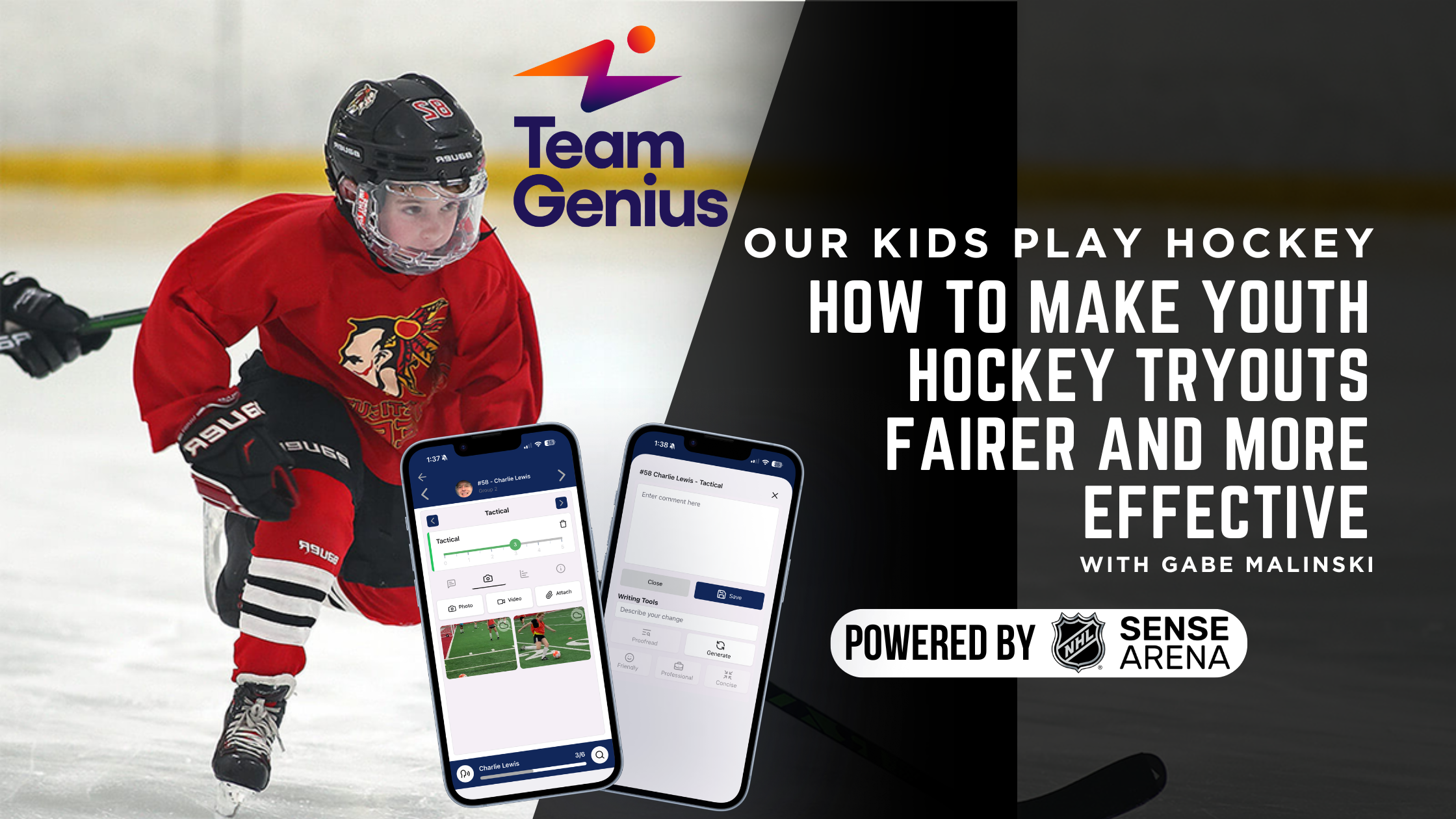
In a conversation with Gabe Malinski of Team Genius, the hosts of Our Kids Play Hockey explored how associations can build more effective evaluation systems—and how parents, coaches, and players can approach tryouts with a healthier perspective.
The most important lesson is surprisingly simple: the primary purpose of a tryout is to form teams.
Everything else should support that goal.
More Evaluation Criteria Do Not Always Produce Better Evaluations
Organizations often believe that collecting more information will automatically produce better results.
An evaluator may be asked to score:
- Forward skating
- Backward skating
- Edge control
- Passing
- Shooting
- Puckhandling
- Hockey IQ
- Compete level
- Communication
- Positioning
That may sound thorough, but it can become unrealistic during a short tryout session. Evaluators begin looking down at forms instead of watching the ice. They rush through scores, miss players, or interpret the criteria differently.
A simpler system is often a more accurate system.
The number of categories should reflect the age of the players, the size of the association, and the amount of separation needed between participants.
For younger players, an organization may need only one or two major criteria. Skating is often the most important because it affects nearly everything else a player can do.
A player may possess an excellent shot, but that skill has limited value if the player cannot reach open space, pursue the puck, or create enough time to release it.
As players get older, skating may be divided into more specific categories such as:
- Acceleration
- Top speed
- Backward skating
- Edge control
- Agility
- Transitional movement
A larger association with hundreds of players may also need more criteria than a smaller program. More participants create more overlapping scores, so additional categories can help evaluators distinguish between players.
The goal, however, should never be to collect data simply because it is available.
Every score should help the organization make a better decision.
Evaluators Need More Than a Number Scale
One of the most avoidable tryout problems is a lack of evaluator alignment.
Consider a scoring system from one to five. Does five represent the strongest performance, or does one? Is a three considered average for the entire age group, or average for the smaller group currently on the ice?
Those details may seem obvious, but when they are not clearly explained, the final rankings can become unreliable.
A useful evaluation rubric should define what each score means.
For example:
- 1: The skill requires significant development
- 2: The player demonstrates the skill inconsistently
- 3: The player performs the skill at the expected age-group level
- 4: The player performs the skill consistently above the expected level
- 5: The player demonstrates advanced mastery
Organizations should also decide whether evaluators are comparing players with the entire age group or only with the group currently skating.
This becomes especially important when players are separated after an initial session. A player receiving a five in a lower group should not automatically rank above a player receiving a three in the strongest group.
Without clear instructions, the data may create more confusion rather than more clarity.
The Drills Must Match the Evaluation Criteria
Evaluators cannot accurately grade a skill they have not been given a chance to observe.
When coaches design tryout drills, they should know exactly which skills the evaluators are measuring.
A passing drill may reveal puck control and decision-making, but it may not provide enough information to evaluate top skating speed. A straight-line sprint may produce a useful time, but it will reveal little about hockey IQ or positional awareness.
Before the players step on the ice, coaches and evaluators should understand:
- What each drill is designed to reveal
- When the evaluator should focus on a specific skill
- How each skill will be scored
- Whether the drill creates an equal opportunity for every player
- How goaltenders will be evaluated separately
This preparation requires additional work, but it improves both the accuracy and credibility of the process.
Tryouts are often a family’s first major interaction with an organization each season. That makes the evaluation process an important first impression.
Can Bias Ever Be Completely Removed?
Parents frequently ask for a completely unbiased tryout.
That is a reasonable goal, but it is difficult to achieve.
Organizations can reduce bias through strategies such as:
- Using third-party evaluators
- Exchanging evaluators with a neighboring association
- Removing names from jerseys
- Assigning unfamiliar numbers
- Using consistent drills and rubrics
- Collecting objective measurements
- Averaging scores from multiple evaluators
Objective testing can be especially valuable for measurable skills. Timing gates may record skating speed more reliably than a handheld stopwatch. Technology can also capture shooting speed, accuracy, acceleration, or physical testing results.
Those numbers provide helpful evidence.
However, hockey is not played in a laboratory.
The fastest player is not automatically the most effective player. A powerful shot has little value if the player cannot recognize when to use it. A strong skater may struggle to anticipate pressure, support teammates, or make decisions away from the puck.
Important qualities such as hockey IQ, compete level, leadership, attitude, resilience, and coachability still require informed human judgment.
The goal should not be to eliminate coaches from the process. It should be to give them better information.
A One-Hour Tryout Cannot Tell the Entire Story
Players can have bad days. Evaluators can miss details. A short tryout can never provide a complete picture of a child’s development.
That is why evaluations should continue throughout the season.
Coaches see qualities during practices and games that may never appear during a formal tryout:
- Does the player respond well to instruction?
- Does the player compete when the team is losing?
- Does the player support teammates?
- Does the player consistently arrive prepared?
- Does the player improve after receiving feedback?
- Does the player demonstrate leadership?
- Does the player maintain effort away from the puck?
In-season evaluations can help the next coaching staff understand the player more fully. They can also provide the player with meaningful development goals before the next tryout arrives.
A useful conversation might include:
- Where the player began the season
- Where the player is now
- Which skills have improved
- Which habits need additional work
- What the player should focus on next
That is far more valuable than waiting until the end of the year and providing only a roster decision.
Honest Feedback Can Turn Disappointment Into Direction
Being told that you did not make a desired team is painful.
However, disappointment can become productive when it is paired with clear, respectful feedback.
“You did not make the team” leaves the player with frustration.
“You need to improve your first three strides and your ability to defend while skating backward” gives the player direction.
Feedback does not need to be cruel, overwhelming, or excessively detailed. It should be honest, specific, and actionable.
Players can then ask a powerful question:
How do I improve that?
That question reflects a growth mindset. It moves the player away from blaming the process and toward controlling the next step.
Organizations may not always be able to provide extensive feedback to every participant. But when feedback is offered, it should help the player understand what development looks like.
Feedback is also valuable for the players who make the team.
A roster spot does not mean development is complete. Coaches can celebrate the selection while still identifying two or three areas that will help the player succeed at the next level.
Tryout Preparation Begins Long Before Tryout Week
Players cannot transform into completely different athletes during one evaluation.
The habits they demonstrate at tryouts are usually the habits they have practiced throughout the year.
Preparation includes:
- Consistent effort during practices
- Purposeful offseason development
- Good sleep
- Proper hydration
- Appropriate meals
- Arriving early
- Sharpening skates in advance
- Preparing equipment before leaving home
- Listening carefully to instructions
- Avoiding unnecessary changes to equipment or routines
Players should also understand that feeling nervous is normal.
Nerves often appear because the player cares about the outcome. The goal is not necessarily to eliminate those feelings. The goal is to arrive prepared enough to perform through them.
Three simple rules can help a player focus:
- Listen to the coach.
- Work as hard as you can.
- Remember to have fun.
A tryout is still hockey. Players perform best when they remain engaged in the game rather than becoming consumed by the evaluation.
Parents Set the Emotional Temperature
Parents have an important role before, during, and after tryouts.
They are often responsible for transportation, meals, hydration, scheduling, equipment, and emotional support. They also influence how large the moment feels to the child.
When parents treat an evaluation like a life-changing event, young players may carry unnecessary pressure onto the ice.
A calmer message is often more helpful:
Work hard. Listen. Show what you can do. Enjoy skating with the other players. Whatever happens, we will figure out the next step.
Parents should also be careful about trying to interpret every action from the stands.
Without knowing the criteria, the drill plan, or the instructions given to evaluators, it is almost impossible to determine why a coach is watching one player, moving another player to a different group, or using a specific lineup.
The most helpful post-tryout response is support—not immediate blame.
Parents can acknowledge disappointment while guiding the player toward the next opportunity.
Questions such as these can help:
- What did you think went well?
- What did you learn?
- Did the coach provide any feedback?
- What would you like to improve next?
- How can we help you continue enjoying the game?
The goal is not to pretend the player is not disappointed. The goal is to prevent one decision from defining the child’s identity.
The “Wrong” Team May Become the Right Opportunity
A player who misses a desired roster may receive more ice time, leadership opportunities, special-teams experience, or freedom to develop creativity on another team.
Christie shared how her daughter once missed a AAA team she desperately wanted to make. On the team she joined instead, she became a captain, played significant minutes, developed leadership skills, and expanded her creativity.
That experience helped prepare her for future opportunities, including playing Division I college hockey.
Gabe also shared the journey of his brother, Sam Malinski.
Sam played on a B team when he was young. During his sophomore high school season, he recorded no points. He was cut by a USHL team during the season and had to adjust his path.
Rather than treating those moments as the end of the journey, he used them as opportunities to develop new parts of his game. He eventually played at Cornell, reached the American Hockey League, and continued into the NHL after going undrafted.
That does not mean every child will follow the same path.
It does demonstrate that development is rarely linear.
One tryout result is a moment—not a final destination.
Technology Should Support Decisions, Not Replace People
Team Genius helps organizations collect, organize, and communicate evaluation data. But Gabe emphasized that technology should not automatically build rosters for coaches.
A team requires more than a numerical ranking.
Coaches need different positions, playing styles, personalities, and roles. They must consider how players fit together and what each athlete may become with proper development.
Technology can help organizations:
- Standardize evaluations
- Reduce paperwork
- Keep evaluators focused on the ice
- Compare scores more clearly
- Track progress over multiple seasons
- Share development feedback
- Collect player self-assessments
- Identify differences between player and coach perceptions
- Add objective testing data
- Make decisions easier to explain
The final decision, however, still belongs to informed hockey leaders.
Data should improve the conversation. It should not replace it.
A Better Tryout Process Benefits the Entire Hockey Community
Better evaluations are not only about selecting the top team.
They help organizations build trust. They help coaches understand their players. They give parents clearer expectations. Most importantly, they give young athletes a better opportunity to learn and develop.
A strong process is:
- Simple enough for evaluators to use accurately
- Clear enough for families to understand
- Flexible enough to match the age group
- Detailed enough to support team placement
- Honest enough to provide useful feedback
- Ongoing enough to measure development beyond one day
Youth hockey will always include difficult decisions. Not every player will make the team they hoped to join.
But every player deserves a process designed with care.
When adults communicate clearly, evaluate responsibly, and keep development at the center of the experience, tryouts can become more than a stressful roster-selection event.
They can become another opportunity to teach preparation, resilience, accountability, and growth.
Listen to the full conversation with Gabe Malinski of Team Genius on Our Kids Play Hockey, and share the episode with a coach, board member, or hockey parent preparing for tryout season.
Keep supporting your player, keep asking constructive questions, and keep remembering that development does not happen on one list, during one tryout, or in one season. We’ll see you on the next episode of Our Kids Play Hockey.

How to Be More Coachable—and Learn More From Every Hockey Shift