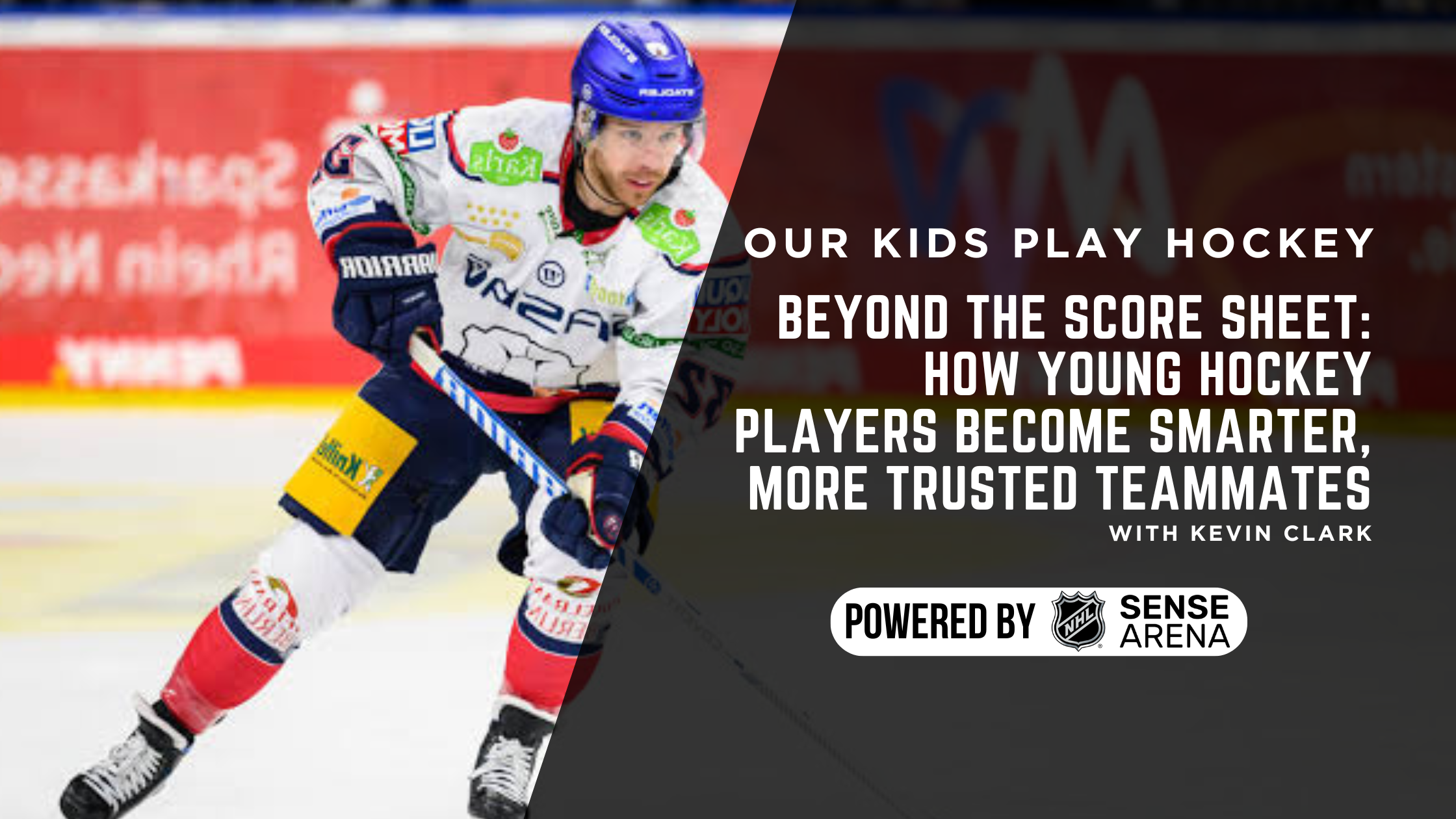
Beyond the Score Sheet: How Young Hockey Players Become Smarter, More Trusted Teammates
A player comes off the ice after a difficult shift.
A parent asks, “What happened?”
The player responds, “I don’t know.”
That answer can frustrate parents and coaches. The player was on the ice, so how could they not know what went wrong?
The truth is that many young players know what happened. They remember the turnover, the missed assignment, the goal against, or the scoring opportunity. What they often cannot explain is why it happened.
Understanding that “why” is one of the foundations of hockey IQ.
During this episode of Our Kids Play Hockey, Kevin Clark of Cascade Hockey joined Lee Elias, Mike Bonelli, and Christie Casciano-Burns to discuss how players can learn to see the game through a more professional lens.
Kevin brings the perspective of a 16-year professional career that included experience in the Vancouver Canucks and Winnipeg Jets organizations and multiple opportunities to represent Team Canada. Today, he helps players understand the details that influence the game but rarely appear on a stat sheet.
The conversation offered an important message for every hockey family:
Development is not simply about producing better results. It is about creating players who can recognize situations, make decisions, solve problems, and understand their value to the team.
A Good Decision Can Still Produce a Bad Result
Youth hockey often operates inside what Kevin described as an achievement-pressure environment.
Players are judged by whether they scored. Teams are judged by whether they won. Individual plays are labeled good or bad based on the final outcome.
But hockey is not that simple.
A player can make the correct read, execute the right play, and still experience a bad outcome. A teammate may mishandle the puck. A defender may make an exceptional play. The puck may take an unfortunate bounce.
The opposite can also happen.
A player can ignore every available option, force a low-percentage play, and still score.
Everyone celebrates the goal, but the decision that created it may not work against stronger, smarter, or more experienced competition.
That distinction matters because results can hide habits.
Parents and coaches should ask:
- Did the player recognize the available pressure?
- Did they collect information before receiving the puck?
- Did they understand where their teammates were?
- Did they make a decision that would work consistently?
- Did their choice support the team’s situation?
- Could they explain what they saw?
The objective is not to criticize every play. It is to help the player understand that a single result does not always reveal the quality of the decision.
The Most Valuable Skills May Never Appear on the Score Sheet
Goals and assists are visible. They are easy to count, celebrate, and compare.
Many of the skills coaches trust most are harder to measure.
A player may create time and space that allows a teammate to score. A defensive forward may prevent a dangerous chance. A winger may delay with the puck so tired defensemen can change. A center may support the puck correctly, even though they never receive a pass.
None of those moments may produce a point.
They still help the team win.
Coaches should actively identify and explain these contributions. Instead of only saying, “Good shift,” they can tell a player exactly why the shift mattered.
For example:
- “You recognized the pressure and gave your defenseman a safe option.”
- “Your backcheck removed their best scoring opportunity.”
- “You created enough time for your teammates to complete a change.”
- “You protected the puck and allowed our scorer to find open space.”
- “You made the simple play when the game situation required it.”
Specific feedback gives a player something more powerful than praise. It gives them identity and purpose.
A young athlete who understands their value is more likely to play confidently, accept responsibility, and continue developing.
Trusted Players Understand Situations
Being a trusted player does not mean never making a mistake.
Trusted players understand what the game requires in different moments.
They recognize:
- The amount of pressure around them
- Whether they have time and space
- Where they are in the period
- How long they have been on the ice
- Whether teammates need to change
- When the team needs a safe play
- When an opportunity exists to attack
- What the likely next play will be
This is situational hockey.
A decision that makes sense early in a shift may be dangerous at the end of one. A play that works with a two-goal lead may be inappropriate when the team is trailing. A winger may want to attack the net, but protecting the puck for three additional seconds may allow the entire defensive unit to change.
To someone watching only the puck—or only their own child—that player may appear to have missed an opportunity.
A coach may see intelligence, awareness, and reliability.
What Parents Should Watch During a Game
Parents naturally watch their own child for most of the game. That is understandable.
The challenge begins when a parent tries to evaluate the entire performance based only on goals, assists, shots, or obvious mistakes.
Kevin encouraged families to look at reliability from shift to shift.
A parent does not need professional playing experience to notice useful details. They can watch for questions such as:
- Does my child scan the ice before receiving the puck?
- Do they recognize when a defender is closing quickly?
- Can they support the puck when a teammate is under pressure?
- Do they recover after making a mistake?
- Are they engaged when they do not have the puck?
- Do they understand when it is time to change?
- Are they making the same mistake repeatedly?
- Have they improved in an area that was difficult six months ago?
This approach changes the postgame conversation.
Instead of immediately asking, “Why didn’t you score?” or “What happened on that goal?” a parent might say:
“I noticed you kept working to get available for your defenseman. What were you seeing?”
That question invites reflection without turning the car ride home into a coaching session.
The parent’s primary job is still to provide support, encouragement, and perspective. Watching the smaller details simply allows that support to be more informed.
Hockey Is Chaotic, So Why Do We Always Practice It Neatly?
One of the strongest themes in the conversation was the difference between how hockey looks in games and how it is often practiced.
Games are messy.
Players operate under pressure. Passing lanes disappear. Pucks bounce. Teammates move unexpectedly. Opponents force decisions. Players are frequently outnumbered and uncomfortable.
Yet many practices are built around clean lines, uncontested repetitions, and predetermined passing patterns.
Those drills may look organized, but organization does not automatically equal learning.
Kevin’s approach focuses on placing players in situations they experience frequently during games.
Consider a winger moving from the middle of the ice toward the defensive-zone wall to receive a puck. That situation could happen hundreds of times during a season.
The player may need to learn:
- How to collect information before reaching the puck
- How to handle the puck on the backhand
- How to open their body
- How to recognize pressure
- How to protect the puck
- How to make the next pass
- How to escape when the expected option disappears
The progression can begin simply. Pressure, teammates, and additional options can be layered in later.
The key is that the coach must understand the focus of the activity. Adding more players does not automatically create an effective game-like drill.
The activity should challenge a specific decision or skill that repeatedly appears in competition.
Fundamentals and Problem-Solving Must Work Together
Game-based learning does not mean abandoning technical skill development.
Players still need to learn how to skate, stop, turn, pass, receive, shoot, and protect the puck. A player who cannot comfortably receive a backhand pass may struggle to execute a breakout, regardless of how well they understand the concept.
The solution is not choosing between fundamentals and hockey IQ.
Players need both.
Coaches can teach a technical skill and then place it inside a realistic problem. They can give players multiple attempts, allow mistakes, and help them discover different solutions.
That combination builds a player who can execute a skill and recognize when to use it.
Why Mistakes and Discomfort Matter
Parents sometimes interpret struggle as failure.
A player begins learning a new movement or decision pattern. It looks awkward. They lose the puck. Their timing is off. Another player appears to understand it faster.
The natural reaction may be, “Why aren’t they getting this?”
But learning often feels uncomfortable before it becomes useful.
Kevin explained that hearing a player say, “This feels weird,” can be positive. It may mean the player is attempting something that is not yet part of their default game.
That is where patience becomes essential.
Players need permission to make mistakes without assuming every error will cost them ice time, disappoint a parent, or create an immediate correction from the bench.
Errors give the brain information. Repetition allows the player to adjust. Guidance helps the player focus on the right detail.
Coaches should create environments where players can ask questions, attempt new solutions, and learn without fear.
Every Practice Needs a Purpose
An effective practice requires more than a list of drills.
It needs a developmental objective.
Coaches should be able to explain:
- What are we trying to improve today?
- Why does this matter in a game?
- What should assistants watch for?
- What details should players focus on?
- How will the activity progress?
- What will success look like?
Even a brief conversation among the coaching staff can create better alignment.
Without a shared purpose, one coach may emphasize puck movement while another focuses on speed. A third may correct positioning. Players receive multiple messages and may not understand which detail matters most.
A clear objective gives every coach the same lens.
It also helps coaches evaluate the session by more than whether the drills ran smoothly.
Consistent Language Creates a Better Development Path
Players frequently hear different terminology from different coaches.
One coach names a concept one way. The next coach uses another phrase. An outside instructor introduces different language. The player may understand the idea but believe everyone is teaching something new.
Programs can reduce this confusion by improving communication across age levels.
Coaches working with younger teams should understand what players will need at the next stage. Coaches at older levels should communicate the skills, habits, and language they expect incoming players to know.
That does not require every coach to use identical drills.
It requires the organization to create a connected pathway rather than a collection of isolated teams.
Progress Should Be Measured in Months, Not Minutes
Parents see their children every day.
That closeness can make growth difficult to recognize. Families may become fixated on this week’s game, this month’s ranking, or the mistake that occurred during the most recent shift.
Development becomes clearer when viewed over longer periods.
Compare the player to where they were six months ago.
Can they now receive pucks they once struggled to handle? Are they scanning more frequently? Are they calmer under pressure? Has their stride improved? Are they making fewer repeated mistakes?
Video can be especially useful because it makes progress visible.
A player may not feel different. A parent may not remember the earlier version clearly. Watching clips from several months apart can reveal meaningful changes in movement, awareness, confidence, and execution.
The goal is not to analyze every shift endlessly. It is to give players evidence that their work is producing growth.
Different Players Need Different Voices
Kevin also discussed the value of independent coaching environments.
An outside development coach does not control the player’s position in the lineup or determine their next shift. That separation can make it easier for a player to ask questions, admit confusion, and experiment.
Outside instruction should not undermine the team coach. The development coach should understand what the player is being asked to do and avoid creating conflicting messages.
When communication is aligned, a different voice can help the same lesson connect.
Sometimes a player needs to hear an idea explained with different words, see it on video, or experience it in a smaller setting before it becomes clear.
Cultivate the Drive—Do Not Try to Create It
The conversation eventually moved beyond hockey development and into motivation.
Parents often want to know how to make a child work harder, practice more, or become more committed.
Internal drive cannot be manufactured.
It can, however, be cultivated.
When a child asks to train, play, learn, or pursue something meaningful, adults can support that interest. They can provide opportunities, encouragement, transportation, perspective, and help after setbacks.
They should also recognize that not every child will choose hockey over every birthday, school event, trip, friendship, or outside interest.
That does not mean the child lacks character.
Young athletes need room to experience life.
For highly driven players, missing another event may not feel like a sacrifice. It may simply be the choice they want to make because hockey is where they feel most fulfilled.
The important distinction is ownership.
A child who chooses the work develops a healthier relationship with the process than one who believes the choice was made for them.
Develop the Person, and the Player Has Room to Grow
Youth hockey development is not linear.
A highly motivated eight-year-old may lose interest later. A struggling 12-year-old may become the hardest-working player at 15. The fourth-line player in one program may become a captain after finding a different environment and voice.
Adults cannot predict every outcome.
They can create conditions that help young people continue.
That means:
- Teaching instead of only correcting
- Explaining why a player matters
- Recognizing contributions beyond scoring
- Allowing mistakes to become learning opportunities
- Measuring growth over meaningful periods
- Respecting interests outside hockey
- Supporting internal motivation
- Helping players stand up after disappointment
The most valuable question may not be, “How do we make this child a better hockey player?”
It may be:
“How do we help this child become a confident, thoughtful, resilient person who understands how to learn?”
When coaches and parents begin there, better hockey development often follows.
Listen to the full conversation with Kevin Clark of Cascade Hockey on Our Kids Play Hockey, and share the episode with a parent, coach, or hockey leader who wants to help players see more, understand more, and recognize the value they bring to their team.
Keep supporting the person behind the jersey—and keep making the rink a place where young players can grow.


Food Is Fuel: How Young Hockey Players Can Build Better Nutrition Habits