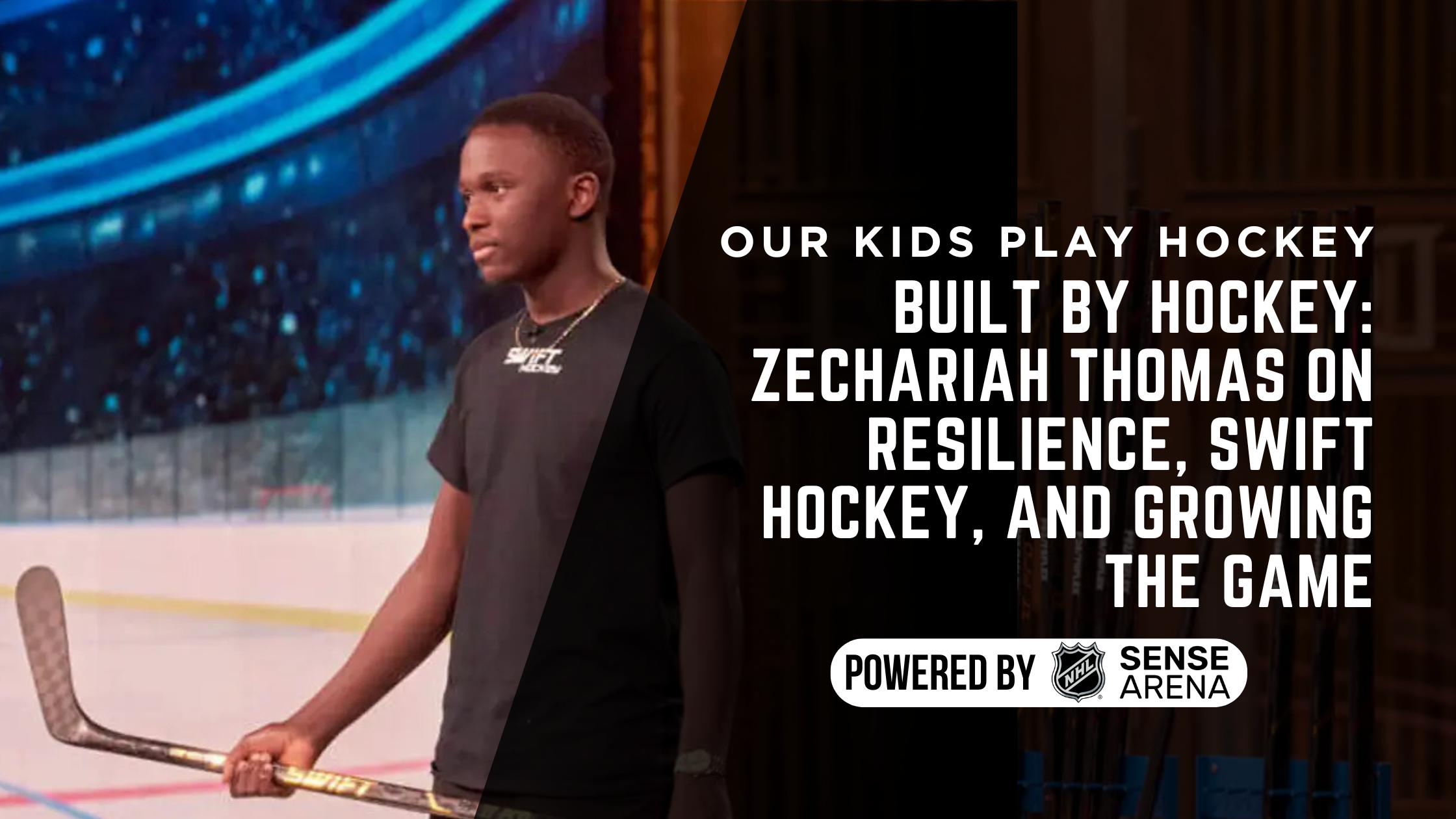
Built By Hockey: Zechariah Thomas on Resilience, Swift Hockey, and Growing the Game
Hockey has a way of shaping people.
Not just as athletes. Not just as competitors. But as thinkers, leaders, builders, and problem-solvers.
In this episode of Our Kids Play Hockey, Lee Elias and Mike Bonelli welcomed Zechariah Thomas, founder of Swift Hockey and a player whose journey has included high-level hockey in Ontario, major junior experience, and representing Team Jamaica internationally.
Zech’s story is one that hockey families need to hear because it challenges several common assumptions about the game: that kids must start extremely young, that there is only one path to success, that expensive equipment creates better players, and that hockey development is only about what happens on the ice.
His journey proves something much bigger.
Hockey can build a life.
Starting “Late” Does Not Mean Starting Behind Forever
Zech began playing hockey at around 10 years old, which many families in today’s hockey culture would consider “late.” In many youth hockey circles, parents can feel pressure to have their kids skating almost as soon as they can walk.
But Zech’s path reminds us that development is not always linear.
When he first entered the game, his family did not come from a hockey background. Like many new hockey families, they had to learn the sport as they went. His early introduction to skating came through figure skating lessons — something he admitted felt embarrassing at the time, especially because he was in a class with all girls.
But what felt awkward then became a major advantage later.
Throughout his career, coaches consistently recognized him as a strong skater. That foundation helped him climb through the levels and eventually reach major junior hockey.
The lesson for hockey parents is simple but important: there is no one perfect path.
Some players start early. Some start later. Some develop through organized programs. Some build their skills on outdoor rinks, rollerblades, or figure skating sessions. What matters most is whether the player keeps learning, keeps moving, and keeps loving the process.
Skating Is Not Just One Skill — It Is the Foundation
One of the strongest themes in the conversation was the importance of skating.
Too often, hockey skills get grouped together: skating, shooting, passing, stickhandling. But as Lee and Mike pointed out, skating deserves its own category.
Because if a player cannot skate effectively, everything else becomes harder.
A great shot matters less if a player cannot get into position to use it. Strong puck skills matter less if the player cannot create separation. Hockey sense matters less if the body cannot keep up with the play.
Zech’s figure skating background gave him edge control, balance, and body awareness. His time spent rollerblading helped him build strength, coordination, and confidence. Those experiences became part of his hockey foundation.
For families, this is a valuable reminder: development does not only happen in expensive private sessions or elite programs.
Players can improve by:
Skating whenever they have the chance
Rollerblading outside
Building balance and coordination
Learning from other skating disciplines
Prioritizing movement over status
The best development is often not the flashiest. It is consistent, creative, and built over time.
Mental Toughness Becomes the Separator
At higher levels of hockey, everyone can play.
Everyone can skate. Everyone has talent. Everyone has put in hours of work.
So what separates players?
For Zech, the answer was clear: the mental side of the game.
He spoke openly about hearing doubt throughout his career. He dealt with people telling him he could not reach certain levels. He also faced the added challenge of being a Black hockey player in environments where he heard comments and experienced adversity that many players never have to carry.
That built toughness. It built resilience. And, in Zech’s words, it became one of his superpowers.
This is an important conversation for hockey families because adversity does not disappear as players climb the ladder. In many ways, it intensifies. The competition gets tougher. The feedback gets sharper. The pressure grows.
Players who advance are not usually the ones who avoid adversity. They are the ones who learn how to move through it.
That does not mean we should normalize harmful environments or excuse poor behavior. It means we should help young athletes build the tools to handle challenges, advocate for themselves, and stay grounded in who they are.
Hockey should build strong people — not just strong players.
The Power of “Uncommon Belief”
One of the most memorable parts of the conversation came when Zech described himself as “delusional” in the best possible way.
He meant that he carried an uncommon belief in what he could accomplish.
At 15, he did not understand why he could not start a company. He did not accept that being young meant being incapable. He did not see the odds as a reason to stop.
That mindset carried from hockey into business.
Lee reframed it beautifully: it is not necessarily delusion — it is an uncommon belief that success is possible when you are willing to do the work.
This is one of hockey’s greatest transferable lessons.
The game teaches kids to ask:
Why not me?
Why can’t I improve?
Why can’t I make the team?
Why can’t I build something meaningful?
Why can’t I keep going after a setback?
Of course, belief alone is not enough. Dreams require work. Ambition requires discipline. Confidence requires action.
But without belief, players often limit themselves before they ever find out what is possible.
From Player to Builder: The Birth of Swift Hockey
Like many athletes, Zech eventually faced the moment when the playing dream shifted.
COVID disrupted his hockey path and created a period where his schedule disappeared. With no normal routine, he turned toward another longtime passion: business.
He studied relentlessly. He read books, watched videos, learned from what he called “YouTube University,” started businesses, failed at several, and eventually sold his first business around age 18.
But something was missing.
The businesses he tried did not all connect to his passion. Selling random products did not fuel him the way hockey did.
That changed when he connected his entrepreneurial drive with a problem he had seen since childhood: the cost of hockey equipment.
Growing up, Zech saw families struggle when a stick broke. He remembered parents feeling the weight of another unexpected expense. He remembered using his sporting goods employee discount to help people afford equipment.
Eventually, he asked a question that great builders often ask:
There has to be a better way.
That question became part of the foundation for Swift Hockey.
Equipment Should Help Players — Not Define Them
One of the most practical takeaways for hockey parents came during the discussion about sticks and equipment.
Hockey families know the pressure. Kids see the big brands. They want the expensive stick. They believe the right logo might give them an edge.
But as the conversation made clear, the player makes the stick. The stick does not make the player.
That does not mean equipment is irrelevant. Proper gear matters. Safety matters. Fit matters. Quality matters.
But families need to think carefully about where their money creates the most value.
Zech pointed out that spending hundreds of dollars more for a brand-name stick may not be the best use of a family’s hockey budget. In many cases, that money could go toward better skates, a better helmet, training, or simply keeping the game more financially sustainable.
This is where Swift Hockey’s mission connects directly with the needs of hockey families: building quality sticks at a more accessible price point.
The larger message is not just about one company. It is about rethinking hockey culture.
We need to stop teaching kids that status equals performance. We need to help them understand that confidence comes from preparation, not a logo.
Representing Team Jamaica and Expanding Hockey’s Identity
Zech’s hockey journey also includes representing Team Jamaica, an experience he described as deeply meaningful.
For him, it was not just about playing international hockey. It was about representing his family’s heritage, his parents’ home, and a flag that carried personal significance.
This part of the conversation highlighted something important: hockey is a global game.
The sport is growing well beyond its traditional boundaries. Nations like Jamaica and Puerto Rico are building strong hockey identities, fueled in part by players with roots across North America and the Caribbean.
And when those teams compete, the hockey is real. The rivalry is real. The pride is real.
For young players, this matters because representation matters.
Seeing different nations, cultures, and communities in hockey expands what kids believe is possible. It reminds families that the game belongs to everyone willing to play it, grow it, and respect it.
The Cost of Hockey Is Still a Major Barrier
The conversation also addressed one of the most urgent issues in youth hockey: cost.
Equipment is expensive. League fees are expensive. Travel is expensive. But one of the biggest barriers is ice time.
When ice can cost hundreds of dollars per hour, training becomes harder to access. Development opportunities become unequal. Families with more money can often buy more reps, more instruction, and more exposure.
That creates a dangerous gap.
Zech spoke honestly about wanting hockey to become more accessible and less controlled by politics or family finances. The goal should be to identify and develop players who are willing to work, not simply those whose families can afford every opportunity.
This is a challenge for the entire hockey community.
Rinks, associations, coaches, companies, and families all have a role to play in making the game more sustainable and inclusive.
Because if hockey becomes too expensive for too many families, the sport loses talent, diversity, and long-term growth.
Growing the Game Requires Everyone
Near the end of the episode, Zech made an important point: growing hockey cannot fall on one person, one company, or one program.
It requires everyone.
Parents need to support healthier hockey environments. Coaches need to prioritize development and belonging. Companies need to innovate with accessibility in mind. Families need to challenge the idea that more expensive always means better.
And players need to remember why they started.
The future of hockey depends on whether we can make the game better for the next generation — not just more competitive, more expensive, or more exclusive.
Better.
More welcoming. More creative. More affordable. More focused on building people.
Final Thoughts: Hockey Can Build More Than Players
Zechariah Thomas’ story is a powerful reminder of what hockey can do when we let the game become bigger than the scoreboard.
It can teach resilience. It can build confidence. It can spark entrepreneurship. It can connect players to culture and identity. It can inspire someone to take a problem they saw as a child and build a company designed to help solve it.
For hockey parents, the message is clear:
Your child’s hockey journey does not have to look like anyone else’s.
They do not need the most expensive stick to become a better player. They do not need to follow a perfect path to find success. They do not need to be defined by where they start.
What they need is support, belief, work ethic, and a game that gives them room to grow.
And when hockey does that well, it does more than develop athletes.
It helps build people ready to make an impact far beyond the rink.
Thanks for being part of the Our Kids Play Hockey community — and for helping make the game better for every family who loves it.
From Olympic Dream to Walter Cup Champion: Hayley Scamurra’s Historic Year in Hockey
