See More, Think Faster: Building Better Hockey Awareness
Some hockey players always seem to know where the puck is going next.
They find open teammates before the passing lane becomes obvious. They sense pressure before an opponent arrives. They protect the puck when necessary, move it quickly when space disappears, and rarely appear surprised by what is happening around them.
That ability can look like natural talent, but much of it comes from a skill that can be developed: awareness.
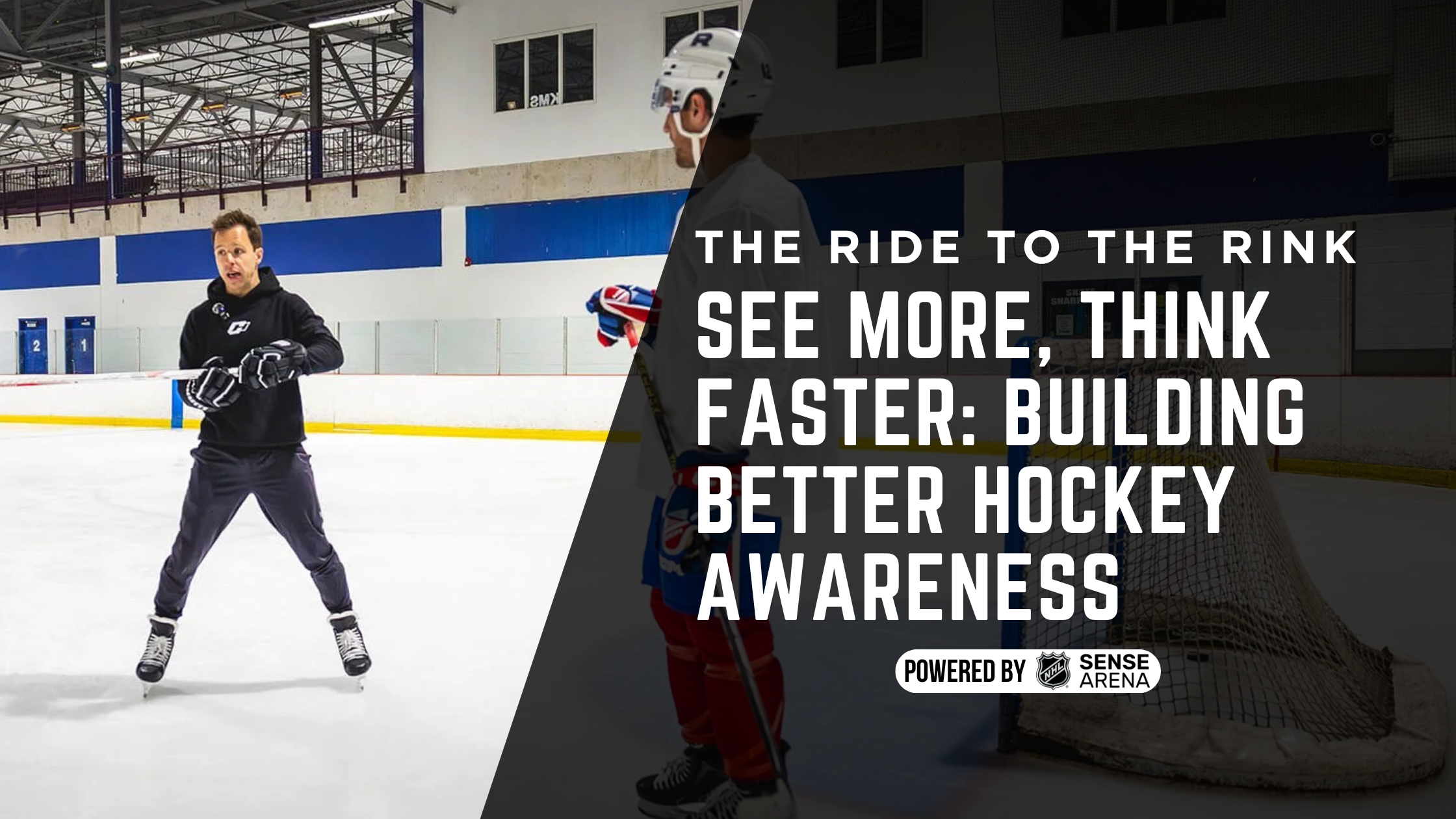
In this episode of The Ride to the Rink, former professional hockey player and development coach Kevin Clark offers young players a valuable challenge. Do not simply move faster. Learn to see more.
Kevin’s advice focuses on several connected habits: moving on quickly from mistakes, continuing to develop throughout the season, scanning the ice, and gathering information that helps you make your next decision.
These lessons are valuable for young players at every level because they do not require perfect hands, elite speed, or expensive equipment. They begin with attention, intention, and a willingness to learn.
A Short-Term Memory Helps You Stay in the Game
Every hockey player makes mistakes.
A pass gets intercepted. A shot misses the net. A player loses an edge, misses an assignment, or turns the puck over in a dangerous area.
Young players often carry those moments with them. They replay the mistake while skating back to the bench, think about it during the next shift, and become so worried about making another error that they stop playing confidently.
Kevin recommends developing a short-term memory.
That does not mean players should ignore mistakes or refuse to learn from them. It means they should understand that the middle of a game is not always the right time to analyze everything that went wrong.
Hockey moves too quickly.
The next faceoff, forecheck, backcheck, pass, or scoring opportunity is already happening. A player who remains mentally trapped in the previous play is less prepared for the next one.
The same lesson applies after a great play. A goal, a strong defensive stop, or a perfect pass can build confidence, but players still need to reset. Celebrating internally for too long can be just as distracting as dwelling on an error.
A useful mental routine is:
- Recognize what happened.
- Take one breath.
- Identify the next responsibility.
- Rejoin the play with full attention.
The best response to the previous shift is often to become completely present for the next one.
Development Should Not Stop During the Season
Many players view the summer as development time and the hockey season as performance time.
The offseason becomes the period for skill work, strength training, skating instruction, and camps. Once the season begins, the player attends team practices and games but may stop working intentionally on individual development.
Kevin encourages players to find manageable opportunities to keep learning throughout the season.
That does not mean filling every available hour with more hockey. Rest, school, family time, and recovery remain important. It means identifying realistic moments when a player can receive additional instruction or focus on a skill that may not receive much attention during team practice.
An outside coach, teacher, or trusted development professional can offer a different perspective from the player’s team coach. That new voice may notice a habit, introduce a different teaching method, or help the player understand the game from another angle.
The value often comes from variety.
A player who receives different forms of instruction can begin adding tools to their game. Those additions may feel small at first, but consistent improvement compounds over time.
Players and parents can begin by asking:
- What is one skill that needs focused attention?
- What can be practiced without creating exhaustion?
- Is the additional training supporting the player’s goals?
- Is the schedule still allowing enough recovery?
- Is the player enjoying the process?
Development should challenge young athletes, not overwhelm them. The goal is sustainable progress.
Scanning Is More Than Turning Your Head
One of Kevin’s strongest recommendations is for players to improve their scanning.
Coaches may describe this habit as shoulder checking, pre-scanning, or looking around before receiving the puck. Whatever term is used, the purpose is the same: understand what is happening before the puck arrives.
However, simply moving your head is not enough.
A player can look over both shoulders and still gather no useful information. The movement may appear correct, but it does not improve the next decision unless the player understands what they saw.
Effective scanning should answer questions such as:
- Where is the nearest opponent?
- Is pressure coming from the left or right?
- How much time and space do I have?
- Where are my teammates?
- Is there an open passing lane?
- Should I turn, pass, protect the puck, or move it immediately?
- Is open ice available behind the pressure?
The purpose of scanning is not to satisfy a coaching instruction. It is to build a clearer picture of the play.
When a player gathers that information early, the puck does not arrive as a surprise. The player has already begun preparing a response.
Better Information Creates Better Decisions
Hockey decisions are heavily influenced by time and space.
A player receiving the puck with an opponent directly behind them may need to protect it. A player with open ice may be able to turn and attack. A teammate in a better position may require a quick pass. A dangerous area may call for a simple, safe play.
Without scanning, the player may attempt the same move in every situation.
That is when players appear to have “blinders on.” They see only the puck or the first option in front of them. They do not recognize the other paths available.
Awareness expands those options.
A player who understands the location of teammates and opponents can make decisions more confidently because they are reacting to information instead of guessing.
This is one reason experienced players often appear to have more time. They may not physically have more space than anyone else. They simply processed the situation sooner.
Their decision began before the puck reached their stick.
What Skaters Can Learn From Goalies
The episode also highlights the awareness goalies develop by watching the entire game.
Goalies must track more than the puck. They observe player movement, passing options, screens, rebounds, changes in possession, and developing threats. Because the game unfolds in front of them, they often gain a broad understanding of systems and patterns.
Skaters do not have the same viewpoint, but they can learn from that mindset.
Instead of mentally checking out when they are on the bench or away from the puck, players can continue observing:
- What forecheck is the other team using?
- Which opponents are aggressive?
- Where is open ice appearing?
- How is the opposing defense handling pressure?
- Which teammates are consistently becoming available?
- What patterns are developing during breakouts or entries?
Watching the game with purpose can help young players recognize situations more quickly when they return to the ice.
The bench can become a classroom.
How Young Players Can Practice Awareness
Awareness improves when players practice it consistently.
A young athlete can begin with one small objective during each practice or game. Trying to notice everything at once may become overwhelming, but focusing on one repeatable habit creates progress.
Here are several simple challenges:
Before Receiving the Puck
Look over your shoulder and identify the nearest pressure.
Away From the Puck
Locate teammates, opponents, and open space instead of watching only the puck carrier.
On the Bench
Choose one player in your position and observe how they create time and space.
After a Mistake
Use a brief reset phrase such as “next play” and immediately identify your responsibility.
During Practice
Ask a coach what information you should be collecting in a specific drill.
After the Game
Reflect on one moment when scanning helped and one moment when more awareness would have created another option.
The goal is not perfection. The goal is to make awareness a habit.
Parents Can Reinforce the Right Lessons
Parents play an important role in helping young athletes develop these skills.
After a game, it can be tempting to focus on goals, assists, missed chances, or mistakes. Those outcomes are visible and easy to discuss. Awareness, however, may not always appear on the scoresheet.
Parents can support deeper learning by asking questions such as:
- What did you notice on the ice today?
- When did you feel like you had time with the puck?
- Did scanning help you make a play?
- How did you reset after a difficult shift?
- What is one thing you learned by watching from the bench?
- What would you like to notice earlier next time?
These questions encourage reflection without turning the car ride home into a performance review.
Young players need room to think, learn, and take ownership of their development.
The Goal Is to See the Whole Game
Speed, strength, shooting, and puck skills will always matter in hockey. But those abilities become even more effective when a player understands when and where to use them.
A great pass begins with seeing the teammate.
Strong puck protection begins with recognizing pressure.
A quick shot begins with understanding how little time is available.
A smart defensive play begins with noticing the developing threat.
Kevin Clark’s message to young players is clear: collect more information.
Look before the puck arrives. Observe when you are away from the play. Learn during the season, not only during the summer. Move on from the previous moment and become fully available for the next one.
You do not need to see the entire game perfectly today. Begin by seeing one more option, one more opponent, or one more piece of open ice.
Then do it again on the next shift.
Keep learning, keep looking, and keep believing in your ability to grow. Listen to the full episode of The Ride to the Rink, share it with a teammate, and challenge each other to play with your eyes—and your minds—open.
From Olympic Dream to Walter Cup Champion: Hayley Scamurra’s Historic Year in Hockey
