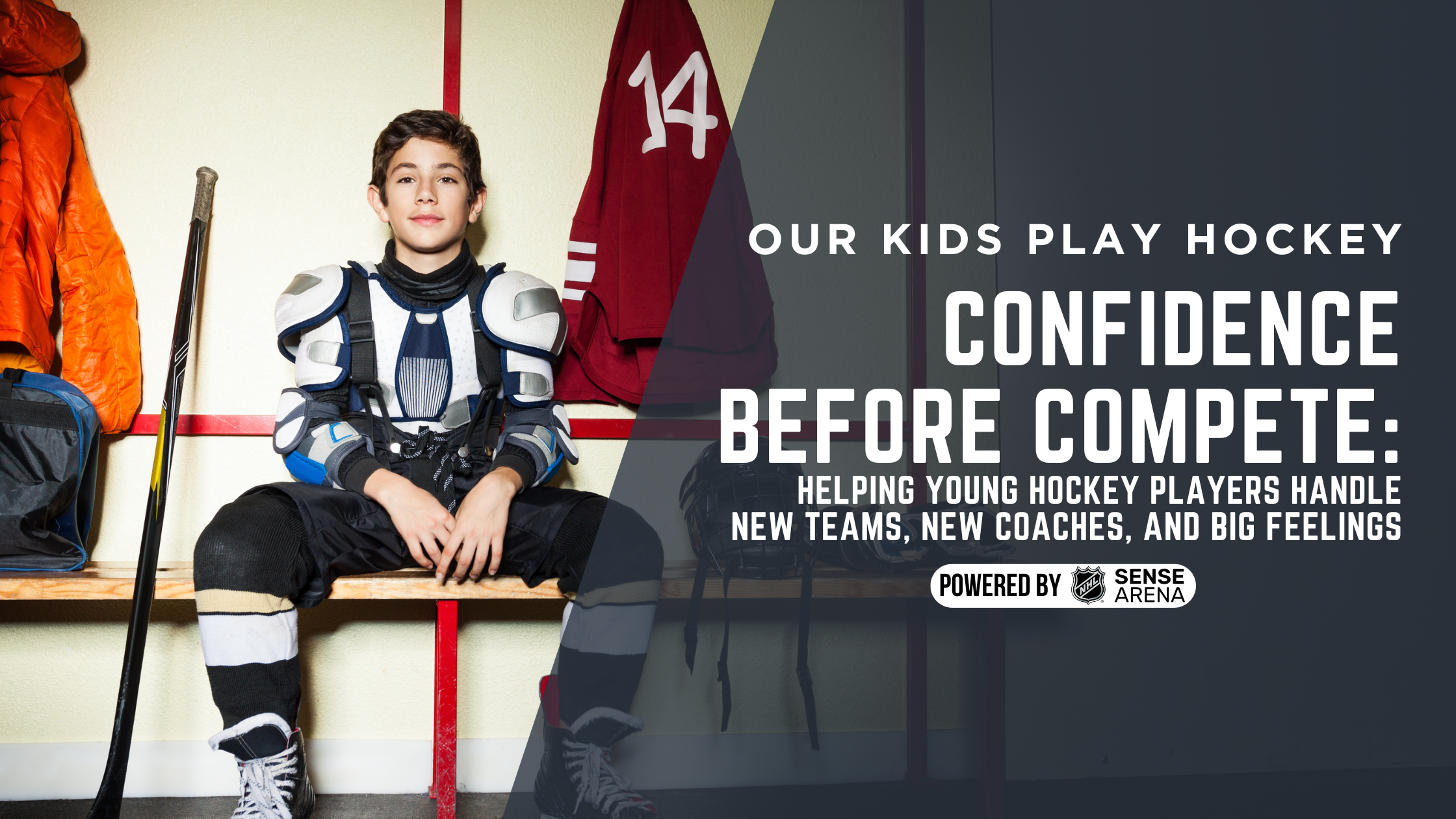
Confidence Before Compete: Helping Young Hockey Players Handle New Teams, New Coaches, and Big Feelings
Every hockey parent has seen it in some form.
Your child loves the game. They skate hard. They work in drills. They show flashes of real ability. Maybe they even make the higher-level team.
But then something changes.
A new rink.
A new coach.
A locker room full of unfamiliar faces.
A faster scrimmage where the puck is bouncing everywhere and the game suddenly feels chaotic.
And the same child who looked confident yesterday now freezes, watches, hesitates, or says they don’t want to go.
That was the heart of this week’s fan mail episode of Our Kids Play Hockey, where Lee Elias, Christie Casciano Burns, and Mike Bonelli responded to a thoughtful letter from a Connecticut hockey dad. His young travel mite loves hockey and has the ability to play at a strong level, but he struggles when the environment feels new or overwhelming. Once he gets on the ice, he often plays well. The challenge is getting him comfortable enough to step in with confidence.
The question this parent asked is one many hockey families wrestle with:
How do you help a child grow and compete harder without hurting their confidence or making them lose their love for hockey?
The answer starts with an important distinction.
Your child may not be uncompetitive.
They may simply be uncomfortable.
Newness Can Look Like a Lack of Compete
One of the biggest takeaways from the episode is that parents need to be careful about how they interpret hesitation.
When a young player hangs back in a scrimmage, avoids the puck, or looks like an observer, it is easy to assume they are not aggressive enough. But that may not be the full story.
As the hosts discussed, a child who competes well in small groups, familiar drills, or one-on-one situations may not lack fire. They may lack comfort in that specific environment.
That matters because the solution changes.
If the real issue is confidence, yelling “compete harder” will not fix it. It may actually make things worse.
Mike Bonelli framed it clearly: confidence often comes before compete. When a child feels secure, included, and familiar with the situation, their compete level has a better chance to show up. But when they feel like an outsider, even a skilled player can become tentative.
For parents, that means the goal is not always to push harder.
Sometimes the goal is to make the new environment feel less new.
“Shrink the Newness”
Christie Casciano Burns offered one of the most practical concepts of the episode: shrink the newness.
That means helping your child become familiar with the environment before expecting them to perform in it.
For a young player joining a new team or clinic, that might look like:
- Visiting the rink before the first session
- Meeting the coach ahead of time
- Walking through where the locker room is
- Talking about what the first practice may look like
- Finding one familiar face before stepping on the ice
- Giving the child language for what they are feeling
Christie compared it to school transitions. We don’t expect kids to walk into middle school, high school, or college with no orientation and immediately feel comfortable. We give them a tour. We let them see the space. We introduce them to people. We reduce the unknown.
Hockey can work the same way.
A new team may feel exciting to adults, but to a young child it can feel like a lot: new kids, new coach, new routines, new drills, new locker room, new expectations. Taking even one or two of those unknowns away can help a child feel more grounded.
And once a child feels grounded, the hockey often follows.
At Seven Years Old, Hockey Should Still Feel Like Play
This episode also delivered a needed reminder for mite hockey parents: seven is still seven.
Yes, some young players are competitive. Yes, some have advanced skill. Yes, some make higher-level teams. But that does not mean the sport should become pressure-filled, transactional, or adult-driven.
Mike put it bluntly: if a seven-year-old does best when hockey is fun and social, then put him in places where hockey is fun and social.
That does not mean development stops. In fact, it may be exactly where real development begins.
Young players build confidence through touches, friendships, success, joy, and repetition. They learn to love the rink because it feels like a place they want to be. If the environment becomes one where they feel constantly evaluated, compared, or pushed beyond their emotional readiness, the game can start to feel heavy.
And once hockey feels heavy, the love can fade.
That is why the hosts pushed back on the idea that young kids must always play at the highest possible level to improve. At seven, being the “big fish” in a slightly smaller pond can be a very good thing. It allows a child to touch the puck, try things, take risks, and feel capable.
Confidence grows in environments where kids get to participate, not just survive.
Don’t Put Adult Hockey Intensity on a Young Child
Lee Elias made an important point that every hockey parent should sit with: adults often bring the intensity of the sport we know into an age group that is not ready for it.
Hockey is fast. Hockey is emotional. Hockey can be intense.
But mite hockey should not carry the same emotional weight as junior, college, or professional hockey.
Parents would never take a seven-year-old to a playground and demand that they swing harder, climb faster, or dominate the monkey bars. Yet in hockey, adults can slip into that mindset quickly.
Why?
Because hockey culture often rewards early labels, early status, and early comparison. Parents hear terms like top team, elite, AAA, spring clinic, rankings, and tryouts, and suddenly a child’s normal nervousness can feel like a problem to solve immediately.
But youth hockey is not only about building hockey players.
It is about building people.
That means learning how to walk into new spaces, meet new teammates, talk to coaches, handle nerves, recover from mistakes, and keep showing up. Those are life skills, and they matter just as much as puck battles at young ages.
Help Kids Name What They Feel
One of the strongest parenting moments in the listener’s letter was the family’s shift from “I don’t want to go” to “I feel nervous.”
That change matters.
When a child says, “I don’t want to go,” it can sound like defiance, laziness, or lack of commitment. But when they can say, “I feel nervous,” the conversation becomes more productive.
Now the parent and child are dealing with the real issue.
Nervousness is normal. New situations are hard. Big feelings can make a child freeze. Naming those feelings gives the child a little more control over them.
Lee emphasized that this is a powerful skill not just for hockey, but for life. Whether a child is seven, twelve, or older, being able to say “I’m nervous,” “I’m angry,” or “I’m overwhelmed” helps them separate who they are from what they are feeling.
That does not make the feeling disappear instantly.
But it gives the child a way through it.
Ask Your Child What They Want
One of the simplest pieces of advice in the episode may also be the most overlooked:
Ask your child what they want.
Ask what feels fun.
Ask what feels scary.
Ask what they like about hockey.
Ask what would help them feel more comfortable.
Ask whether they want more hockey or less hockey.
Parents often assume they know the answer, especially if they played the game themselves or are deeply invested in the sport. But kids are separate people. They may be motivated differently than we are. They may need different kinds of support.
Some kids respond to challenge. Some respond to encouragement. Some need familiarity. Some need humor. Some need time.
As Lee noted near the end of the episode, coaches and parents should not assume every child is motivated the same way. The best way to find out is to ask.
That conversation may reveal that your child wants to improve, but they are scared. Or that they love hockey, but not the pressure. Or that they want to stay with friends more than chase the highest-level team.
Those answers matter.
Protect the Love of the Game
The clearest answer to the listener’s question came late in the conversation.
If you think your child is starting to lose their love for hockey, back off.
Not forever. Not dramatically. But immediately enough to protect the foundation.
Because love of the game is the base layer. Without it, there is nothing meaningful to build on.
Skill can be developed.
Compete can grow.
Confidence can come with time.
Comfort in new environments can be practiced.
But once a child starts associating hockey with pressure, disappointment, or feeling like they are never enough, the damage can be hard to undo.
The hosts were not saying parents should never challenge their kids. They were not saying children should never face discomfort. Growth often does live just outside the comfort zone.
But there is a difference between helping a child stretch and dragging them into a version of the game they are not ready for.
The job of a hockey parent is not to manufacture an elite athlete at age seven.
The job is to help the child keep coming back with joy, confidence, and a sense that the rink is a place where they belong.
Final Takeaway for Hockey Parents
If your young player gets nervous in new hockey situations, take a breath.
It does not mean they are weak.
It does not mean they lack compete.
It does not mean they are behind.
It does not mean you have to fix everything right away.
Start by shrinking the newness. Help them name their feelings. Build familiarity. Prioritize fun and social connection. Ask what they want. Let confidence grow before demanding compete.
And above all, protect their love for the game.
Because the players who stay in hockey the longest are not always the ones who were pushed the hardest at seven years old. They are often the ones who felt safe enough, supported enough, and joyful enough to keep showing up.
Thanks for being part of the Our Kids Play Hockey community. Keep asking thoughtful questions, keep supporting your players, and keep remembering that the best hockey development starts with kids who love coming to the rink.

Want to Try That Hockey Move in a Game? Put in the Reps First