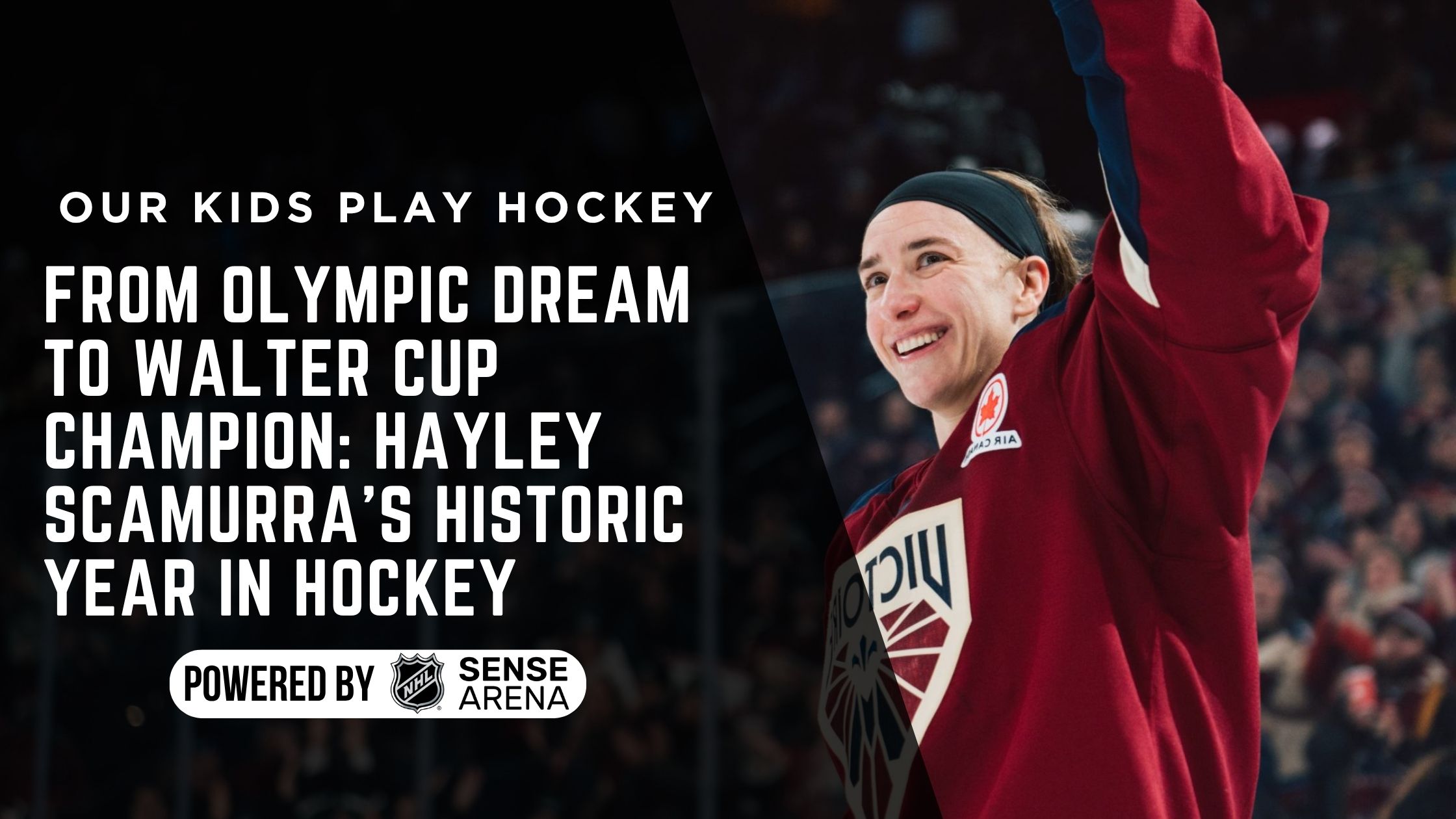
From Olympic Dream to Walter Cup Champion: Hayley Scamurra’s Historic Year in Hockey
Sometimes you begin telling one story and realize, somewhere along the way, that you are documenting history.
That is exactly what happened with Hayley Scamurra.
When Our Kids Play Hockey began following Hayley through the 2025–26 season, the idea was relatively simple: give hockey families a genuine look inside the life of a professional player and Olympian.
What does her schedule really look like? How does an elite player prepare? What happens when international hockey and professional hockey collide? How does someone competing at the highest level handle the pressure, travel, uncertainty, and expectations that come with it?
By the end of the journey, those questions were still important.
But the story had become much bigger.
Hayley went from competing for an Olympic roster spot to winning gold with Team USA. Then she returned to the PWHL, helped the Montreal Victoire climb to first place, battled through the playoffs, and finished the season by lifting the Walter Cup.
In doing so, she became the first woman to win an Olympic gold medal and the Walter Cup in the same year.
For young hockey players and their families, however, what happened between those championships may be every bit as valuable as the championships themselves.
Before the Gold Medal, There Was Uncertainty
It is easy to look at an Olympic champion after the fact and assume the outcome was inevitable.
It wasn't.
At the beginning of the journey, Hayley was one of the players trying to earn one of the limited roster spots available for Team USA.
That meant months of camps, evaluations, Rivalry Series games, travel, professional hockey responsibilities, and constant competition among some of the best players in the world.
Nothing was guaranteed.
And Hayley's approach during that process offers an important lesson for every young athlete.
Rather than obsessing over what everyone around her was doing, she focused on something much more controllable:
her role.
Hayley knew what she brought to a team. She knew the elements of her game that made her different. And instead of trying to suddenly become another player because Olympic selections were approaching, she committed to doing what she did best at the highest possible level.
That mindset matters.
Young athletes often fall into the trap of evaluating themselves entirely through comparison.
Who scores more?
Who made the higher team?
Who gets more ice time?
Who is getting recruited?
Who seems to be progressing faster?
At the elite level, Hayley's experience reinforces something we talk about frequently on Our Kids Play Hockey: teams don't need 20 identical players.
They need players who understand what they contribute.
Development is not only about adding skills. It is also about learning who you are as a player.
The Phone Call Every Olympic Hopeful Dreams About
Eventually, months of uncertainty came down to a phone call.
Hayley knew Team USA selections were coming. She knew her phone might ring. And despite having already experienced an Olympic selection earlier in her career, the waiting still carried enormous emotional weight.
Then the call came.
She had made the team.
For a moment, everything else stopped.
Hayley allowed herself to experience the relief, excitement, gratitude, and emotion that came with becoming a two-time Olympian.
Then professional hockey provided an immediate reminder of how quickly elite athletes have to turn the page.
The next day?
Back to business.
There were still PWHL games to play.
That ability to celebrate a major accomplishment without losing sight of the next responsibility became one of the defining themes of her season.
Olympian and Professional Hockey Player—At the Same Time
This season also represented something new for women's hockey.
For the first time, a well-established professional women's league and an Olympic season were operating simultaneously at this scale.
That meant players were preparing alongside future Olympic teammates while also competing against them in professional games.
A Canadian teammate in Montreal could soon become an Olympic opponent.
An American opponent in the PWHL could soon become a Team USA teammate.
And organizations including national governing bodies, international hockey leadership, and the PWHL had to work together to make schedules function.
For players, it required a remarkable ability to compartmentalize.
When Hayley was with Montreal, she needed to be present with Montreal.
When she joined Team USA, her focus shifted toward the Olympics.
That ability to stay in the moment would become especially important later in the year.
“I Am a Gold Medalist”
Before Hayley ever had the medal around her neck, she had already written the words.
I am a gold medalist.
The phrase appeared on a whiteboard in her home. She wrote it in journals. She repeated it to herself.
It was part goal, part visualization, and part reminder of what she believed was possible.
During the Olympic tournament, Hayley even caught herself mentally jumping ahead and imagining the team winning gold.
She had to remind herself that there were still games left to play.
But that visualization also helped reinforce a positive mindset.
And ultimately, the vision became reality.
Team USA won Olympic gold.
For Hayley, the medal represented far more than one tournament.
It represented backyard hockey with her brothers and father.
It represented missed social events while growing up.
It represented travel, practices, sacrifices, teammates, coaches, family support, and thousands of hours spent pursuing a dream.
When young players see an athlete standing on an Olympic podium, they see the finish line.
What they don't always see are all the ordinary days that came first.
The early mornings.
The long drives.
The difficult practices.
The cuts and disappointments.
The moments when progress doesn't feel obvious.
The years when there is no medal waiting at the end.
That is what makes an Olympic moment so powerful.
The medal may be awarded in one day.
The journey required a lifetime.
Then Came the Reality of Professional Sports
You might imagine that winning an Olympic gold medal comes with a long opportunity to celebrate and recover.
Not for Hayley.
After returning from Italy, she had roughly a day to reset before professional hockey demanded her attention again.
There was laundry to do.
Bags to unpack.
More bags to pack.
Jet lag to manage.
Practices to attend.
And important PWHL games waiting.
At the same time, winning gold created another challenge: attention.
Hundreds of messages arrived.
Interview requests poured in.
Media opportunities appeared.
At one point, Hayley received an opportunity to appear on The Kelly Clarkson Show, where Pink was guest hosting.
Suddenly, a professional hockey season also included national television, hair and makeup, dressing rooms, a live studio audience, and conversations with celebrities.
Then?
Back to Montreal.
Back to hockey.
That sequence reveals something families don't always consider about professional athletes: performing well creates additional demands.
Success brings opportunities, but those opportunities still require time and energy.
Learning how to manage that energy is part of being a professional.
Montreal Starts Rolling
Once the Olympic break ended and players returned to their PWHL teams, the Montreal Victoire began building momentum.
Eventually, Montreal climbed all the way to first place.
In a league where every point matters and the season is considerably shorter than an NHL schedule, consistency becomes incredibly valuable.
There isn't much time for a slow start.
Ten games isn't simply an early-season sample.
It represents a significant portion of the schedule.
Montreal's first-place finish reflected the team's ability to remain competitive throughout an unusual season while continuing to improve.
It also earned them one of the PWHL's most fascinating advantages:
the opportunity to choose their semifinal opponent.
Montreal selected the Minnesota Frost.
And after losing the opening game of the series, the questions immediately started.
Had Montreal chosen incorrectly?
Did picking Minnesota give the defending champions extra motivation?
But inside a playoff series, there isn't much value in spending time worrying about outside narratives.
Hayley's description of Montreal's response reflected another valuable youth hockey lesson:
flush the last game and prepare for the next one.
Players cannot change what happened yesterday.
Their responsibility is the next shift, the next practice, and the next opportunity.
Montreal responded, survived the series, and earned a spot in the Walter Cup Final.
A Walter Cup Final Filled With Drama
Waiting for Montreal was the Ottawa Charge.
And the championship series immediately delivered the kind of moments hockey fans remember for years.
In Game 1, Montreal was seconds away from losing.
Laura Stacey had gone down injured.
Ottawa held the lead.
The clock was disappearing.
Then Montreal found another level.
With just seconds remaining, the Victoire tied the game.
Overtime followed.
And in a moment that felt almost scripted, Stacey returned to the ice, helped create the winning goal, and Montreal completed the comeback.
Those moments reveal something numbers rarely capture.
Belief.
A team can know mathematically that there are only seconds remaining and still believe there is enough time.
There was no panic.
There was simply an understanding that the next play still mattered.
That is a powerful mindset for any athlete.
Hayley Finds the Net in the Final
Later in the series, Hayley created one of her own unforgettable moments.
In Game 3, with the game scoreless deep into the third period, she entered the offensive zone, moved the puck wide, drove toward the net, tracked the rebound, and finished the play.
It was a perfect example of the type of hockey that does not always begin with a highlight-reel move.
Good positioning.
Reading the play.
Driving the net.
Following the puck.
Being available when the opportunity appears.
Those details are often what separate effective players from players simply waiting for something to happen.
Ottawa eventually won Game 3, extending the series.
So Montreal had to respond again.
The Championship Game Was About More Than Scoring
The deciding game tells us a lot about Hayley's season.
Montreal won 4–0.
But the scoreboard doesn't explain everything.
Hayley's impact included penalty killing, defensive responsibility, important face-offs, positioning, and doing the type of work required when a championship is on the line.
That matters because earlier in the season, Hayley talked about embracing her role.
Here was the payoff.
She did not need to become someone else.
She needed to be the most effective version of herself.
And when the clock reached zero, that version of Hayley Scamurra was a Walter Cup champion.
Two Championships—and a New Understanding of Her Own Game
Winning Olympic gold and the Walter Cup in the same year placed Hayley in hockey history.
But one of the most meaningful reflections from the entire journey came when she discussed how the season changed the way she viewed herself.
She had spent the year thinking intentionally about the value she brought to successful teams.
And then she watched the results stack up.
Olympic gold.
First place with Montreal.
A playoff run.
A Walter Cup.
The lesson isn't that one player's mindset single-handedly produced those results.
Hockey doesn't work that way.
The lesson is that confidence can grow when players stop measuring their worth only through traditional statistics and begin understanding all the ways they help a team succeed.
Young players need to hear that.
Goals matter.
Assists matter.
But so do:
- defensive responsibility
- communication
- penalty killing
- positioning
- energy
- leadership
- supporting teammates
- winning battles
- understanding situations
- bringing consistency every day
There are many ways to help a hockey team win.
Discover yours.
Then Montreal Showed What This Championship Really Meant
Perhaps the most powerful image of the season didn't happen on the ice.
It happened in the streets of Montreal.
The players climbed aboard a double-decker bus for their championship celebration.
At first, there were groups of supporters along the route.
Then more.
And more.
Eventually, players looked behind the bus.
What they saw stopped them.
A sea of people filled the street, following the champions toward the celebration.
Thousands of fans had shown up for women's professional hockey.
The players danced on stage.
They lifted the Walter Cup.
Fans waited for autographs.
The celebration had the feeling of the championship parades athletes grow up watching on television.
And that may be one of the most important moments in this entire story.
Because young girls watching women's hockey today are growing up with a different definition of what is possible.
They can watch professional women's teams.
They can have favorite players.
They can see championship celebrations.
They can imagine themselves wearing those jerseys someday.
The dream has become visible.
The History of Today Becomes the Expectation of Tomorrow
When we began following Hayley's season, we wanted to show hockey families what life looked like for a professional player and Olympian.
We certainly got that.
But we also witnessed something much larger.
We watched a player pursue an Olympic roster without knowing whether she would make it.
We watched her win gold.
We watched her return immediately to professional hockey.
We watched Montreal climb the standings.
We watched an unforgettable playoff run.
We watched Hayley lift the Walter Cup.
And finally, we watched a city fill the streets to celebrate women's hockey.
Hayley Scamurra achieved two lifelong dreams in one season.
But for young players watching her, perhaps the most meaningful part is what happens next.
Because eventually, historic accomplishments stop feeling unusual.
They become examples.
Then possibilities.
Then expectations.
Today's players are creating a version of hockey where tomorrow's young girls don't have to ask whether a professional career, an Olympic medal, or a championship parade is possible.
They'll already know.
They watched it happen.
Keep dreaming, keep working, and keep finding what makes you valuable to your team.
And congratulations to Hayley Scamurra and the Montreal Victoire on a season hockey families will remember for a very long time.
🎧 Hear the complete journey on Our Kids Play Hockey and join us as we continue sharing the stories, lessons, and people helping shape the future of the game.


Food Is Fuel: How Young Hockey Players Can Build Better Nutrition Habits