How Young Goalies Can Build Confidence, Handle Pressure, and Reset After a Goal
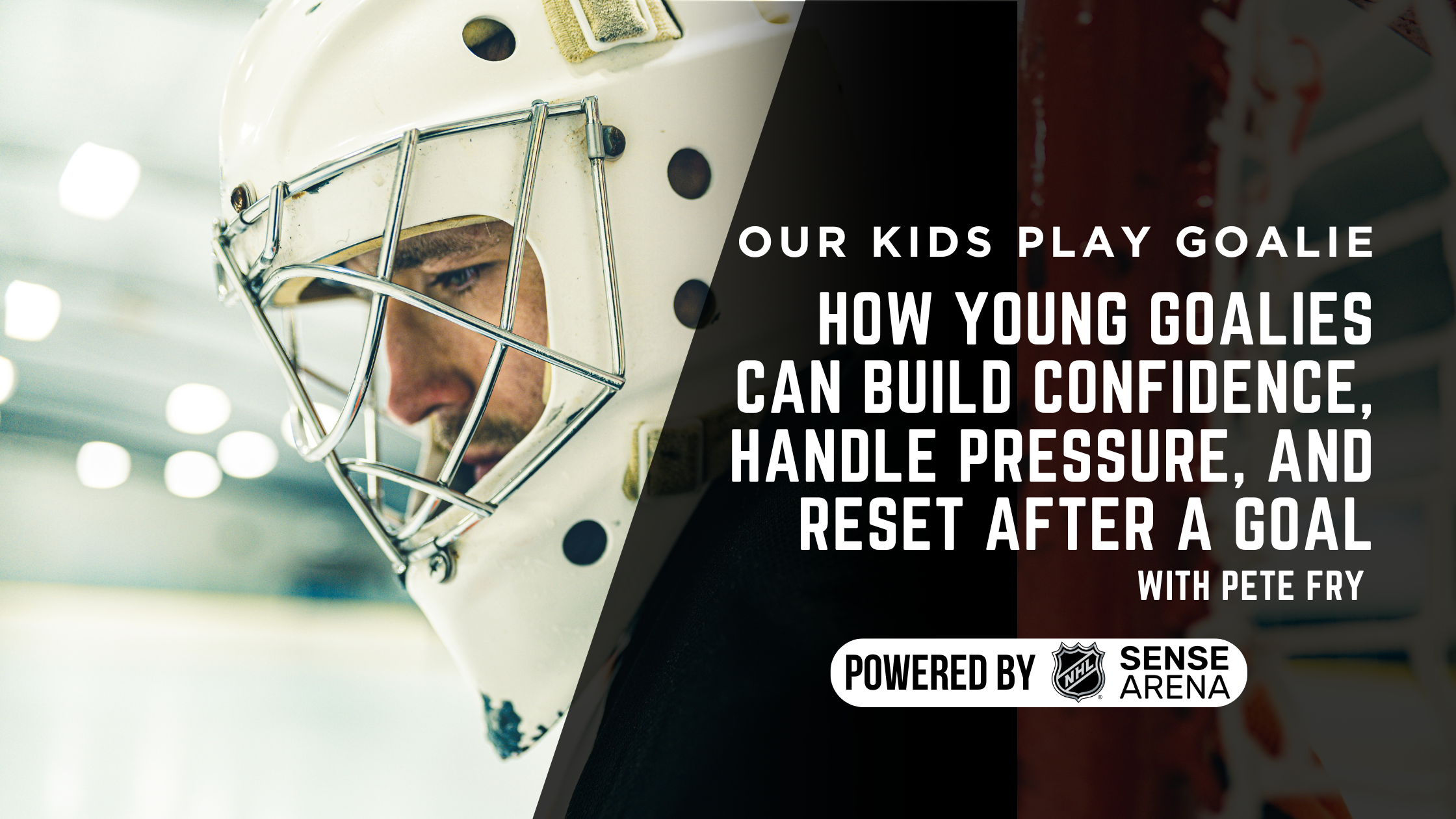
Playing goalie is not simply a technical challenge.
It is emotional. It is mental. It is highly visible. And unlike nearly every other position in sports, a goaltender can do almost everything correctly and still watch the puck end up in the net.
That is why young goalies need more than skating ability, positioning, tracking, and save selection. They also need tools that help them manage pressure, recover from mistakes, control their attention, and maintain belief in themselves when the game becomes difficult.
On this episode of Our Kids Play Goalie, Lee Elias and Christie Casciano Burns speak with Pete Fry, widely known as “The Goalie Mindset Guy.” A former WHL All-Star, NHL draft pick, and professional goaltender, Pete now works with goaltenders and elite athletes across professional, collegiate, junior, international, and youth sports.
His central message is one every hockey family should hear:
The picture a goalie holds of themselves can influence how they prepare, respond, and perform.
But mindset is not magic, and visualization is not a replacement for hard work. Mental preparation gives an athlete direction. Action, repetition, coaching, training, and courage are what move that athlete forward.
The Difference Between Talent and Belief
Pete’s interest in mental performance was shaped by his own playing career.
He had the skill to become a WHL All-Star, earn an NHL draft selection, and play professionally. Yet when he was drafted by the New Jersey Devils, he focused heavily on the number of goalies already under contract.
Instead of entering camp convinced that he belonged, he began to see himself as a player without a realistic opportunity.
That belief affected his preparation.
Pete later realized that he had played against other goaltenders who may not have been more talented at the time, but who eventually reached the NHL. The difference was not always physical ability. It was often how those athletes saw themselves, how they handled uncertainty, and whether they continued preparing as though the opportunity was possible.
This is an important lesson for young goalies.
A player’s internal story can either encourage action or quietly discourage it.
A goalie who thinks, “I cannot compete with these players,” may train differently than one who thinks, “This is difficult, but I belong here and I am going to prepare.”
The goal is not to convince children that success is guaranteed. It is to teach them not to eliminate themselves before the competition begins.
Visualization Is More Than Positive Thinking
Many athletes are told to “think positively.”
That advice is well-intentioned, but it is often too vague to be useful.
Pete encourages athletes to create specific mental images. Instead of merely hoping to play well, the goalie imagines what success looks, sounds, and feels like.
A young goaltender might visualize:
- Tracking the puck clearly through traffic
- Arriving early and set on a lateral pass
- Controlling a rebound into a safe area
- Breathing calmly before the opening faceoff
- Responding confidently after allowing a goal
- Making the first save and preparing immediately for the next one
The more detailed the image becomes, the more useful the exercise can be.
Pete also uses mind mapping, in which an athlete writes an outcome in the center of a page and builds visual and descriptive details around it. Those details may include what the athlete wants to see, hear, feel, and do.
The drawing component matters because athletes do not always think in complete sentences. They often remember moments through images.
For a child, this exercise can be creative and fun. It should not feel like homework or a test. The objective is to help the goalie build a clear, confident picture of preparation and performance.
Visualization Must Be Followed by Action
There is an important distinction between productive visualization and wishful thinking.
A goalie cannot picture themselves making saves and then ignore practice habits, conditioning, recovery, coaching, or technical development.
As Pete explains, action is essential.
Visualization can help an athlete identify where they want to go. The work creates a path toward it.
For young goalies, that work may include:
- Arriving prepared for practice
- Listening to coaching
- Repeating movements with intention
- Training consistently without overtraining
- Learning from difficult games
- Developing strength and mobility appropriately
- Practicing mental skills before pressure arrives
- Asking questions instead of pretending to understand
Parents can reinforce this balance by praising both belief and behavior.
It is healthy for a child to dream about playing college, junior, professional, or international hockey. It is equally important to help them understand that large goals are supported by small daily choices.
Why Goalies Feel So Much Pressure
Goaltenders face an unusual number of uncontrollable variables.
A screen can block their vision. A puck can deflect off a defender. A player can lose an edge. A pass can change direction. A teammate can make a turnover. A perfectly executed save attempt can still fail.
The goalie is also the final player between the puck and the net, which makes every result highly visible.
This can cause young goaltenders to believe that they are responsible for everything.
They are not.
Goalies are responsible for their preparation, focus, effort, communication, body language, compete level, and response to the next play. They are not responsible for controlling every bounce, decision, deflection, or mistake.
Helping a young goalie separate controllable actions from uncontrollable outcomes is one of the most valuable things a parent or coach can do.
A Practical Reset After Allowing a Goal
Every goalie needs a post-goal routine.
Without one, the mind tends to enter what Pete describes as a type of internal video review. The goalie replays the shot, judges the decision, wonders what the coach thinks, imagines being pulled, and carries the previous play into the next faceoff.
There is a time to review goals. That time is usually not during the few seconds before play resumes.
A simple reset routine can include four steps.
1. Reframe the goal
Instead of immediately labeling the goal as terrible, the goalie can use a neutral or confident statement:
“That is unusual. I normally stop that.”
Or:
“Good goal, bad goal—who cares? Next shot, next save.”
This does not mean the athlete refuses accountability. It means they delay technical judgment until they can evaluate the play productively.
2. Change posture
The goalie should look up, stand tall, and move with purpose.
Body language affects both the athlete and the team. Looking defeated can deepen the emotional reaction. Strong posture can signal that the moment is over.
3. Use water as a reset cue
A drink of water can become more than hydration.
The goalie can:
- Take a sip and notice the temperature
- Spray water on their face
- Watch a drop fall and imagine the last play leaving with it
A repeated physical cue can help the brain transition to the next moment.
4. Control the breath
Pete recommends simple breathing patterns, including box breathing:
- Inhale for four counts
- Hold for four
- Exhale for four
- Hold for four
During a game, the routine can be simplified. Even one controlled inhale and exhale may help interrupt panic and restore focus.
The routine should be practiced before it is needed. Goalies cannot expect a new mental tool to feel natural for the first time during a championship game.
Shrinking the Mental Image of Failure
One of the most actionable stories in the episode involves an NHL goaltender who felt intense anxiety before a start.
The goalie was picturing himself struggling and being removed from the game. The mental image felt close, large, vivid, and threatening.
Pete asked him to imagine pushing the picture farther away, shrinking it, and reducing its emotional power.
That is a useful exercise for young athletes.
A goalie who keeps seeing a bad goal from the previous game can imagine:
- Moving the image farther away
- Making it smaller
- Draining away some of the color
- Replacing it with an image of a strong save
- Taking one physical action, such as swiping the old image away
This does not erase what happened. It changes the athlete’s relationship with the memory.
The purpose is not to avoid learning from failure. It is to prevent one mistake from becoming the dominant picture the goalie carries into the next game.
Coaches Must Tell Goalies What to Do
Language matters.
A coach who says, “Do not let in the first goal,” may believe they are offering motivation. But the phrase directs the athlete’s attention toward exactly what everyone wants to avoid.
A more productive instruction would be:
“See yourself making the first save.”
The same principle applies during games.
Instead of saying:
- “Do not get beat short side.”
- “Do not give up another rebound.”
- “Whatever you do, do not allow a soft goal.”
Try:
- “Hold your edge and seal the post.”
- “Track the puck into your body.”
- “Set your feet and trust your positioning.”
- “Win the next shot.”
Specific, affirmative coaching gives the goalie an action to perform.
Negative instructions often give them an outcome to fear.
Parents Should Avoid Becoming Postgame Analysts
Goalie parents care deeply.
That is exactly why they can become overly involved in evaluating performance.
Some track every shot, record every goal, calculate statistics, identify technical errors, and begin the postgame review before the child has removed their equipment.
Even accurate observations can become harmful when the parent-child relationship begins to feel like an ongoing performance evaluation.
After a game, most young goalies need a parent more than they need another coach.
That does not mean families can never talk about hockey. It means the timing, tone, and role should be considered carefully.
Helpful postgame questions may include:
- “Did you have fun?”
- “What did you feel good about?”
- “Was there anything you learned?”
- “Do you want to talk about the game, or would you rather relax?”
- “What are you proud of?”
Parents should also be careful not to pull their child into what Pete calls the fan mindset.
The fan mindset focuses on referees, defensive mistakes, coaching decisions, bad luck, and blame.
The athlete mindset focuses on preparation, response, effort, learning, and the next play.
A parent may think they are protecting their child by criticizing the team. In reality, they may be teaching the goalie to direct attention toward things they cannot control.
Teach Goalies to Welcome Difficult Moments
Most goalies naturally prefer when the puck is far away from their net.
Pete challenges them to develop a different relationship with pressure.
When the opponent gains possession, the goalie can think:
“Here comes my opportunity.”
When the team takes a penalty:
“This is a chance to make an important save.”
When facing a breakaway:
“This is why I play the position.”
This does not mean the goalie hopes their teammates make mistakes. It means they stop treating every difficult moment as a threat.
Pressure can become an invitation to compete.
That shift is valuable because goalies who want to advance will eventually face better shooters, faster plays, heavier traffic, and more difficult situations. Resistance is not evidence that they are failing. It is often the environment in which they improve.
The Goalie’s Body Language Affects the Entire Team
A goalie is not only the last line of defense. They are also an emotional signal for the bench.
When a goal is allowed and the goaltender drops their head, slams equipment, blames a teammate, or appears overwhelmed, the team may interpret that body language as evidence that the game is slipping away.
When the goalie resets, stands tall, communicates, and shows confidence, the team receives a different message:
“We are still in this.”
Pete points to elite goaltenders whose body language remains consistent regardless of whether they have just made a save or allowed a goal.
Young goalies do not need to become emotionless. They need to become intentional.
Their physical presence can help stabilize the group.
A key save can produce an emotional lift similar to a goal. A confident reset can keep the bench engaged after a setback.
Let Young Goalies Dream Big
Parents often struggle when a child announces a dream of playing in the NHL, PWHL, NCAA, major junior, or for a national team.
Adults understand the odds. They want to protect children from disappointment.
But there is a difference between promising an outcome and supporting a dream.
A parent does not need to guarantee that a child will reach the highest level. They can support the child’s right to imagine it, work toward it, and discover what the pursuit teaches them.
Big dreams can develop:
- Discipline
- Courage
- Resilience
- Time management
- Self-awareness
- Coachability
- Healthy ambition
- The willingness to attempt difficult things
The dream may eventually change. The growth created through the pursuit can remain.
Coaches should be especially careful about telling an entire locker room that nobody will make it. That statement offers little developmental value and may deeply affect the one child who needed encouragement at that moment.
A better message is:
“The path is difficult. Dream as big as you want, and learn to love the work required to improve.”
The Goal Is Not Perfection
Goalie mindset training is not designed to eliminate every nervous thought.
Even elite athletes feel fear, doubt, anger, excitement, and pressure.
The objective is to help the goalie recognize those emotions without allowing them to control the next play.
Confidence does not mean believing every puck will be stopped.
Confidence means believing:
- “I can prepare.”
- “I can compete.”
- “I can respond.”
- “I can recover.”
- “I can make the next save.”
That is a mindset a young goaltender can carry far beyond the rink.
Final Takeaway for Goalie Families
Technical training matters. Physical development matters. Good coaching matters.
But young goalies also need language, routines, and mental tools that help them handle the reality of the position.
Parents can support that development by protecting the child’s confidence, limiting immediate postgame analysis, focusing on controllable actions, and encouraging ambitious dreams without guaranteeing outcomes.
Coaches can help by using clear, affirmative instructions and avoiding language that plants fear.
Goalies can learn to visualize success, reset after mistakes, breathe through pressure, move with confidence, and focus on one simple objective:
Next shot. Next save.
Listen to the full episode of Our Kids Play Goalie for more from Pete Fry on visualization, pressure, confidence, athlete mindset, NHL Sense Arena, and building resilient young goaltenders.
Keep supporting the person behind the mask—and keep helping young goalies become confident athletes on the ice and capable, courageous people away from it.

How Young Hockey Players Can Handle Conflict With Teammates, Coaches, and Parents