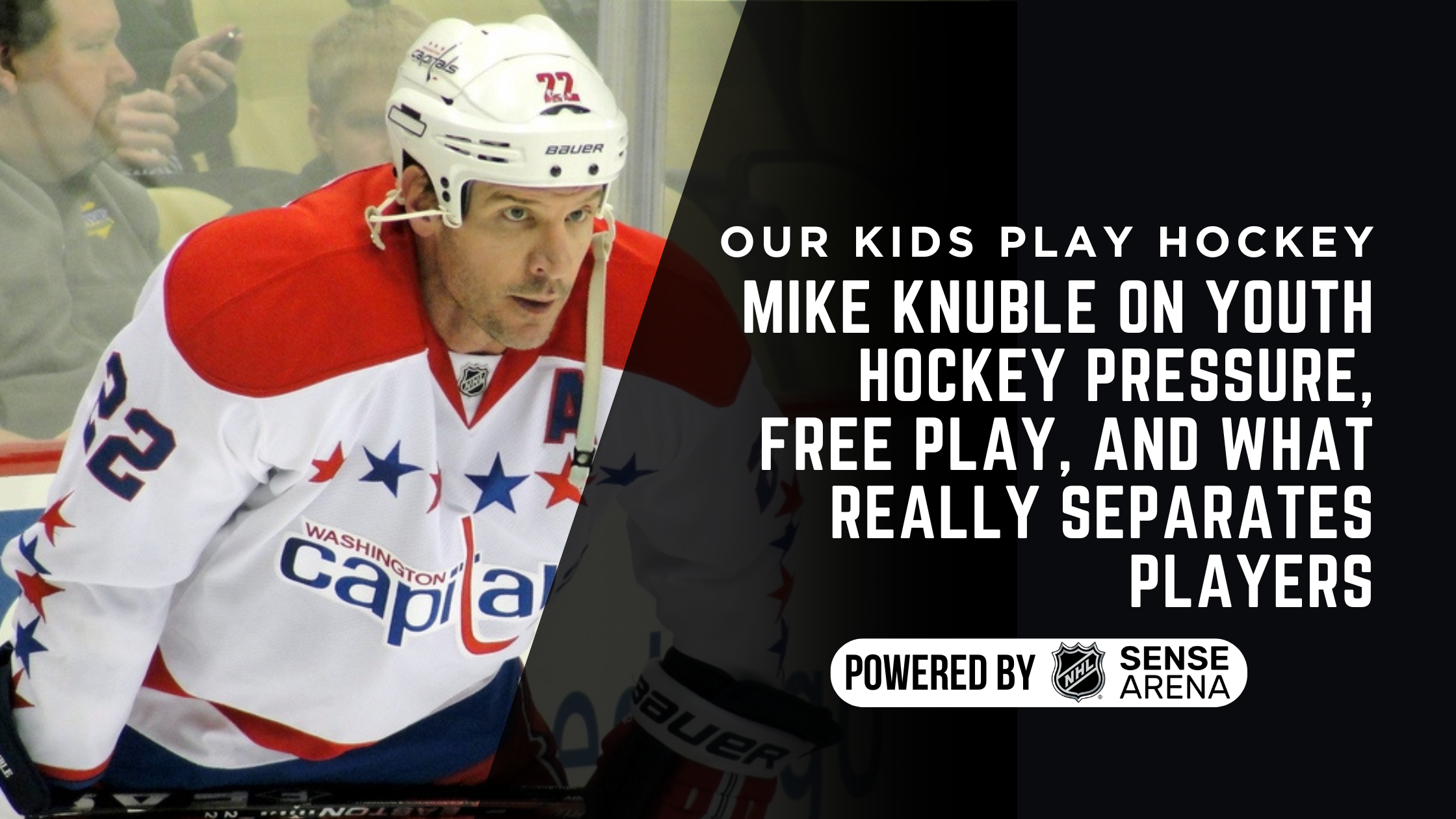
Mike Knuble on Youth Hockey Pressure, Free Play, and What Really Separates Players
🏒 Youth hockey has changed. A lot.
The rinks are busier. The calendars are fuller. The training is more specialized. The tournaments start earlier. The pressure feels bigger. And for many families, the path can feel more confusing than ever.
That is why conversations like this one matter.
On this episode of Our Kids Play Hockey, Lee Elias and Mike Bonelli welcome back former NHL forward Mike Knuble, who played over 1,000 NHL games across a long career with the Detroit Red Wings, New York Rangers, Boston Bruins, Philadelphia Flyers, and Washington Capitals.
But this episode is not just about Mike’s NHL career.
It is about what he has learned as a player, parent, coach, and hockey lifer — and what today’s youth hockey families can take from that experience.
The conversation covers the modern hockey landscape, elite youth pressure, unstructured play, practice quality, character, player evolution, and the difficult balance between helping kids chase big goals while still protecting their love of the game.
And at the center of it all is a simple but powerful reminder:
The journey still matters.
Youth Hockey Is More Intense Than Ever
Mike Knuble begins by reflecting on how different youth hockey was when he was growing up compared with today.
When he was a kid, hockey was something you played in season. Travel hockey existed, but it was not the all-consuming machine it can feel like now. Families driving hours for youth games was once considered unusual. Today, for many hockey families, it is just another weekend.
Now, young athletes are exposed to specialized skills coaches, elite tournaments, showcases, academies, social media attention, and year-round development paths at much earlier ages.
Some of that growth has created opportunity. Kids have access to better training, more knowledge, and more visibility than ever before.
But it has also created pressure.
Parents are trying to make the right decisions earlier. Players are being evaluated younger. Families are being told — directly or indirectly — that every team, tournament, or missed opportunity could define the future.
Mike’s perspective is important here: yes, hockey has changed, and families have to navigate the world as it exists. But that does not mean every moment needs to become life-or-death.
For most kids, hockey is not going to become a paycheck. It can still become something deeply valuable.
It can build confidence.
It can create friendships.
It can teach resilience.
It can bring families together.
It can shape character.
That is not a consolation prize. That is the point.
The Danger of Too Much Pressure Too Soon
One of the more serious parts of the episode focuses on elite youth hockey pressure, including the way some young players can feel “anointed” or dismissed before they have even reached their teenage years.
The group discusses the emotional weight that can come with high-profile tournaments and early selection environments. The concern is not that talented kids should be held back. Talented, motivated players deserve opportunities to grow.
The concern is what happens when children begin to believe:
- “If I make this team, I’m on the path.”
- “If I don’t make this team, I’m done.”
- “If I’m not elite at 10, I’m behind forever.”
- “If I don’t become a pro, I failed.”
That is a dangerous way for any child to define success.
Mike and the hosts make an important distinction: some kids really are deeply driven. Some children are naturally obsessed with hockey the way another child may be obsessed with music, science, books, or astronomy. That drive can be real, healthy, and powerful.
But parents still have to know their child.
Is the motivation coming from the player?
Is the player still enjoying the game?
Is the family making decisions that fit their values and reality?
Is hockey becoming the child’s entire identity?
Those questions matter.
A player can love hockey deeply without being defined only by hockey. Parents can support ambition without turning every weekend into a referendum on the future.
Kids Need More “Real Hockey”
One of the strongest themes in this episode is the importance of unstructured play.
Lee and Mike talk about street hockey, roller hockey, driveway games, backyard sports, pickup basketball, and all the informal settings where kids used to learn without even realizing they were learning.
This kind of play teaches things that are hard to replicate in a drill:
- How to solve problems
- How to read opponents
- How to create deception
- How to compete without a coach managing every decision
- How to handle conflict
- How to adapt
- How to try things without fear of failure
In today’s youth sports culture, many kids are highly scheduled. They go from school to practice to training to tournaments. Their development is often organized by adults from start to finish.
Structure has value. Coaching matters. Good practices matter.
But if everything is structured, players can lose the freedom to explore.
Free play is where a child learns that a certain fake works. It is where they realize a defender cannot turn one way. It is where they discover that a goalie bites on a move. It is where creativity is born.
And perhaps most importantly, free play belongs to the kids.
No whistle.
No clipboard.
No pressure.
Just the game.
Practices Should Teach, Not Just Tire Kids Out
Another major coaching takeaway from this episode is that a hard practice is not automatically a good practice.
Mike Bonelli makes the point that many coaches, especially early in their coaching careers, can fall into the trap of valuing sweat over learning. If the kids are exhausted, parents may assume it was a great session.
But did the players actually learn?
That question should guide every practice.
A valuable practice does not have to be long. It does not have to be complicated. It does not have to leave every player crawling off the ice.
It should be organized, purposeful, energetic, and engaging.
Lee also points out that even simple habits can be coached better. For example, when a drill ends in a shot, players should not treat the shot as an afterthought. Coaches can teach players to look at the goalie, follow rebounds, change angles, and think critically about the scoring chance.
Those little moments matter.
They are opportunities to build hockey IQ.
For volunteer coaches, the message is not “be perfect.” No coach runs a perfect practice every time. Some practices will miss the mark. That is part of coaching.
But good coaches keep learning too.
They ask what worked. They notice when kids want “one more rep.” They pay attention to whether players are smiling, competing, and understanding. They adjust.
The best practices are not just busy.
They are meaningful.
The Best Players Keep Evolving
Mike Knuble offers one of the most important player development lessons of the episode: the players who last are the ones who keep evolving.
A player may dominate at nine or ten because they are faster, bigger, stronger, or have one move that nobody can stop yet. But as players get older, the game catches up.
Defenders learn to skate.
Goalies get better.
Opponents get stronger.
Coaches scout tendencies.
The space disappears.
The “bag of tricks” that worked at 10 may not work at 16.
That is where development becomes more than early talent.
Mike uses examples like Sidney Crosby and Jaromir Jagr to explain how great players continue to adapt. They do not stay the same player forever. They add layers. They respond to criticism. They change their game as their body, role, and environment change.
That lesson applies at every level.
Young players should ask:
- What am I good at right now?
- What needs to improve?
- What part of my game can I add next?
- Am I relying on one advantage?
- Can I still help the team if I am not the star?
That last question is especially important.
At younger ages, some players are always the best player on the ice. But as the pyramid narrows, everyone is good. The players who keep advancing are often the ones who find new ways to contribute.
Maybe that means becoming better defensively.
Maybe it means winning battles.
Maybe it means improving skating.
Maybe it means becoming more reliable.
Maybe it means learning how to play with better players.
Evolution is not optional. It is part of the game.
Character Matters More Than Parents Think
One of the clearest messages from Mike Knuble is that as players get older, people do their homework.
Hockey is a small world.
Coaches talk. Scouts talk. Trainers talk. Former coaches talk. Teammates talk. People learn about the player, the family, the attitude, the work ethic, and the way someone handles adversity.
Talent opens doors, but character helps determine how long those doors stay open.
Mike explains that coaches will often have more patience for a slightly less talented player who gives everything, listens, works, and supports the team than for a more talented player who brings constant problems.
That does not mean every confident or fiery player is a problem. Hockey needs personality. It needs competitiveness. It needs emotion.
But players have to learn the difference between confidence and selfishness. Between competitiveness and entitlement. Between standing out and separating themselves from the team.
Parents should hear this clearly:
Your child’s reputation is being built long before the “big” moments arrive.
How they treat teammates matters.
How they respond to coaching matters.
How they handle being cut matters.
How they act when they are not the star matters.
How the family behaves matters too.
The higher the level, the smaller the margins.
Character can become a separator.
Coaches Can Change a Kid’s Life
The episode also offers a powerful reminder for coaches: sometimes the player who looks like a problem is really a kid who needs help finding their place.
Lee shares a story about a young player who moved in from out of town, was bigger than the other kids, and was starting to be viewed as a bully. Instead of labeling him, Lee saw a kid who was lost, new, and struggling socially.
A little patience, a little one-on-one attention, and a gradual connection with teammates helped that player fit in.
That is coaching.
Not every issue can be solved that way. Not every player will respond. But coaches should never underestimate the impact of a calm, honest, ego-free conversation.
Kids remember the adults who cared enough to guide them.
Sometimes a coach’s words come back years later as something that changed a player’s life. That is one of the great privileges of coaching.
The job is not only to build better breakouts or power plays.
It is to help build people.
Make It Impossible Not to Take You
Near the end of the development conversation, the group lands on a powerful idea for players:
Make it impossible for coaches not to take you.
Mike shares a story about a player who was not originally in his plans. He did not intend to keep an extra forward. But this player kept showing up in every way that mattered. He battled. He went to the hard areas. He blocked shots. He chipped in. He gave the effort the coaches were asking for.
Eventually, the player made the decision for the staff.
That is a lesson every young athlete can use.
You may not control the roster.
You may not control who else tries out.
You may not control what a coach is looking for.
You may not control politics, timing, or numbers.
But you can control how hard you compete.
You can control your attitude.
You can control whether you listen.
You can control your habits.
You can control whether you make people notice your effort.
That does not guarantee every player makes every team.
But it gives them the best chance to leave the right impression.
Hockey Is Bigger Than One Path
The episode wraps with a fun update on Mike Knuble’s recent hockey trip to Scotland, where he played in Edinburgh in front of passionate fans and experienced the game in a different part of the world.
It is a fitting ending because it reinforces one of the biggest themes of the episode:
Hockey is bigger than one path.
It is bigger than one tournament.
It is bigger than one team.
It is bigger than one tryout.
It is bigger than one country.
It is bigger than one version of success.
For some players, hockey leads to the NHL. For others, it leads to college, juniors, coaching, adult league, lifelong friendships, or simply a love of the game that never leaves.
All of those outcomes have value.
Parents and coaches should absolutely support kids who dream big. But they should also protect the parts of the game that make those dreams worth chasing in the first place.
The joy.
The creativity.
The friendships.
The lessons.
The growth.
The journey.
Final Thoughts
This conversation with Mike Knuble is one every hockey family should hear.
It is honest about the pressure of today’s game, but not cynical. It recognizes the value of development, but does not worship the process at the expense of the child. It respects elite ambition, but reminds families that hockey should never become the only measure of a young person’s worth.
For parents, the takeaway is simple:
Support the dream, but do not lose sight of the kid.
For coaches:
Teach the game, but remember the person inside the equipment.
For players:
Keep evolving, keep competing, keep learning, and make it impossible for people not to notice the way you play the game.
🎧 Listen to the full episode of Our Kids Play Hockey for more from Mike Knuble, Lee Elias, and Mike Bonelli on youth hockey development, pressure, character, and why the journey still matters.
Keep helping your kids love the game — because when they love it, they give themselves the best chance to grow through it.

What Really Makes a Great Young Goalie? Lessons from Andrew Raycroft