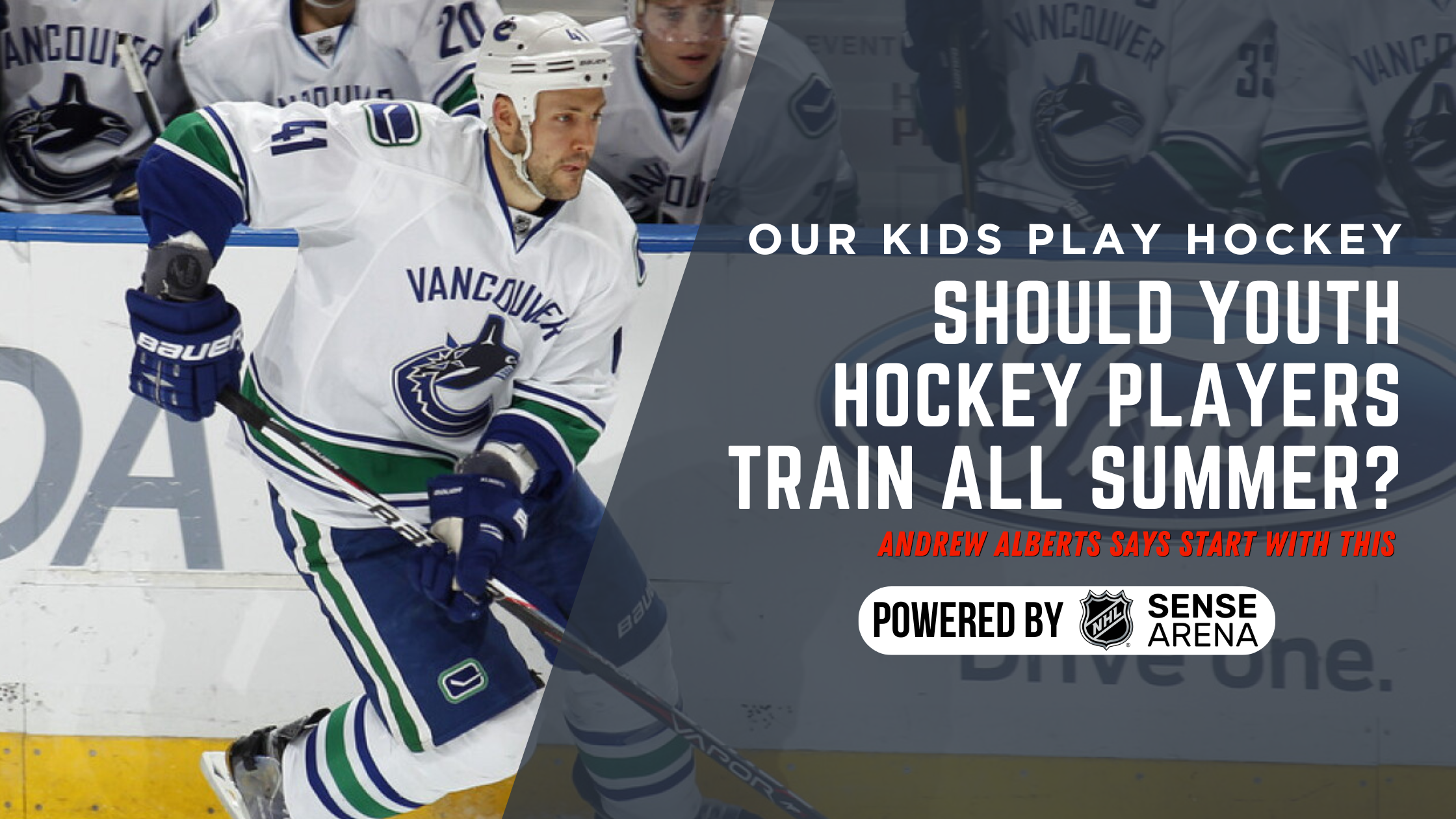
Should Youth Hockey Players Train All Summer? Andrew Alberts Says Start With This
Every hockey parent knows the feeling.
The season ends, tryouts wrap up, and almost immediately the questions begin:
Should we sign up for spring league?
Should we do private lessons?
Should my child be skating all summer?
What is everyone else doing?
Are we falling behind?
In this episode of Our Kids Play Hockey, Lee Elias sits down with returning guest Andrew “Albie” Alberts, a nine-year NHL veteran, Boston College standout, and Hockey Development Director at NHL Sense Arena, to tackle one of the biggest questions in youth hockey: what should the offseason actually look like?
The answer is not one-size-fits-all. But the message is clear.
Kids need to be kids.
That does not mean development stops. It means development needs to be thoughtful, age-appropriate, balanced, and led by the player’s own motivation — not fear, pressure, or comparison.
The Best Offseason May Start With Putting the Hockey Bag Away
One of the strongest messages from Albie is also one of the simplest:
Take a break.
For his own kids, ages 12, 10, and 8, Albie shared that the hockey bags go away after the season. His children move into lacrosse, golf, backyard games, and other activities. They still play around with sticks and pucks, but the formal hockey structure disappears for a while.
That matters.
Youth hockey seasons are long. Even if kids recover faster than adults, they still experience fatigue, soreness, mental strain, and emotional wear. A real break gives them space to reset.
And as Lee pointed out, one of the best things a hockey parent can hear in July is:
“When do I get to go back on the ice?”
That is very different from hearing:
“Can I please have a break?”
The first tells you the child is refreshed and excited. The second may be a warning sign that hockey has become too much.
Less Structure, More Play
Albie’s advice for younger players, especially in the 10–14 age range, is not to overload the offseason with constant instruction.
That does not mean players cannot skate. It does not mean they cannot train. But the offseason should not feel like a second full season.
Instead, Albie encourages:
- Pickup hockey with friends
- Backyard games
- Three-on-three play
- Stickhandling for fun
- Trying creative moves
- Making mistakes without fear
- Playing other sports
- Taking time away from formal coaching
This is where kids build creativity.
A lot of hockey skill is developed when nobody is yelling instructions from the bench. Kids learn from siblings, neighbors, friends, and trial and error. They learn how to compete, how to improvise, how to fail, and how to solve problems.
That type of development is hard to recreate in a structured drill.
As Lee emphasized, if spring or summer hockey is supposed to be “just for fun,” then parents have to let it be fun. That means not screaming from the stands, not coaching every shift, and not treating a low-pressure game like a playoff final.
Multi-Sport Athletes Build Better Hockey Players
One of the most important reminders from the conversation is that other sports are not distractions from hockey.
They are part of athletic development.
Albie talked about growing up playing baseball and golf, while his own kids now play lacrosse, golf, and other sports depending on the season. Each sport develops different physical and mental tools.
Lacrosse can help with spacing, movement, hand-eye coordination, physical awareness, and quick decision-making.
Baseball and softball can help with tracking, timing, patience, and coordination.
Tennis can help with anticipation, reaction, footwork, and reading an opponent.
Golf can help with focus, emotional control, and repetition.
Music, theater, or other non-athletic interests can build discipline, confidence, and self-expression.
The key is not to frame everything as, “This will help your hockey.”
Kids should be allowed to enjoy another sport or activity for what it is.
Yes, those experiences may make them better hockey players. But they may also make them more balanced, more confident, and more complete people.
That matters more.
Parents: Help Your Child Set Goals, But Let Them Own the Goals
One of the most practical takeaways from the episode is Albie’s advice around goal setting.
He encourages parents to ask their player:
“What are your goals for next season?”
Then give them time to think. Let them write the goals down. Put them somewhere visible. The fridge, bedroom wall, or locker room mirror can all work.
But there is one critical piece:
The player has to own the goal.
Parents can guide. Parents can support. Parents can help build the plan. But if the dream belongs only to the parent, it will not create the same commitment.
Lee expanded on this beautifully: if a child says they want to play in the NHL, do not crush the dream. Instead, help them understand the process.
What would need to happen?
What habits would support that goal?
What skills need work?
What sacrifices might be required?
What does effort look like today?
There are no guarantees. But the process of pursuing a goal teaches lessons far beyond hockey.
Discipline. Resilience. Ownership. Patience. Self-awareness.
Those are wins no matter where the game takes them.
Commitment Comes Before Confidence
One of the standout ideas from the conversation was this:
Commitment comes before confidence.
That is a powerful lesson for hockey and for life.
Players often think they need to feel confident before they commit to doing the work. But in reality, confidence usually comes because they committed.
A player decides to work on skating.
They show up.
They struggle.
They improve.
They notice progress.
Confidence grows.
The same applies to shooting, passing, defending, playing without the puck, music, school, or anything else worth improving.
Parents can help by reminding kids that not every day will feel exciting. Not every workout will be fun. Not every rep will produce instant results.
But effort compounds.
And when kids begin to understand that practice leads to progress, they start to build one of the most valuable habits in youth sports.
What NHL Offseason Training Can Teach Youth Hockey Families
Albie also gave a window into what his NHL offseasons looked like.
He made it clear that youth players should not simply copy professional athletes. A 12-year-old does not need an NHL offseason program.
But there are lessons families can take from the pro level.
After an NHL season, Albie would take time off — often 10 days to two weeks — to recover mentally and physically. Then training would progress in phases: rebuilding strength, developing power, improving explosiveness, eventually getting back on the ice later in the summer.
The big lesson?
Even pros take breaks.
They do not go full speed year-round without recovery. Their training has purpose. Their rest has purpose. Their ramp-up has purpose.
That is a useful model for youth hockey families.
Instead of asking, “How much can we fit into the summer?” ask:
What does my child need right now?
Maybe they need rest.
Maybe they need another sport.
Maybe they need skating technique.
Maybe they need strength and coordination.
Maybe they need confidence.
Maybe they need to miss hockey for a few weeks.
That is not falling behind. That is developing with intention.
Skating Is Still the Foundation
When Lee and Albie moved into skill development, one point came through clearly:
If you cannot skate, you cannot play.
Shooting, stickhandling, and passing can all be worked on off the ice in meaningful ways. But skating is harder to replicate away from the rink.
That does not mean every young player needs intense power skating all summer. But skating technique is one of the few areas Albie gave a clear green light to, especially when it is age-appropriate and not overly demanding.
For younger players, that may mean:
- Technique-focused skating sessions
- Edge work
- Balance
- One-legged power
- Starts and stops
- Agility
- Explosive movement
- Body control
The goal is not to grind kids down. The goal is to build a better foundation.
And as Albie noted, hockey is a one-legged game in many ways. Players need balance, strength, and control on each leg. Simple, smart offseason work can make a big difference without becoming overwhelming.
The Next Frontier: Hockey IQ and Playing Without the Puck
One of the most important parts of the episode focused on hockey IQ.
At higher levels, everyone can skate. Everyone can shoot. Everyone can handle the puck.
The separators are often the players who understand the game.
Where is the open ice?
How do I support the puck?
When should I create space for a teammate?
What should I do when I do not have the puck?
How do I read pressure?
When do I attack, delay, pass, chip, or regroup?
Albie and Lee discussed how much of the game is played without the puck. A player may only have the puck on their stick for a small amount of time in a game. The rest of the time, they are reading, moving, supporting, anticipating, defending, and creating options.
That is why tools like Sense Arena are becoming part of the development conversation. Albie shared that Sense Arena is continuing to build training experiences focused on playing without the puck — helping players learn reads, support, spacing, routes, timing, and decision-making in a repeatable environment.
This matters because hockey IQ requires reps too.
Players need to see situations again and again. They need to make mistakes. They need to understand that most plays are not simply “right” or “wrong.” Often, there are multiple good options and multiple poor ones.
The more a player learns to recognize those options, the more prepared they are when the game speeds up.
Albie’s Offseason Green Lights and Red Lights
Lee closed the episode with a rapid-fire offseason segment for players around ages 10–14.
Here is the general guidance:
Year-round tournaments: Red light
Multiple sports: Green light
Early morning lifts for young players: Red light
Private lessons every day: Red light
Pickup with friends: Green light
Taking two weeks completely off from hockey: Green light
Skating technique work: Green light when done properly and age-appropriately
That list is simple, but it says a lot.
The offseason should not become a race to do everything. It should be a chance to reset, grow, explore, and return to the rink with energy.
Final Takeaway: Train Smarter, Not Just More
The biggest mistake hockey families can make in the offseason is assuming that more always means better.
More ice.
More tournaments.
More lessons.
More pressure.
More structure.
But more is not always development.
Sometimes development looks like lacrosse.
Sometimes it looks like golf.
Sometimes it looks like sleeping in.
Sometimes it looks like writing down goals.
Sometimes it looks like playing street hockey until dinner.
Sometimes it looks like two weeks with no hockey at all.
The best offseason is not the one that copies another family’s schedule. It is the one that fits your child’s age, goals, motivation, body, and love for the game.
So before you fill the calendar, pause and ask better questions.
What does my child need?
What do they want?
Are they excited?
Are they tired?
Are we developing the whole athlete — or just chasing more hockey?
Because the goal is not just to build better players.
It is to help kids love the game longer, grow through the game, and become stronger people because of it.
🎧 For more conversations like this, listen to Our Kids Play Hockey, share the episode with another hockey family, and enjoy the offseason with purpose, perspective, and maybe a little pickup in the driveway.

Prepare, Believe, Reset: Steve Briere’s Lessons for Young Hockey Players